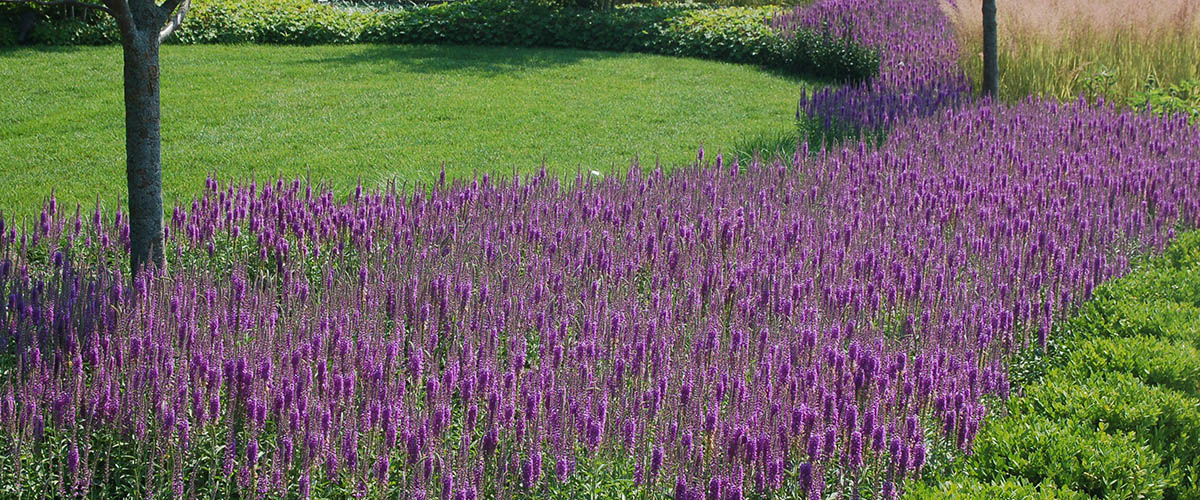
Evaluating Perennials for Chicagoland Gardens
Perennials in Focus is a plant evaluation program that examines new and underused plants for Chicagoland, the third largest metropolitan area in the country. A group of horticultural experts trials and evaluates plants at numerous locations across the region. Results help consumers, public gardens, growers, landscape designers, breeders, and other industry professionals make informed plant choices.
Perennial groundcovers for weed control in new shrub beds
Newly planted shrub beds often leave wide patches of exposed soil between young plants. Sunlight reaches the ground, rain disturbs loose soil, and wind carries weed seed into every gap. A carefully chosen layer of perennial groundcovers can occupy that space, soften the planting design and reduce the time spent hoeing, hand-weeding and replenishing mulch.
Groundcovers work best as part of a wider weed-management system rather than as an instant replacement for preparation. In Australian gardens, conditions may range from sandy coastal soil in Perth to heavy clay in Melbourne or summer-dry beds around Adelaide. The most reliable results come from matching plants to the site, establishing them well and maintaining realistic spacing around the shrubs.
Start with a clean, prepared bed
Remove existing weeds before planting, including persistent runners and perennial roots. Annual weeds can be dug out or shallowly cultivated, while invasive perennial weeds may require repeated removal or a carefully targeted herbicide application. Avoid deep digging once the soil is reasonably clean, because turning the ground can bring buried weed seed to the surface.
Improve the bed according to a soil test rather than adding large amounts of compost by habit. Organic matter can help compacted ground, but poorly decomposed material may contain weed seed and excessive nutrient levels can produce soft, leafy growth. In heavy clay, concentrate on drainage, structure and plant selection; these principles are also discussed in this heavy clay guidance, although Australian species and rainfall patterns require local adjustment.
Install irrigation before planting if possible. A dripline or low-flow system directs water to the root zone without regularly wetting the entire bed, helping new groundcovers establish while reducing conditions that favour some weed seedlings.
Choose plants for the exact conditions
Match the groundcover to light, moisture, soil texture and the mature size of nearby shrubs. In a bright, well-drained bed, low-growing thyme, native pigface varieties or selected low-spreading daisies may suit a dry-climate design. In filtered shade, native violet, kidney weed and some mondo grass cultivars can provide living cover where turf-like plants would struggle.
In cooler or temperate areas, low-growing bergenia, heuchera, ajuga or liriope may be available through the nursery trade, but check their behaviour in your district before planting large numbers. A plant that is restrained in one garden can spread aggressively in another. Look for clumping, slow-spreading or sterile forms where available, and avoid species listed as environmental weeds by your state or territory.
Plant diversity can improve resilience. Two or three compatible groundcovers, repeated in deliberate groups, usually create a more natural and stable surface than a single species scattered randomly. Keep vigorous plants away from small shrubs until their growth rates are understood, and leave access paths so the bed can still be inspected.
Use spacing and mulch together
Groundcovers do not suppress weeds effectively when planted too far apart. Excessive spacing leaves bare soil open for months, while very tight spacing increases the establishment cost and can create competition for water. Use the mature spread as a guide, then consider how quickly the plant grows under local conditions. A modestly closer layout is often worthwhile in a high-visibility bed that needs to knit together quickly.
Mulch remains valuable after the perennials go in. Apply a consistent layer of coarse organic mulch, keeping it clear of shrub trunks and perennial crowns. A depth of roughly 50–75 millimetres is commonly useful, though heavy or waterlogged soils may need a thinner layer. Fine mulch can mat together, shed water or break down rapidly, so choose material suited to the bed and renew it before bare patches appear.
Do not bury small groundcovers under mulch. Place the material around the plants, then gently pull it away from their crowns. As stems spread, they will shade portions of the soil surface and gradually reduce the amount of mulch that needs to be maintained.
Give plants a strong establishment period
Water deeply and consistently during the first growing season, adjusting the schedule for rainfall, soil and temperature. Newly planted perennials have limited roots and may dry out quickly beside established shrubs. In Sydney’s sandy soils, watering may need to be more frequent at first; in Melbourne clay, slower infiltration means checking moisture below the surface before adding more.
Weed control is most important while the groundcover is filling in. Inspect the bed every week or two, especially after rain, and remove small weeds before they flower or set seed. Hand-weeding is often safest close to young perennials and shrubs. A sharp hoe can deal with shallow annual weeds in open spaces, but it should not be used where it will slice through spreading crowns or surface roots.
Avoid heavy feeding during establishment unless a soil test indicates a deficiency. Excess fertiliser can favour weeds and encourage groundcovers to produce soft growth rather than a dense, durable mat. Once plants are established, a light seasonal feed may be appropriate for nutrient-demanding species, while many native groundcovers perform better with modest fertility.
Keep the design compatible with shrubs
Allow a clear ring around each shrub, particularly during the first year. Groundcovers planted directly against the base can trap humidity, conceal pests and make it harder to water or prune. The ring also gives the shrub room to develop without immediate root competition. It can be mulched until the surrounding perennials are established.
Consider height and texture as carefully as weed suppression. A low, even cover works well beneath formal shrubs, while a slightly taller, flowering perennial can create a softer transition at the edge of an informal bed. In a structured garden, repeating plants in measured drifts is more effective than filling every gap with unrelated specimens. Ideas about repetition, edging and plant rhythm can be adapted from these rose garden design notes.
Leave room for seasonal maintenance. Shrubs may need pruning, fertilising or pest inspection, and groundcovers should not make those tasks difficult. Stepping stones or a narrow access strip prevent soil compaction from repeated foot traffic and reduce the temptation to trample plants.
Monitor spread and local compliance
A successful groundcover gradually occupies bare soil without escaping into lawns, drains, bushland or neighbouring gardens. Trim runners that cross paths, lift self-sown seedlings where they are unwanted and divide crowded clumps before they smother shrubs. In Brisbane’s warm, wet conditions, growth may be rapid, while a Perth garden may need to balance weed suppression with water conservation.
Check plant names against current state or territory weed lists before purchase. Australia’s biosecurity rules and declared-weed legislation differ between jurisdictions, and local councils may provide additional guidance about environmental weeds. Nursery labels can be inconsistent, so confirm the botanical name and choose locally recommended alternatives where a species has a poor record of escaping.
Buy from reputable local nurseries and ask how the plant behaves in gardens similar to yours. The Australian market includes waterwise natives, mass-produced ornamental perennials and improved cultivars, but availability changes by season. Gardeners who usually shop on weekends at a local nursery or hardware garden centre can improve their choices by taking a photo of the bed, noting its sun hours and asking for mature spread rather than relying on the pot size.
A groundcover planting should be judged over several seasons, not after its first flush of growth. Record which plants cover soil, flower reliably, tolerate dry periods and remain manageable around the shrubs. This practical observation creates a planting palette suited to the local garden rather than an attractive list that performs only under nursery conditions.
Choose a small trial area, prepare the soil thoroughly, plant compatible groundcovers at sensible spacing and keep mulch between the plants as they establish. With regular early weeding and attention to local water, climate and biosecurity requirements, the living layer will gradually close gaps and make the new shrub bed easier to maintain.
In the Garden
Evaluator gardens are located across the Chicagoland area, representing a range of growing conditions. Visit our retail and wholesale partners to find trialled perennials for your own garden.
Retail & Wholesale: Hinsdale Nurseries (Willowbrook, IL), Mariani Nurseries (Kenosha, WI & Garden Prairie, IL), Northwind Perennials (Burlington, WI), The Growing Place (Aurora, IL).
Wholesale Only: Hinsdale Nurseries (Plano, IL), Intrinsic Perennial Gardens (Hebron, IL).
Our Evaluation Program
The 2017–2020 evaluation cycle included Agastache 'Blue Boa', Allium senescens 'Blue Eddy', Amsonia ciliata var. filifolia 'Georgia Pancake', Astilbe 'Chocolate Shogun', Boltonia astroides 'James Crocket', Brunnera 'Alexander's Great', and Geranium cinereum 'Jolly Jewel Purple'. Completed evaluations include Amsonia 'Blue Ice' (2004–07).
On April 10, 2020, the program published snapshot profiles for Vernonia lettermanii 'Iron Butterfly', Stokesia laevis 'Elf', Stachys officinalis 'Pink Cotton Candy', Lobelia 'Monet Moment', Helleborus 'Winter Thrillers', Geum 'Mai Tai', Geranium soboliferum 'Butterfly Kisses', Gentiana x intermedia 'True Blue', Eurybia divaricata, Asparagus 'Purple Passion', and Agastache 'Bolero'.
Browse the full collection of snapshots organized alphabetically — from A–D, E–H, I–Q, and R–Z — to find detailed performance data on perennials trialled across Chicagoland.