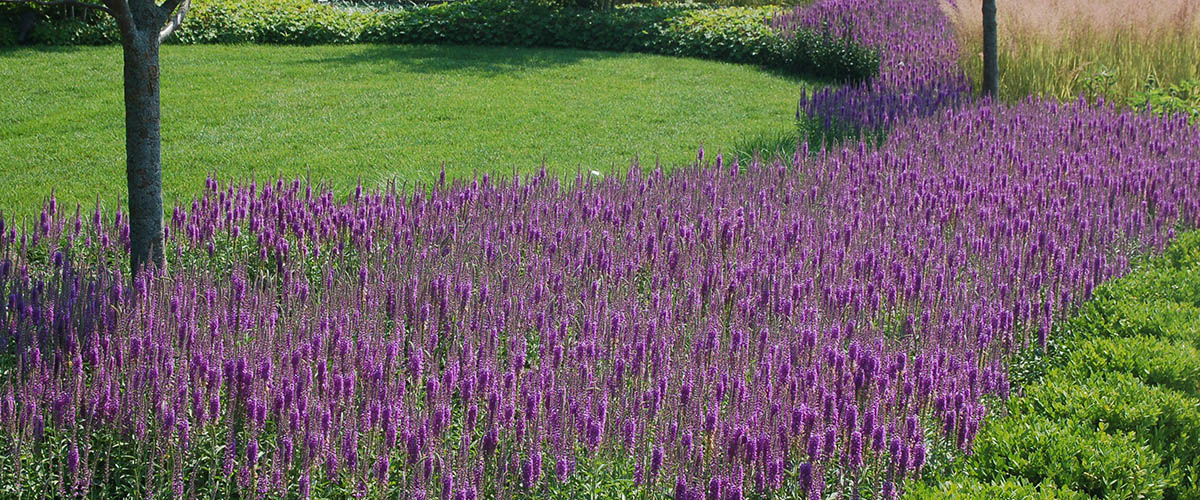
Evaluating Perennials for Chicagoland Gardens
Perennials in Focus is a plant evaluation program that examines new and underused plants for Chicagoland, the third largest metropolitan area in the country. A group of horticultural experts trials and evaluates plants at numerous locations across the region. Results help consumers, public gardens, growers, landscape designers, breeders, and other industry professionals make informed plant choices.
Perennials that thrive in Chicago’s heavy clay soil
Choosing perennials for heavy clay soil in the Chicago area starts with understanding how the ground behaves through the seasons. Chicagoland soils often contain fine particles that hold water tightly, become sticky when wet, and harden into dense masses during dry spells. These conditions can suffocate roots in spring and restrict them during summer.
The best plant choices are adapted to periodic moisture, compacted soil, and dramatic temperature changes. Native prairie plants, resilient woodland species, and well-tested garden perennials can all succeed when they are matched to the site rather than selected by flower color alone.
Drainage, sunlight, mature size, and bloom timing matter just as much as soil tolerance. A perennial that handles clay in full sun may fail in a shaded, poorly drained corner, while a moisture-loving plant may struggle beside a foundation where rain rarely reaches the soil.
Read the site before choosing plants
Begin by observing the planting area after a heavy rain and again during a midsummer dry spell. Water that remains for many hours indicates slow drainage, while cracked soil and wilted plants point to seasonal dryness. Clay can be both waterlogged and drought-prone because its tightly packed particles restrict air and make stored moisture difficult for roots to access.
Sun exposure also changes the soil’s behavior. A sunny border may dry and heat quickly at the surface, while a north-facing bed can remain cool and wet. Note nearby downspouts, roof overhangs, tree roots, pavement, and compacted paths. These details often explain poor growth more accurately than the soil’s texture alone.
A simple test can reveal whether the soil is workable. Take a handful when it is moist but not saturated. If it forms a smooth ribbon or moldable ball, it contains substantial clay. Avoid digging or amending it while it is sticky, since working wet clay destroys soil structure and creates long-lasting clods.
Match plants to moisture and light
For sunny clay beds, consider plants with sturdy root systems and a tolerance for variable moisture. Baptisia, daylilies, garden phlox, bee balm, sneezeweed, black-eyed Susan, and many ornamental grasses can perform well when drainage is adequate. New England aster and several goldenrod cultivars also suit Chicago’s late-season conditions and support pollinators.
Plants for damp clay need a different profile. Swamp milkweed, Joe-Pye weed, obedient plant, cardinal flower, and certain sedges can handle heavier moisture, especially in low areas or rain gardens. They should not be treated as universal solutions, since a wet spring followed by stagnant summer water can still cause crown or root problems.
Shadier locations call for dependable foliage as well as flowers. Hosta, lungwort, coral bells, golden ragwort, wild geranium, and some fern species can tolerate clay if the bed is not permanently saturated. Choose cultivars with mature dimensions suited to the space, because crowded roots compete for the limited oxygen available in dense soil.
Use regional trial information
Plant labels often describe a species in broad terms, but local performance can vary sharply. A perennial rated for a wide hardiness range may still flop, bloom briefly, or succumb to wet winter soil in a Chicago garden. Regional observations provide more useful context, particularly for newer cultivars and plants that have not been widely grown in the Midwest.
The Perennials in Focus snapshots offer concise observations from trials in the Chicagoland region. Look for details such as bloom duration, mature height, spread, flower color, and seasonal habit. These records help compare plants under conditions closer to those found in local residential landscapes.
Trial information should guide, rather than replace, site observation. A plant that performs well across several gardens is a strong candidate, but the final result still depends on drainage, maintenance, exposure, and competition from nearby trees. Give priority to plants with a consistent record and a size that fits the intended border.
| Site condition | Perennials to consider | Points to watch |
|---|---|---|
| Sunny, moderately moist clay | Baptisia, daylily, bee balm, garden phlox, sneezeweed | Provide airflow and divide crowded clumps |
| Sunny, seasonally wet clay | Swamp milkweed, Joe-Pye weed, obedient plant, sedges | Avoid areas with stagnant water year-round |
| Sunny, drier clay | Black-eyed Susan, coneflower, switchgrass, goldenrod | Water deeply during establishment |
| Part shade with average moisture | Wild geranium, coral bells, hosta, lungwort | Protect from intense afternoon heat |
| Shade with damp soil | Ferns, golden ragwort, moisture-tolerant sedges | Watch for slug pressure and poor air movement |
Improve clay without replacing it
Organic matter can improve clay, but it must be incorporated thoughtfully. Spread a thin layer of finished compost over the bed and mix it into the upper soil when conditions are workable. Repeated modest applications are safer and more effective than filling a planting hole with rich compost that has a different texture from the surrounding ground.
Avoid adding sand to clay soil in small amounts. The combination can create a dense, concrete-like mixture rather than reliable drainage. Do not place gravel beneath individual planting holes either; this can create a perched water zone where roots remain saturated.
Raised or gently mounded beds are useful where drainage is consistently poor. Build the grade gradually so water moves away without washing soil into paths. In very wet locations, select plants adapted to moisture instead of trying to force dry-soil perennials into an unsuitable site.
A two- to three-inch layer of shredded leaf mulch or quality organic mulch helps protect the surface from crusting and temperature swings. Keep mulch away from crowns and stems. As it breaks down, it contributes organic matter while reducing evaporation during Chicago’s hot summer periods.
Plant for establishment and winter survival
Fall and spring are both suitable planting seasons, but the ground must be workable rather than saturated. Spring planting gives new roots time to develop before winter, while early fall planting allows perennials to settle during cool weather. Late fall installations need adequate time for roots to contact the soil before it freezes.
Water new plants slowly and deeply, especially during the first growing season. Clay may appear wet at the surface while remaining dry around the root ball, particularly beneath mulch. Check moisture several inches down before irrigating again, and allow the upper layer to dry slightly for plants that dislike constant wetness.
Plant crowns at the correct depth. Setting a perennial too deeply is especially risky in clay because limited oxygen around the crown can encourage rot. Break up circling roots in containers, but avoid turning the root ball into a muddy hole. Firm the surrounding soil gently to eliminate large air pockets without compacting it.
Leave standing stems through winter when they provide habitat and visual structure. Cut back diseased foliage in late fall, but healthy stems can often remain until late winter or early spring. This approach also protects crowns from temperature changes and gives birds access to seed.
Build a durable planting palette
A successful clay-soil border benefits from several layers of interest. Combine early foliage and spring flowers with summer bloomers, late-season asters, seed heads, and grasses. Repeating a few reliable plants creates visual rhythm and makes maintenance easier than managing a collection of unrelated specimens.
Use mature width when spacing plants. A bed that looks sparse after installation may fill in within two or three seasons. Overplanting encourages weak stems, mildew, and competition for moisture. Give larger perennials room to develop, especially vigorous plants such as bee balm, obedient plant, and Joe-Pye weed.
Diversity also improves resilience. Include plants with different root forms, bloom periods, and responses to moisture. If one cultivar performs poorly in an unusually wet spring or dry summer, the entire border will still retain structure and color.
For additional regional plant information and trial context, explore the Perennials in Focus program. Its evaluations can help gardeners, designers, growers, and retailers narrow a long plant list to choices with demonstrated Chicagoland potential.
Make selection decisions more reliable
Use these practical checks before purchasing or installing a perennial:
- Identify whether the bed is wet, average, or dry during both spring and summer.
- Match the plant to its available light at the time it will be fully grown.
- Check mature height and spread instead of relying on the container’s current size.
- Favor plants with regional trial observations or a strong record in Midwest gardens.
- Improve soil gradually with compost and mulch rather than radically replacing the native clay.
Heavy clay does not have to limit a Chicago-area garden to a short list of ordinary plants. It can support a rich, long-lived planting when moisture patterns, light, mature dimensions, and seasonal performance guide the choices. Start with one bed, record what succeeds through a full year, and use those observations to refine future plantings.
Review regional trial findings, compare candidates against your site conditions, and plant a resilient mix suited to your garden’s actual soil. With careful selection and patient establishment, dense clay can become the foundation for a dependable perennial landscape.
In the Garden
Evaluator gardens are located across the Chicagoland area, representing a range of growing conditions. Visit our retail and wholesale partners to find trialled perennials for your own garden.
Retail & Wholesale: Hinsdale Nurseries (Willowbrook, IL), Mariani Nurseries (Kenosha, WI & Garden Prairie, IL), Northwind Perennials (Burlington, WI), The Growing Place (Aurora, IL).
Wholesale Only: Hinsdale Nurseries (Plano, IL), Intrinsic Perennial Gardens (Hebron, IL).
Our Evaluation Program
The 2017–2020 evaluation cycle included Agastache 'Blue Boa', Allium senescens 'Blue Eddy', Amsonia ciliata var. filifolia 'Georgia Pancake', Astilbe 'Chocolate Shogun', Boltonia astroides 'James Crocket', Brunnera 'Alexander's Great', and Geranium cinereum 'Jolly Jewel Purple'. Completed evaluations include Amsonia 'Blue Ice' (2004–07).
On April 10, 2020, the program published snapshot profiles for Vernonia lettermanii 'Iron Butterfly', Stokesia laevis 'Elf', Stachys officinalis 'Pink Cotton Candy', Lobelia 'Monet Moment', Helleborus 'Winter Thrillers', Geum 'Mai Tai', Geranium soboliferum 'Butterfly Kisses', Gentiana x intermedia 'True Blue', Eurybia divaricata, Asparagus 'Purple Passion', and Agastache 'Bolero'.
Browse the full collection of snapshots organized alphabetically — from A–D, E–H, I–Q, and R–Z — to find detailed performance data on perennials trialled across Chicagoland.