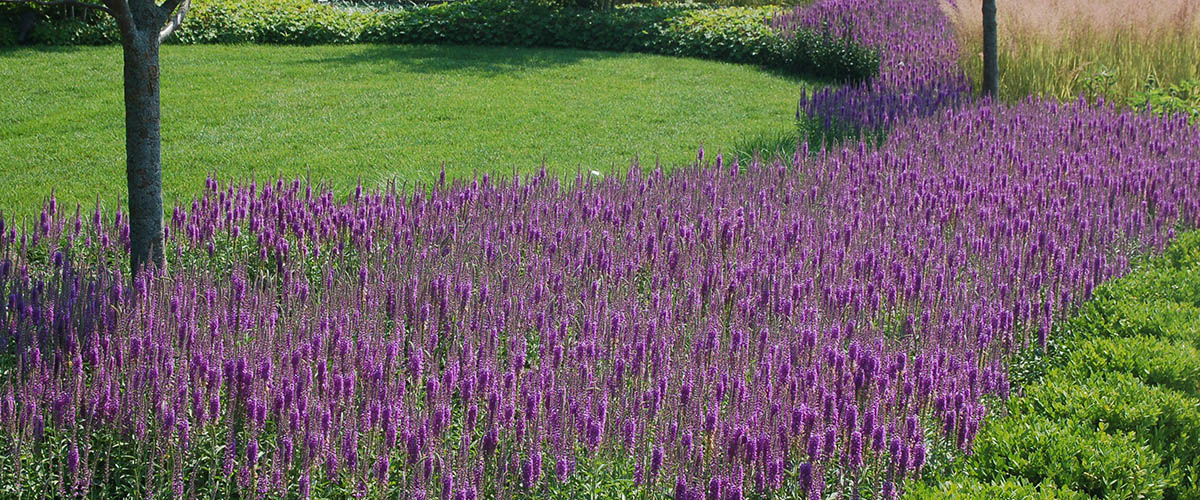
Evaluating Perennials for Chicagoland Gardens
Perennials in Focus is a plant evaluation program that examines new and underused plants for Chicagoland, the third largest metropolitan area in the country. A group of horticultural experts trials and evaluates plants at numerous locations across the region. Results help consumers, public gardens, growers, landscape designers, breeders, and other industry professionals make informed plant choices.
Trialing wind tolerance in tall grasses on exposed sites
Tall ornamental grasses can bring movement, height and winter structure to a garden, yet their performance changes sharply when they are planted in open, windy positions. A clump that stands upright in a sheltered border may lean, split or shed its flower heads when exposed to prevailing gusts.
Panicum virgatum, commonly called switchgrass, is a useful plant for studying this difference. Its upright foliage, airy panicles and strong seasonal colour make it an appealing perennial for large borders and naturalistic landscapes. Cultivars vary considerably, however, in height, stem strength, spread and ability to recover after severe weather.
The Perennials in Focus approach offers a practical model for evaluating these traits. By recording plants across multiple gardens and seasons, horticultural professionals can move beyond catalogue descriptions and identify dependable performers. That evidence is valuable in Australia, where coastal exposure, hot northerly winds and sudden storm fronts create their own testing conditions.
Selecting plants for a fair wind trial
A useful trial begins with comparable plant material. Record the cultivar or seed strain, container size, planting date and initial crown width. Plants should be healthy and well rooted before assessment, since a newly divided clump may lean simply because its root system has not established.
Include several plants of each selection rather than relying on one specimen. A single plant can be affected by a damaged crown, uneven soil or a nearby tree. Replication helps distinguish genetic differences from site accidents. It is also helpful to include a recognised reliable cultivar as a reference point.
Panicum virgatum selections may differ in mature height from compact forms suitable for residential borders to tall forms intended for screening. Taller plants generally present a larger surface to the wind, but height alone does not predict failure. Stem flexibility, basal density and the timing of flowering all influence how a clump behaves.
Planting date matters as well. In the Chicago region, establishment before winter is a major consideration, and this planting timing guide helps explain how seasonal timing affects perennial establishment. Australian trials should also document whether planting occurred during autumn, winter or spring, since conditions differ between Melbourne, Sydney, Adelaide and Perth.
Reading the site before planting
Wind tolerance cannot be separated from the planting environment. Map the direction of prevailing winds, nearby buildings, fences, hedges and slopes. A site described as “full sun” may still be sheltered from the strongest gusts, while a raised garden, coastal verge or rooftop bed may expose plants to turbulent air from several directions.
Soil moisture is another important variable. Wind increases transpiration, especially when the soil is dry and the air is hot. A grass in deep, moisture-retentive loam may remain upright while the same cultivar in shallow sandy soil becomes stressed and flops. Record soil texture, drainage, irrigation and mulch depth before comparing plants.
For Australian conditions, include sites that reflect local use. A windswept garden in Geelong, a dry suburban block in Canberra, a coastal planting in Wollongong or an exposed Adelaide garden will produce different results. The aim is not to declare one cultivar universally best, but to identify which traits suit each landscape type.
Avoid treating staking as a solution during the main assessment period. Temporary support can hide weak stems and make cultivars appear more wind-firm than they are. If support is necessary to prevent breakage, record its use and analyse that plant separately.
Measuring performance through seasons
A wind trial needs consistent observations rather than occasional impressions. After significant weather events, record the angle of the foliage, the degree of stem lodging, broken culms, damaged flower heads and the time required for recovery. A simple five-point scale can make comparisons easier across gardens.
Also note the plant’s appearance before and after the event. Some grasses bend during a storm and return upright within a day, while others remain permanently splayed. Flexible stems may offer better resilience than rigid ones, especially where repeated gusts occur. The most useful plant is often the one that bends safely and recovers quickly.
| Trait to record | Useful observation | Why it matters |
|---|---|---|
| Mature height | Foliage and flower-head height | Indicates visual impact and wind exposure |
| Basal width | Dense or open crown | Shows how well the plant anchors and fills space |
| Stem posture | Upright, arching or leaning | Helps assess structural strength |
| Lodging after storms | None, temporary or permanent | Separates recovery from failure |
| Flower-head retention | Held, damaged or shed | Measures late-season display |
| Recovery time | Hours or days to regain form | Indicates resilience under repeated wind |
| Seasonal condition | Green, drought-stressed or dormant | Links wind response with moisture and climate |
Photographs taken from the same position are especially valuable. Capture the plants before a storm, soon after it and several days later. Over a two- or three-year period, these images reveal whether a poor season was an isolated event or part of a consistent pattern.
Comparing cultivars and companion grasses
When comparing Panicum virgatum selections, assess more than flowering colour. A cultivar with attractive burgundy panicles may be less suitable for an exposed verge if it opens at the base or collapses at peak height. Look at crown density, the proportion of stems carrying flower heads and whether the foliage remains visually balanced after wind.
Companion grasses can provide useful benchmarks. Australian plants such as Lomandra, Poa labillardierei and selected Austrostipa species have evolved under local conditions, though their form and water requirements differ from switchgrass. They should not be treated as direct substitutes, but they can show how a planting might perform when local species are better adapted to salt, heat or drought.
Mixed plantings also change wind behaviour. Low perennials around the crown can reduce bare-soil exposure and help retain moisture, while neighbouring upright plants may either buffer gusts or create turbulence. Keep spacing records so that a cultivar is not judged without considering the planting design in which it was tested.
For formal landscapes, the same evidence can guide placement. A wind-tolerant grass may soften a rose border without needing constant support, while a weaker selection may be better placed behind a hedge. Ideas for combining perennials with structured planting can be seen in this guide to formal rose borders.
Turning trial data into garden decisions
Trial results become useful when translated into clear recommendations. Instead of describing a grass as simply “wind tolerant”, specify the conditions: reliable in full sun with moderate irrigation, suitable for open sites up to a certain height, or prone to late-season leaning in dry soil. This language helps gardeners choose plants with realistic expectations.
Consider maintenance as part of performance. A clump that needs annual cutting back is not necessarily difficult, but a plant that requires tying, repeated division or frequent replacement may be unsuitable for a low-maintenance public garden. Record whether the plant keeps a clean outline into winter and whether old stems interfere with new growth in spring.
Australian retailers and growers can use this information when deciding what to propagate or stock. A cultivar that performs well in a cool, humid trial may require separate testing before being promoted for Brisbane or Perth. Regional trialling supports better labelling and gives customers more meaningful information than a generic height and hardiness description.
The same principle applies to public gardens and landscape contractors. A selection that remains upright beside a car park, on a broad verge or near a coastal promenade has practical value. Results should include photographs, planting density, irrigation details and a description of the exposure, allowing professionals to judge whether the trial resembles their own project.
Applying lessons in Australian landscapes
Wind-tolerant switchgrass can suit contemporary borders, meadow-style plantings and broad mixed beds, provided its mature size matches the site. Give tall forms enough room to move without striking paths or blocking sightlines. In smaller gardens, compact cultivars may deliver the texture of a tall grass with less risk of visual collapse.
Water management deserves particular attention during establishment. Even a drought-tolerant perennial needs reliable moisture while roots develop. Mulch can reduce evaporation, but it should remain clear of the crown. Once established, irrigation can be adjusted according to local rainfall, soil type and the plant’s seasonal growth.
Check state and local biosecurity guidance before sourcing unfamiliar grasses, and buy from reputable Australian nurseries. Availability can vary sharply between the east coast, South Australia and Western Australia. Where Panicum virgatum is difficult to source or poorly suited to a specific climate, locally proven grasses may offer a more dependable result.
A careful trial turns an attractive idea into sound plant selection. Record the site, measure the response, compare several plants and review performance across seasons. Use the resulting evidence to choose grasses that provide movement and height while retaining enough structure for the realities of Australian gardens. Start with a small, well-documented planting, then expand the selections that remain upright, healthy and visually effective after the wind has passed.
In the Garden
Evaluator gardens are located across the Chicagoland area, representing a range of growing conditions. Visit our retail and wholesale partners to find trialled perennials for your own garden.
Retail & Wholesale: Hinsdale Nurseries (Willowbrook, IL), Mariani Nurseries (Kenosha, WI & Garden Prairie, IL), Northwind Perennials (Burlington, WI), The Growing Place (Aurora, IL).
Wholesale Only: Hinsdale Nurseries (Plano, IL), Intrinsic Perennial Gardens (Hebron, IL).
Our Evaluation Program
The 2017–2020 evaluation cycle included Agastache 'Blue Boa', Allium senescens 'Blue Eddy', Amsonia ciliata var. filifolia 'Georgia Pancake', Astilbe 'Chocolate Shogun', Boltonia astroides 'James Crocket', Brunnera 'Alexander's Great', and Geranium cinereum 'Jolly Jewel Purple'. Completed evaluations include Amsonia 'Blue Ice' (2004–07).
On April 10, 2020, the program published snapshot profiles for Vernonia lettermanii 'Iron Butterfly', Stokesia laevis 'Elf', Stachys officinalis 'Pink Cotton Candy', Lobelia 'Monet Moment', Helleborus 'Winter Thrillers', Geum 'Mai Tai', Geranium soboliferum 'Butterfly Kisses', Gentiana x intermedia 'True Blue', Eurybia divaricata, Asparagus 'Purple Passion', and Agastache 'Bolero'.
Browse the full collection of snapshots organized alphabetically — from A–D, E–H, I–Q, and R–Z — to find detailed performance data on perennials trialled across Chicagoland.