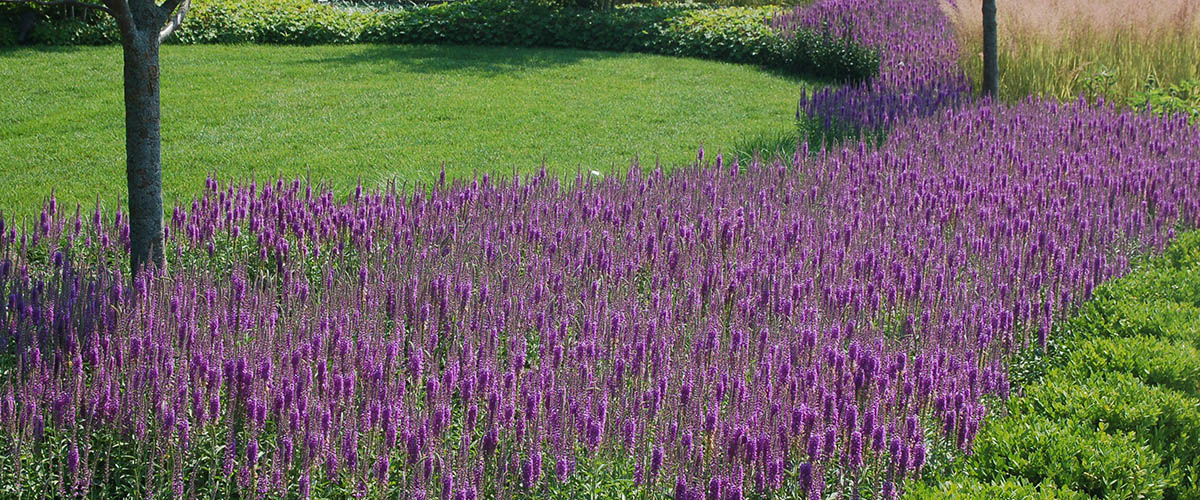
Evaluating Perennials for Chicagoland Gardens
Perennials in Focus is a plant evaluation program that examines new and underused plants for Chicagoland, the third largest metropolitan area in the country. A group of horticultural experts trials and evaluates plants at numerous locations across the region. Results help consumers, public gardens, growers, landscape designers, breeders, and other industry professionals make informed plant choices.
Testing Echinacea purpurea roots in compacted urban soils
Echinacea purpurea, commonly called purple coneflower, is often described as a tough, drought-tolerant perennial. That reputation depends heavily on the soil beneath it. In an urban garden, a plant may face construction rubble, repeated foot traffic, shallow imported topsoil and a dense clay layer that limits how far its roots can travel.
Testing the root depth of Echinacea purpurea in compacted urban soils gives growers a more useful picture than a simple survival rating. It shows whether plants can establish a stable root system, access moisture below the surface and return reliably after seasonal stress. Findings from Chicagoland trials also offer valuable clues for Australian gardens, where compacted verges, paved courtyards and water restrictions create similar growing problems.
Why root depth matters for coneflowers
Purple coneflower develops a substantial crown and a fibrous, branching root system, with thicker roots that can explore deeper soil when conditions allow. In loose, well-drained ground, mature plants may send roots well below the upper planting layer. The exact depth varies with plant age, cultivar, soil texture, moisture and the presence of hardpans.
Root depth affects more than drought tolerance. A deeper, well-distributed system can anchor tall stems, support repeated flowering and reduce the shock of short dry periods. Shallow roots may still produce attractive flowers in the first season, yet plants can collapse during heat, need frequent irrigation or show reduced vigour in the following year.
How compaction changes underground growth
Compacted soil contains fewer large pores, so roots encounter greater physical resistance and less available oxygen. Water may sit on top of a dense layer after heavy rain, then become unavailable once the surface dries. Roots often spread sideways through the easiest path instead of penetrating downwards.
This pattern is common around new housing, apartment developments and streetscape plantings. Machinery can compress soil several metres beyond a visible building footprint. In Sydney and Melbourne, heavy clay or fill can form a barrier beneath a seemingly generous garden bed, while Perth’s sandy soils create a different challenge: rapid drainage above a compacted subgrade.
Echinacea can tolerate periods of dryness, but it does not perform well in stagnant, airless soil. A plant with roots trapped in the top 10 to 15 centimetres may be labelled drought hardy, yet still require close watering during a hot Australian summer.
A practical trial method for urban beds
A useful evaluation begins with comparable plants of the same age and similar starting size. Plant them in replicated plots with at least three soil conditions: loosened garden soil, moderately compacted soil and a heavily compacted treatment. Record planting depth, irrigation, mulch, rainfall and any soil amendments so root results can be interpreted properly.
At the end of the trial, excavate plants when the soil is moist but not saturated. Dig a broad trench beside the crown, expose the root system gradually and measure the deepest continuous root zone, the widest lateral spread and the proportion of roots confined to the surface layer. Washing soil from roots with a gentle stream can reveal fine roots without tearing them away.
A simple penetrometer reading or resistance test adds useful context. Soil bulk density, infiltration time and drainage observations help explain why one plot supports deeper roots than another. The strongest result is not always the greatest single depth; a consistent root profile across several plants is more meaningful for landscape decisions.
Comparing likely root responses
Root depth should be assessed alongside establishment speed, crown health and flowering. A plant that reaches deep soil but suffers crown rot may be less useful than one with a moderately deep, well-aerated system. Likewise, a shallow profile in the first year may expand after the soil is improved and the crown gains strength.
| Soil condition | Likely root pattern | Main risk | Useful management response |
|---|---|---|---|
| Open, friable loam | Deep central growth with broad lateral roots | Drying if soil is too free-draining | Mulch and water deeply during establishment |
| Dense clay | Shallow or sideways growth above the clay layer | Waterlogging followed by hard drying | Improve drainage and avoid planting in a bowl-shaped bed |
| Construction fill | Irregular roots around rubble and voids | Uneven moisture and nutrient supply | Remove debris and create a consistent planting volume |
| Compacted sandy subgrade | Surface roots with limited downward movement | Rapid moisture loss | Incorporate suitable organic matter and irrigate slowly |
| Mulched, lightly loosened urban soil | More even root distribution | Competition from nearby trees or turf | Keep a weed-free root zone and monitor moisture |
These categories help translate trial observations into practical plant specifications. They also prevent the common mistake of treating “drought tolerant” as a guarantee that a perennial will cope with any neglected or compacted site.
Reading Chicagoland results in Australia
The Perennials in Focus programme evaluates plants across multiple gardens and seasons, recording traits such as flowering period, colour, height and spread. Root observations can extend that work by showing how a plant responds below ground before visible decline appears. Chicagoland’s freeze-thaw cycles differ from Australian conditions, yet the evaluation approach remains highly transferable.
For Australian readers, the most useful comparison is between soil and climate behaviour rather than identical calendar dates. A coneflower trial in Chicago may reveal crown persistence after winter, while a garden in Adelaide or Canberra may be more concerned with dry summers and cold snaps. In Brisbane, intense rain and humid conditions make drainage and crown aeration especially important.
Trial notes should state whether irrigation was occasional and deep or frequent and shallow. That distinction matters in Australian retail and landscaping, where labels such as “low water” influence purchasing decisions. A plant that performs with deep weekly irrigation during establishment may still become resilient later, provided its roots have room to develop.
Designing a better planting site
Before planting, break through compacted layers with a garden fork, broadfork or suitable mechanical equipment. Work across the entire bed rather than making a narrow hole surrounded by hard ground. A small pocket of rich soil can encourage roots to circle within it, leaving the plant vulnerable when that pocket dries.
Use mature organic matter in moderation and avoid creating a sharply different soil texture from the surrounding ground. Compost can improve structure, microbial activity and water-holding capacity, but it will not repair severe compaction by itself. Where drainage is poor, raising the bed slightly may be more effective than adding extra fertiliser.
Allow adequate spacing for mature Echinacea crowns and maintain a coarse organic mulch layer away from the crown. In Australian streetside beds, drip irrigation or low-flow emitters are preferable to brief hand watering, particularly during the first summer. Water slowly enough to wet the future root zone, then allow the surface to dry between applications where drainage permits.
Using root findings in mixed plantings
Root depth trials can guide plant combinations as well as individual plant selection. Deep-rooted coneflowers may occupy a different soil layer from lower groundcovers, although competition increases where all plants are confined above a hardpan. Use spacing, mulch and periodic division to prevent a vigorous companion from dominating the same shallow zone.
When choosing a living carpet for a difficult urban edge, compare its moisture needs and rooting habit with the coneflower. Research on deadnettle and bugleweed can help clarify how groundcovers behave as alternatives, rather than assuming every low-growing perennial will suit the same compacted site.
Flowering sequence also matters. Echinacea contributes strongly from summer into early autumn, so pairing it with earlier performers can keep a garden visually active while roots are still developing. Guidance on spring-to-summer bloom is useful when planning a bed that must carry colour through changing weather.
Turning measurements into plant choices
For growers, a root-depth assessment can identify selections that establish evenly in difficult soil rather than simply producing impressive flowers in ideal plots. Record crown width, survival, flowering stems and root distribution together. This creates a fuller performance profile for retailers, landscape professionals and public gardens.
Home gardeners can apply the same principle on a smaller scale. Probe the bed before planting, observe how quickly irrigation infiltrates and inspect a failed plant’s root zone rather than blaming the cultivar immediately. If roots are tightly concentrated near the surface, the site may need structural improvement before another plant is installed.
Well-documented regional trials give Australian buyers better information than broad claims about toughness. They show how a perennial behaves in a real planting system, including soil limitations, irrigation patterns and seasonal stress. That evidence supports smarter plant lists for council verges, school gardens, apartment courtyards and residential landscapes.
Use root-depth observations to select Echinacea purpurea with confidence, prepare the soil before planting and track performance through at least two growing seasons. Share clear records of soil type, irrigation and flowering so local growers and gardeners can build a stronger evidence base for resilient perennial planting.
In the Garden
Evaluator gardens are located across the Chicagoland area, representing a range of growing conditions. Visit our retail and wholesale partners to find trialled perennials for your own garden.
Retail & Wholesale: Hinsdale Nurseries (Willowbrook, IL), Mariani Nurseries (Kenosha, WI & Garden Prairie, IL), Northwind Perennials (Burlington, WI), The Growing Place (Aurora, IL).
Wholesale Only: Hinsdale Nurseries (Plano, IL), Intrinsic Perennial Gardens (Hebron, IL).
Our Evaluation Program
The 2017–2020 evaluation cycle included Agastache 'Blue Boa', Allium senescens 'Blue Eddy', Amsonia ciliata var. filifolia 'Georgia Pancake', Astilbe 'Chocolate Shogun', Boltonia astroides 'James Crocket', Brunnera 'Alexander's Great', and Geranium cinereum 'Jolly Jewel Purple'. Completed evaluations include Amsonia 'Blue Ice' (2004–07).
On April 10, 2020, the program published snapshot profiles for Vernonia lettermanii 'Iron Butterfly', Stokesia laevis 'Elf', Stachys officinalis 'Pink Cotton Candy', Lobelia 'Monet Moment', Helleborus 'Winter Thrillers', Geum 'Mai Tai', Geranium soboliferum 'Butterfly Kisses', Gentiana x intermedia 'True Blue', Eurybia divaricata, Asparagus 'Purple Passion', and Agastache 'Bolero'.
Browse the full collection of snapshots organized alphabetically — from A–D, E–H, I–Q, and R–Z — to find detailed performance data on perennials trialled across Chicagoland.