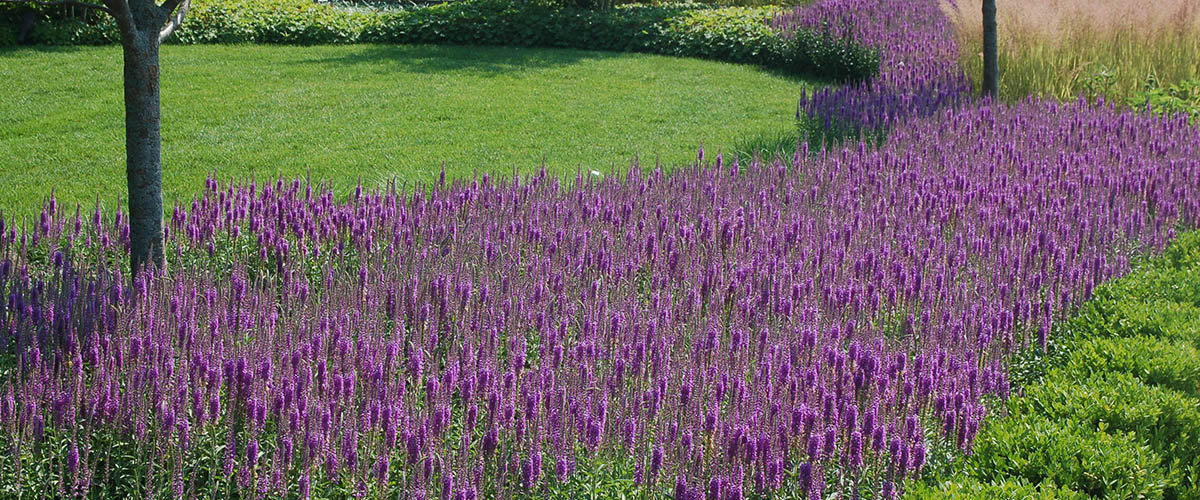
Evaluating Perennials for Chicagoland Gardens
Perennials in Focus is a plant evaluation program that examines new and underused plants for Chicagoland, the third largest metropolitan area in the country. A group of horticultural experts trials and evaluates plants at numerous locations across the region. Results help consumers, public gardens, growers, landscape designers, breeders, and other industry professionals make informed plant choices.
Testing Anther Shatter in Liatris aspera Pollinator Plantings
Liatris aspera, or rough blazing star, is evaluated for a feature easily overlooked in a spectacular flower spike: what happens to its pollen-bearing anthers as the bloom ages. Here, anther shatter means the breakup or premature opening of the anther tube and the resulting loss of pollen or anther material. It is a practical field description, not another name for the whole flower falling apart.
That distinction matters because Liatris belongs to the daisy family and presents pollen from tubular disk florets. The five anthers are joined into a tube, and visiting insects remove pollen while transferring it between flowers. A planting can look pollinator friendly yet offer diminishing pollen if the anthers fail, while a plant that sheds visibly can still be visited productively.
Perennials in Focus trials plants across gardens and seasons, making it suited to ask whether this behaviour is consistent in Chicagoland or mainly a response to one soil, weather pattern, or maintenance routine. Its records of bloom period, flower colour, height, spread, and survival provide a useful baseline without pretending Chicago results automatically apply in Australia.
For Australian growers, the test must be reversed against local seasons and expanded across different climates. The practical question is not whether Liatris aspera is visually desirable, but whether it delivers accessible pollen and sustained insect activity among locally useful plants without creating biosecurity or environmental risks.
Reading anther shatter in the field
Observers should separate three events that can occur together: normal anther dehiscence, pollen removal by an insect, and physical breakage or detachment. Normal dehiscence exposes pollen at the correct stage; insect removal may leave the tube intact but empty; shatter indicates that the structure has split, frayed, or fallen away before pollination is complete.
A repeatable score can move from an intact tube to a split tube, visible pollen loss, and detached tissue. Check tagged stems at regular intervals, using a hand lens on a defined group of florets. Record the proportion affected, recent rain or wind, time of day, and whether damage is concentrated low on the spike or across the flowering zone.
Why rough blazing star is worth testing
Rough blazing star is a clump-forming North American prairie perennial with tall, usually lavender to purple spikes that open from the tip downward in late summer. Strong plants can approach 1–2 metres in favourable soil, and their narrow leaves and upright habit differ from the compact, often misidentified Liatris sold in the trade.
For bees, open florets offer landing and feeding points, while elevated spikes make flowers easy to locate above lower perennials. That does not guarantee broad pollinator value: some visitors may only collect pollen, and an exotic plant should complement rather than displace native forage. An evaluation should therefore record insect taxa, contact with the anther tube, pollen carried away, and actual seed set.
Building a replicated regional trial
Trials need replicated plants, untreated comparison groups, and several sites. Randomised positions help separate plant differences from irrigation and soil variation, while exclusion sleeves on selected branches reveal damage without pollinator contact. Seed set, stem stability, and unvisited florets then show whether anther loss has a reproductive consequence.
The Perennials in Focus approach to mulch-removal findings is a useful model of comparison, even though mulch and hellebores differ from blazing star. Testing one variable at a time, labelling consistently, and revisiting marked plants across dates can reveal effects an informal visit would miss. The Liatris trial also needs a clear definition of shatter and scaled photographs.
Translating results for Australian gardens
Regional differences are likely to exceed small differences between cultivars. Climate affects flowering speed, humidity, storm exposure, and drying, while winter cold and summer moisture influence dormancy. The comparison below offers a starting point for Australian trial sites.
| Setting | Typical conditions | Main trial risks | Management to record |
|---|---|---|---|
| Chicagoland | Cold winters, hot summers, humid storms | Spring frost and summer moisture | Drainage, irrigation and weather dates |
| Melbourne | Cool winters, dry summers, strong wind | Heat and wind damage | Establishment irrigation and exposure |
| Sydney and Brisbane | Warm, humid conditions | Heavy rain, lodging and disease | Spacing, airflow and rain dates |
| Adelaide | Mediterranean climate and hot, dry summers | Heat and irrigation pressure | Irrigation zone and heat observations |
Australian gardeners commonly create small pollinator borders, shared street verges, and backyard wildlife corridors, often supplemented by native bee hotels. Liatris can provide a conspicuous late-season accent, but placement should follow flowering gaps rather than a rigid calendar. Combining it with proven local species that overlap in bloom gives insects a continuous forage route and makes a poor performance year visible.
Measuring pollen, bloom, and pollinator activity
Data collection should follow a disciplined regional format: record first and last bloom, flower colour, mature height and spread, vigour, and weather. The programme’s Chicagoland trial guidance illustrates why observations need a common baseline before plants are described as reliable performers.
At each flowering date, count open florets in marked sections of the spike, score anther condition, and note the main visitors. Fixed observation periods make counts repeatable. Pollen viability or germination testing can confirm whether material from damaged tubes remains usable, while bagged branches provide a weather-only comparison. Link anther condition to visitation, seed production, and disease.
Interpretation must allow for exceptional heat, heavy rain, or an unusually active bee population. Two seasons across several gardens are more informative than one spectacular display. Report site-specific findings with photographs, dates, and management notes so another Australian nursery or public garden can repeat the work rather than inherit an unsupported rating.
Climate, commerce, and ecological context
The local market adds another layer. Australia’s specialist perennial nurseries, garden centres, landscape contractors, and online sellers serve Brisbane, Sydney, Melbourne, and Adelaide, but plants may be sold under a general Liatris name. Liatris spicata and its cultivars can replace L. aspera without notice, so botanical identity, propagation source, and mature dimensions should be confirmed before results are assigned.
Commercial success should be judged beyond the first flowering flush. Buyers need plants that hold their form, resist lodging, and continue offering forage in a mixed border. Wholesalers benefit from consistent production and predictable labels; public gardens need honest multi-season data. Cut-flower growers may value the stems, although heavy pollen loss could create handling issues that home gardeners never notice.
Import and escape precautions are equally important. Liatris aspera is not native to Australia, and propagation material should move through approved channels. Before distribution, growers should check state and local council weed information, biosecurity requirements, and nearby natural areas. A pollinator plant that may escape its intended range should not be promoted simply because bees visit it.
Choose with evidence and local responsibility
The strongest candidate is not the plant with the largest spike or fastest anther break. It combines a long, well-defined bloom period, intact and pollen-bearing florets, steady activity by native bees and other useful insects, reliable seed set, and stable growth across local sites. Those measures connect flower behaviour to the success of a whole planting.
Choose botanically labelled, nursery-propagated Liatris aspera for a replicated trial, place it with compatible Australian perennials, and record the same flower, weather, and pollinator observations each week. Share the results with local growers, public gardens, and the Perennials in Focus network. Regional evidence can help the trade supply a distinctive prairie perennial, give bees dependable forage, and protect Australia’s native plant communities.
In the Garden
Evaluator gardens are located across the Chicagoland area, representing a range of growing conditions. Visit our retail and wholesale partners to find trialled perennials for your own garden.
Retail & Wholesale: Hinsdale Nurseries (Willowbrook, IL), Mariani Nurseries (Kenosha, WI & Garden Prairie, IL), Northwind Perennials (Burlington, WI), The Growing Place (Aurora, IL).
Wholesale Only: Hinsdale Nurseries (Plano, IL), Intrinsic Perennial Gardens (Hebron, IL).
Our Evaluation Program
The 2017–2020 evaluation cycle included Agastache 'Blue Boa', Allium senescens 'Blue Eddy', Amsonia ciliata var. filifolia 'Georgia Pancake', Astilbe 'Chocolate Shogun', Boltonia astroides 'James Crocket', Brunnera 'Alexander's Great', and Geranium cinereum 'Jolly Jewel Purple'. Completed evaluations include Amsonia 'Blue Ice' (2004–07).
On April 10, 2020, the program published snapshot profiles for Vernonia lettermanii 'Iron Butterfly', Stokesia laevis 'Elf', Stachys officinalis 'Pink Cotton Candy', Lobelia 'Monet Moment', Helleborus 'Winter Thrillers', Geum 'Mai Tai', Geranium soboliferum 'Butterfly Kisses', Gentiana x intermedia 'True Blue', Eurybia divaricata, Asparagus 'Purple Passion', and Agastache 'Bolero'.
Browse the full collection of snapshots organized alphabetically — from A–D, E–H, I–Q, and R–Z — to find detailed performance data on perennials trialled across Chicagoland.