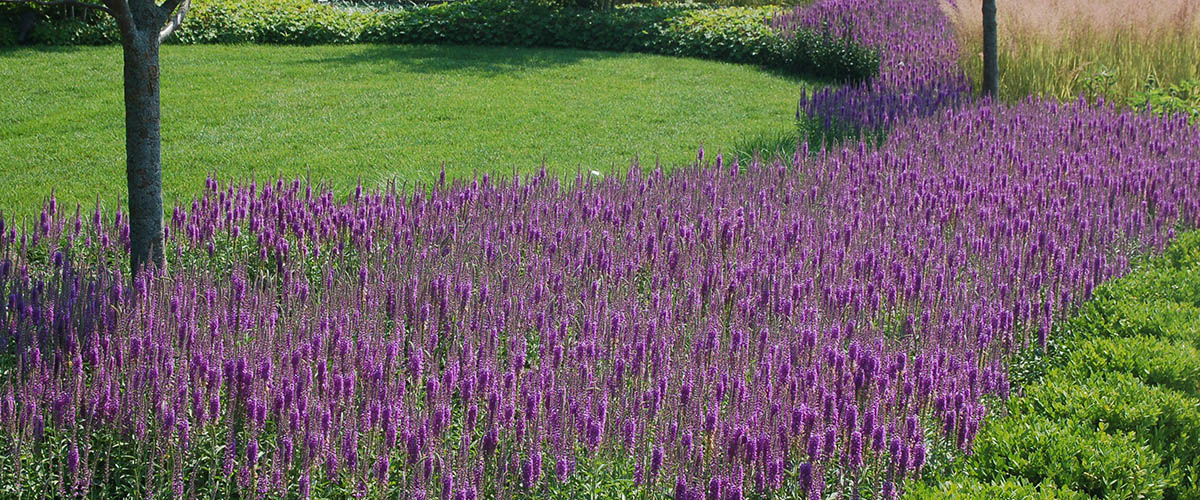
Evaluating Perennials for Chicagoland Gardens
Perennials in Focus is a plant evaluation program that examines new and underused plants for Chicagoland, the third largest metropolitan area in the country. A group of horticultural experts trials and evaluates plants at numerous locations across the region. Results help consumers, public gardens, growers, landscape designers, breeders, and other industry professionals make informed plant choices.
Proven Winners perennial standouts from Chicagoland trials
Choosing a perennial for the Chicago area involves more than admiring a catalog photograph. Plants must handle cold winters, wet springs, hot summers, heavy clay, fluctuating moisture, and the competition created by established roots. A cultivar that thrives in a mild garden elsewhere may struggle when exposed to the full range of Chicagoland conditions.
Perennials in Focus evaluates plants across multiple gardens and growing seasons to identify reliable performers for the region. The resulting observations help gardeners compare bloom duration, plant habit, flower color, height, spread, disease tolerance, and seasonal appeal before committing valuable space.
Several Proven Winners perennials have attracted attention in these trials because they combine strong ornamental qualities with practical garden performance. The most useful findings are not limited to a single spectacular bloom; they include how plants emerge, fill out, handle weather, and contribute to the landscape after flowering.
What makes a perennial trial-worthy
A strong trial plant earns recognition through consistent performance rather than a single impressive week. Evaluators look for healthy growth after winter, dependable flowering, sturdy stems, an attractive outline, and enough vigor to compete without becoming invasive. Plants are also observed during periods of heat, drought, excessive rainfall, and abrupt temperature changes.
This regional approach matters because Chicagoland gardens vary widely. A sunny suburban border, an urban courtyard, and a partially shaded public garden can produce very different results. Repeated observations across sites reveal whether a plant is broadly adaptable or best reserved for a specific position.
The best selections also offer value beyond bloom. Persistent seedheads, ornamental foliage, pollinator activity, and a tidy habit can extend a perennial’s contribution from spring through fall. These traits are especially important in low-maintenance landscapes where plants must carry visual interest between peak flowering periods.
Echinacea brings a long season of color
Coneflowers remain among the most useful summer perennials for the region. Proven Winners selections in the Sombrero series are valued for saturated flower colors, branching habits, and a compact profile that fits mixed borders as well as larger perennial plantings. Their daisy-shaped flowers attract bees and butterflies, while dried seedheads can provide late-season texture.
Trial observations help separate cultivars that bloom early from those that continue producing flowers well into late summer. Gardeners comparing cultivars can review Echinacea bloom timing before planning a sequence of color. This detail is particularly helpful when combining coneflowers with daylilies, ornamental grasses, or late-blooming asters.
Full sun and well-drained soil support the strongest growth. Newly planted coneflowers need regular moisture while establishing, but mature plants generally perform best when their roots are not kept constantly wet. Avoid excessive fertilizer, which can encourage soft growth and fewer flowers.
Catmint and Russian sage support pollinators
Catmint is a dependable bridge between spring and summer displays. Cat’s Meow catmint forms a dense mound of gray-green foliage topped with lavender-blue flowers. Its restrained height makes it useful along paths, at the front of a border, or beneath taller plants. The foliage remains attractive after the first flush of bloom, and a light shearing can encourage renewed flowering.
Denim ’n Lace Russian sage offers a taller, airier effect. Its silver foliage and blue flowers create contrast with bold coneflowers, dark-leaved sedums, and warm-toned grasses. In Chicagoland trials, this type of plant is most effective where it receives full sun and has room to develop a broad, open shape.
Both perennials benefit from sharply drained soil. Heavy clay should be amended through long-term soil improvement rather than a small pocket of compost placed in the planting hole. Cutting back old stems in late winter or early spring also allows fresh growth to emerge cleanly without removing valuable winter structure too soon.
Reliable plants for structure and texture
Rock ’N Grow sedums provide one of the clearest examples of a perennial that earns its place through several seasons. Broad, succulent foliage forms a strong mound in spring and summer, followed by clusters of flowers that deepen in color as autumn approaches. The sturdy stems often remain upright into winter, giving the plant value after the growing season ends.
Decadence baptisia contributes a different kind of structure. Its upright habit, blue-green foliage, and pea-like flowers create a substantial presence in a sunny border. Baptisia develops a deep root system and may take time to establish, but once settled it can become a long-lived anchor plant with limited maintenance needs.
The following comparison summarizes useful landscape roles and typical placement considerations for several Proven Winners perennial candidates observed by gardeners and professionals in the region:
| Perennial | Main ornamental feature | Approximate garden role | Best placement |
|---|---|---|---|
| Sombrero echinacea | Saturated summer flowers | Pollinator border and cut flower planting | Full sun, well-drained soil |
| Cat’s Meow catmint | Lavender-blue bloom and aromatic foliage | Low edging or border front | Full sun, average soil |
| Denim ’n Lace Russian sage | Silver foliage and airy blue flowers | Mid-border accent | Full sun, dry to average soil |
| Rock ’N Grow sedum | Succulent foliage and late-season flower heads | Structural mound | Full sun, sharply drained soil |
| Decadence baptisia | Spring flower spikes and blue-green foliage | Long-lived anchor plant | Full sun, room to mature |
These categories should be treated as starting points rather than rigid formulas. Actual height and spread can vary with soil, irrigation, winter conditions, and the age of the planting. Trial data is most useful when combined with the details of a specific garden site.
Choosing plants for challenging Chicagoland conditions
Winter survival is only one part of regional hardiness. A perennial can tolerate low temperatures yet decline in a wet planting bed, suffer crown damage during freeze-thaw cycles, or become floppy when exposed to summer storms. Drainage, air movement, sunlight, and spacing often determine whether a cultivar reaches its potential.
Plants with sturdy stems are particularly valuable in exposed gardens. Sedum and baptisia can retain an organized form when heavy rain affects more loosely branched perennials. Catmint and Russian sage benefit from enough space for air circulation, which reduces the damp, crowded conditions that can lead to foliar problems.
Gardeners should also match maintenance expectations to the site. A formal border may justify regular deadheading and division, while a public planting or large residential landscape may favor self-supporting plants with a long period of interest. The most successful design combines both types: a few high-impact focal plants supported by durable, lower-maintenance companions.
Building a longer display with layered bloom times
A trial-tested border becomes more useful when plants are arranged by succession. Baptisia can provide late spring color, followed by catmint and early coneflowers. Russian sage, sedum, and later echinacea extend the display into summer and early autumn, while ornamental grasses and seedheads carry form into winter.
Repeating a cultivar in groups of three or more generally creates greater visual impact than scattering individual plants throughout a bed. Repetition also makes it easier to monitor performance. If one plant struggles, the surrounding group reveals whether the issue is cultivar-related or caused by a localized site problem.
Color should be considered alongside texture. Blue flowers and silver foliage cool a hot planting palette, while pink, orange, and red coneflowers add energy. Broad sedum leaves, fine grass blades, and upright baptisia stems create contrast even when flowers are between flushes.
Recommendations for a more dependable planting
- Select plants according to sunlight, drainage, mature size, and soil moisture rather than flower color alone.
- Give new perennials consistent water during their first growing season, then adjust irrigation to their established needs.
- Leave adequate spacing so mature plants have airflow and do not require constant division.
- Record bloom dates, winter survival, pest pressure, and maintenance needs in your own garden.
- Use regional trial observations to compare cultivars before purchasing large quantities.
The strongest Proven Winners perennials from Chicagoland evaluations show that beauty and resilience can work together. By reviewing performance across seasons and planting conditions, gardeners can create borders that flower longer, support pollinators, and remain attractive after the peak display has passed.
Explore the Perennials in Focus findings, compare candidates for your site, and use the trial data to make your next perennial planting a more confident regional choice.
In the Garden
Evaluator gardens are located across the Chicagoland area, representing a range of growing conditions. Visit our retail and wholesale partners to find trialled perennials for your own garden.
Retail & Wholesale: Hinsdale Nurseries (Willowbrook, IL), Mariani Nurseries (Kenosha, WI & Garden Prairie, IL), Northwind Perennials (Burlington, WI), The Growing Place (Aurora, IL).
Wholesale Only: Hinsdale Nurseries (Plano, IL), Intrinsic Perennial Gardens (Hebron, IL).
Our Evaluation Program
The 2017–2020 evaluation cycle included Agastache 'Blue Boa', Allium senescens 'Blue Eddy', Amsonia ciliata var. filifolia 'Georgia Pancake', Astilbe 'Chocolate Shogun', Boltonia astroides 'James Crocket', Brunnera 'Alexander's Great', and Geranium cinereum 'Jolly Jewel Purple'. Completed evaluations include Amsonia 'Blue Ice' (2004–07).
On April 10, 2020, the program published snapshot profiles for Vernonia lettermanii 'Iron Butterfly', Stokesia laevis 'Elf', Stachys officinalis 'Pink Cotton Candy', Lobelia 'Monet Moment', Helleborus 'Winter Thrillers', Geum 'Mai Tai', Geranium soboliferum 'Butterfly Kisses', Gentiana x intermedia 'True Blue', Eurybia divaricata, Asparagus 'Purple Passion', and Agastache 'Bolero'.
Browse the full collection of snapshots organized alphabetically — from A–D, E–H, I–Q, and R–Z — to find detailed performance data on perennials trialled across Chicagoland.