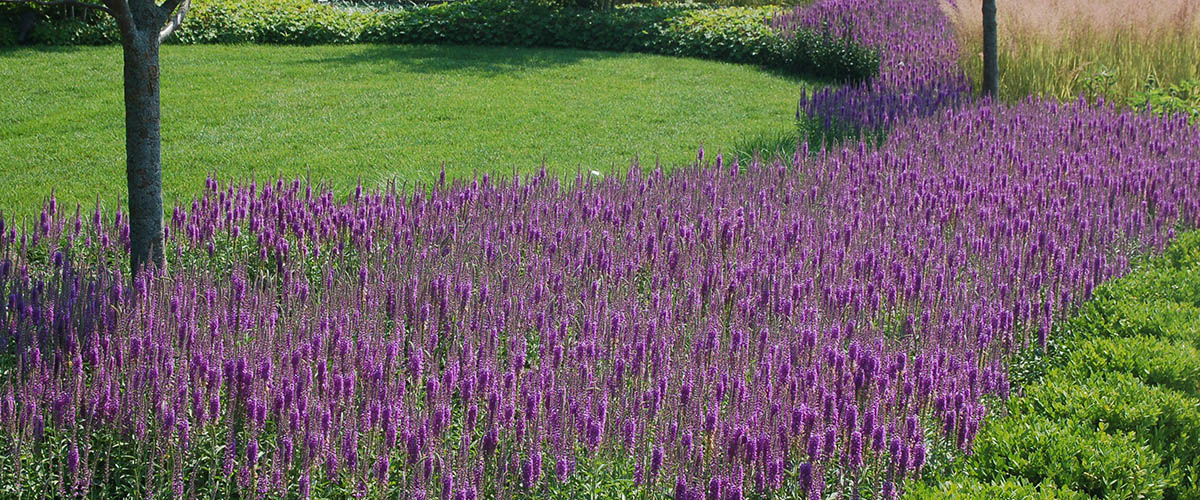
Evaluating Perennials for Chicagoland Gardens
Perennials in Focus is a plant evaluation program that examines new and underused plants for Chicagoland, the third largest metropolitan area in the country. A group of horticultural experts trials and evaluates plants at numerous locations across the region. Results help consumers, public gardens, growers, landscape designers, breeders, and other industry professionals make informed plant choices.
Choosing Perennials for Compacted Urban Soil After Construction
New developments often leave gardens with difficult ground conditions. Heavy machinery compresses soil, buried rubble interrupts drainage, and imported fill may contain little organic matter. A site can look finished while its planting beds remain hostile to roots.
For Australian gardeners, the problem appears in new housing estates, apartment courtyards, streetscapes and renovated commercial landscapes. Clay in Melbourne, sandy fill around Perth and drought-prone urban sites in Adelaide all behave differently, yet compaction creates a common set of stresses: poor aeration, restricted rooting and uneven moisture.
The best perennial choices are not simply the toughest plants on a nursery bench. They need to match the site’s drainage, sun exposure, summer heat, winter wet and expected maintenance. A plant that performs well in a Chicagoland trial may offer useful clues, but local conditions and verified Australian availability still matter.
A disciplined selection process begins with the soil, then considers plant architecture, seasonal performance and resilience over several years. That approach reduces replacement costs and creates planting that settles into its surroundings rather than merely surviving its first season.
Read the site before choosing plants
Start by digging several inspection holes across the proposed bed. Look for compacted layers, builder’s rubble, pale subsoil, buried asphalt or a sharp change between topsoil and fill. A simple test is to push a sturdy screwdriver into moist soil. If it stops abruptly at the same depth, roots may face a compacted pan.
Observe water after rain or irrigation. If puddles remain for a day or more, poor infiltration may be as serious as dryness. Conversely, raised beds made from sandy imported material can drain too quickly and leave plants exposed to heat. A laboratory soil test can clarify pH, salinity, texture and nutrient levels, especially where recycled fill is suspected.
Avoid assuming that adding a thin layer of compost solves the problem. Organic matter placed over dense subsoil can create a perched water zone, while shallow cultivation may leave the main restriction untouched. Where practical, loosen the profile deeply, remove large debris and blend compost through the root zone rather than creating a surface veneer.
Match perennials to the site’s main stress
Compaction creates several stresses at once, but one usually dominates. Waterlogged ground demands plants tolerant of low oxygen around their roots. Dry, tightly packed soil calls for perennials with durable crowns, efficient water use and roots capable of exploiting narrow channels. Hot reflected conditions beside brick or concrete require foliage that tolerates radiant heat.
Perennials with fibrous, spreading root systems often establish more reliably than those with delicate, highly specialised roots. Grasses, sedges and many prairie-style plants can be useful, provided they are suited to the local climate. Deep-rooted herbaceous species may handle restricted surface soil once a pathway through the compacted layer has been opened.
Consider the plant’s mature spread as carefully as its height. Dense planting can shade bare soil and reduce erosion, but overcrowding in a poorly drained bed increases fungal pressure. A measured scheme with groundcovers, mid-height flowering plants and a few structural specimens usually performs better than a crowded collection of unrelated favourites.
Prioritise proven traits over nursery appeal
A flowering perennial may look impressive in a pot while concealing weak crowns, root circling or a short performance window. Seek information about bloom duration, mature size, disease resistance, winter survival and behaviour across different seasons. Trial observations are especially valuable because they reveal how plants perform beyond a single sales photograph.
The program’s history shows why repeated evaluation across gardens and seasons matters. Characteristics such as flower colour, height, spread and bloom period become more useful when recorded under real regional conditions rather than inferred from a catalogue description.
For compacted urban beds, give extra weight to establishment speed, foliage persistence and tolerance of fluctuating moisture. A plant that flowers brilliantly for three weeks but collapses during summer stress may provide less value than a quieter selection with strong foliage and dependable recovery.
Use plant diversity to spread risk
A resilient perennial bed should contain several compatible plant types rather than rely on one supposedly indestructible species. Combine plants with different root depths and seasonal habits so that the planting continues to function if one selection struggles. Include an evergreen or semi-evergreen element where winter appearance matters, along with flowering species that support pollinators.
In Australia, local sourcing affects what is realistic. Melbourne gardeners may find a broad range of hardy perennials through specialist nurseries and autumn plant sales, while Perth gardeners need to check whether a plant can tolerate sandy soil and intense summer heat. In Sydney and Brisbane, humidity and warm-season rainfall make airflow and disease tolerance important.
Native and introduced plants can work together when their water needs align. Kangaroo paw, dianella and lomandra may suit some Australian streetscapes, but they should not be inserted automatically into every compacted bed. Confirm mature size, drainage preference and maintenance requirements before treating a plant as universally reliable.
Improve the soil without smothering the roots
Soil rehabilitation should support planting rather than delay it indefinitely. Remove construction waste, cultivate to an appropriate depth and incorporate mature compost or quality organic soil improver. Gypsum can help some sodic clay soils, but it is not a general-purpose remedy for all compaction, so a soil test should guide its use.
Mulch helps moderate temperature, reduce evaporation and protect the surface from further sealing. Keep it away from crowns and stems, and choose a depth that allows water to reach the soil. On sloping sites, coarse organic mulch can also reduce runoff and splash-borne disease.
Irrigate deeply and less frequently once plants are established, adjusting for local rainfall and soil texture. Newly planted perennials need consistent moisture while roots expand, but permanently saturated beds encourage decline. In water-restricted areas, drip irrigation and hydrozoning can make a significant difference to survival and maintenance costs.
Watch for disease and seasonal weakness
Urban sites often experience irregular watering, reflected heat and poor air movement between walls. These conditions can expose foliage to mildew, rust, leaf spot and crown problems. Inspect plants regularly, remove damaged leaves and avoid overhead irrigation when disease pressure is high.
Seasonal records help distinguish a temporary setback from a poor plant choice. A perennial that suffers in its first summer may recover strongly after roots reach improved soil, while one that repeatedly develops crown rot or collapses after rain should be replaced. Compare performance across more than one season before making broad conclusions.
Rust resistance is one example of a trait worth checking rather than guessing. A useful Rudbeckia trial checklist demonstrates how structured observation can reveal differences between strains during wet periods. The same habit can be applied to compacted beds: record flowering, dieback, disease, water use and recovery.
Build a shortlist for long-term performance
Before purchasing, create a shortlist of plants that meet the site’s basic requirements: suitable light, drainage tolerance, mature dimensions, seasonal interest and realistic availability. Check whether the plant is sold by reputable Australian nurseries and whether its botanical name is consistent across suppliers.
Use the following framework to compare likely candidates. It is a starting point rather than a universal ranking, because cultivar-level performance, microclimate and soil preparation can change the result.
| Plant group | Useful traits | Main caution | Suitable urban use |
|---|---|---|---|
| Hardy ornamental grasses | Fibrous roots, movement, strong structure | Some dislike persistent wetness | Roadsides, courtyards and sunny borders |
| Sedges and moisture-tolerant perennials | Good for damp pockets and filtered light | Can spread beyond intended areas | Rain gardens and shaded beds |
| Rudbeckia and related flowering perennials | Long bloom season and pollinator value | Check disease resistance and summer moisture | Sunny mixed borders |
| Dianella and lomandra | Tough foliage and low irrigation needs | Confirm mature clump size | Australian streetscapes and commercial landscapes |
| Salvia and similar drought-tolerant types | Strong flowering and heat tolerance | Require drainage and can become untidy | Hot borders and raised beds |
| Heuchera and foliage-focused plants | Colourful leaves for partial shade | May struggle in heat or wet crowns | Sheltered courtyards and entry gardens |
Choose three to six plants for a small trial area before committing to an entire development. Label each selection, record planting dates and note how the soil behaves after rain and during hot weather. This modest investment can prevent large-scale replacement and provide evidence suited to the exact site.
Use the findings to refine plant quantities, spacing and maintenance. For public gardens, retailers and landscape professionals, documented performance can also improve future plant specifications. For home gardeners, it turns an uncertain purchase into a practical, observable trial.
Select perennials with the same care used to assess any long-term garden investment: inspect the soil, verify the plant’s traits and observe performance over time. Begin with a small, well-recorded planting, then expand the combinations that establish strongly in your local conditions. That process creates tougher urban gardens with better seasonal interest and fewer costly failures.
In the Garden
Evaluator gardens are located across the Chicagoland area, representing a range of growing conditions. Visit our retail and wholesale partners to find trialled perennials for your own garden.
Retail & Wholesale: Hinsdale Nurseries (Willowbrook, IL), Mariani Nurseries (Kenosha, WI & Garden Prairie, IL), Northwind Perennials (Burlington, WI), The Growing Place (Aurora, IL).
Wholesale Only: Hinsdale Nurseries (Plano, IL), Intrinsic Perennial Gardens (Hebron, IL).
Our Evaluation Program
The 2017–2020 evaluation cycle included Agastache 'Blue Boa', Allium senescens 'Blue Eddy', Amsonia ciliata var. filifolia 'Georgia Pancake', Astilbe 'Chocolate Shogun', Boltonia astroides 'James Crocket', Brunnera 'Alexander's Great', and Geranium cinereum 'Jolly Jewel Purple'. Completed evaluations include Amsonia 'Blue Ice' (2004–07).
On April 10, 2020, the program published snapshot profiles for Vernonia lettermanii 'Iron Butterfly', Stokesia laevis 'Elf', Stachys officinalis 'Pink Cotton Candy', Lobelia 'Monet Moment', Helleborus 'Winter Thrillers', Geum 'Mai Tai', Geranium soboliferum 'Butterfly Kisses', Gentiana x intermedia 'True Blue', Eurybia divaricata, Asparagus 'Purple Passion', and Agastache 'Bolero'.
Browse the full collection of snapshots organized alphabetically — from A–D, E–H, I–Q, and R–Z — to find detailed performance data on perennials trialled across Chicagoland.