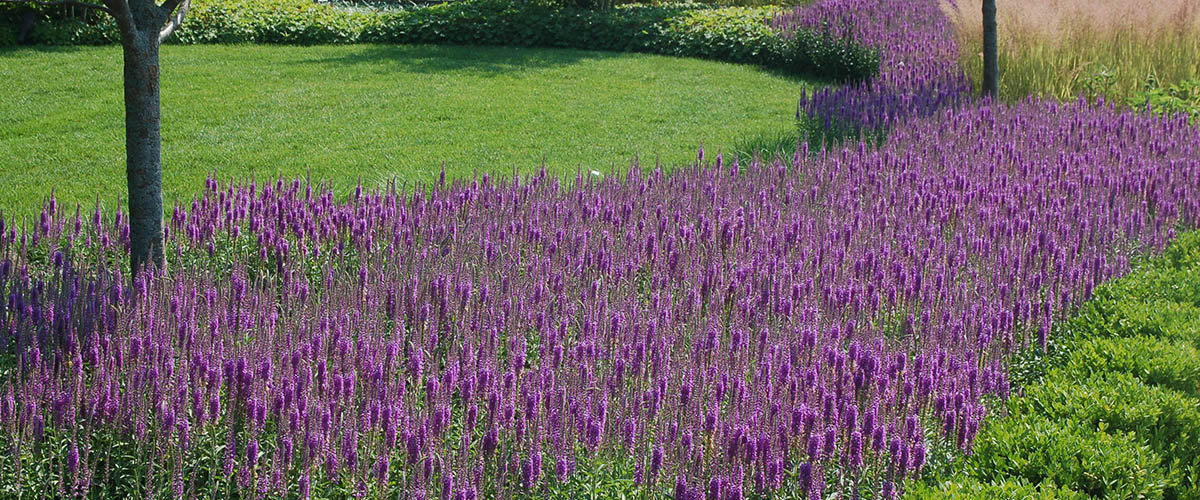
Evaluating Perennials for Chicagoland Gardens
Perennials in Focus is a plant evaluation program that examines new and underused plants for Chicagoland, the third largest metropolitan area in the country. A group of horticultural experts trials and evaluates plants at numerous locations across the region. Results help consumers, public gardens, growers, landscape designers, breeders, and other industry professionals make informed plant choices.
Groundcover steep slopes with sedum and phlox
Establishing plants on a steep slope requires matching them to drainage, aspect and rainfall, then preventing soil movement while their roots develop. This guide explains how to establish a perennial groundcover for steep slopes with sedum and phlox, including where each plant is likely to succeed. The aim is continuous living cover, not a fragile layer of foliage that collapses during the first storm.
Australian conditions demand careful observation. Frost can limit Melbourne’s cooler slopes, Adelaide may experience severe heat and drought, Perth’s sandy soil drains rapidly, and Sydney’s humidity can encourage leaf disease. Intense ultraviolet radiation, irregular winter rainfall, bushfire concerns and council weed rules also influence plant selection. Local nursery advice and on-site testing should outweigh planting recipes from another country.
| Plant | Best site fit | Establishment role | Main concern |
|---|---|---|---|
| Low-growing sedum | Sunny, sharply drained, relatively dry slopes | Forms dense, low cover once rooted; some types carry drought tolerance | Not every sedum is low-growing, compact or suitable for the local climate |
| Creeping or low garden phlox | Cooler sites with reliable moisture and good drainage | Spreads by rooted stems and provides colourful seasonal flowers | May struggle in extreme heat, prolonged humidity or very dry sandy soil |
Read the slope before choosing plants
Assess the whole slope before buying plants. Note its steepest sections, whether bare soil is exposed to wind, where water collects and where runoff crosses the site. Inspect after rain, because channels, sheet erosion and exposed roots reveal more than a sunny planting-day inspection. A groundcover can reduce minor soil movement, but it cannot replace retaining walls, drainage or professional stabilisation on a large, unstable bank.
Check for underground services and overhead hazards before anyone starts digging. Keep people and machinery away from edges that could collapse, especially near dam walls, creek banks and coastal dunes. Contact the relevant utility and council where required, and avoid importing soil that may contain weed seeds, pathogens or excessive clay. Australian councils can apply different restrictions to particular species, so check the local environmental weed list before ordering.
Existing plants are often more useful than the slope’s appearance suggests. Healthy grasses, shrubs or groundcovers already slow water and shade the soil, even when the cover is uneven. Retain useful roots wherever possible, remove only plants that create a maintenance problem, and avoid stripping the slope bare. Soil tests can guide pH correction, but extensive digging on a steep site usually causes more erosion than it solves.
Match sedum and phlox to conditions
Low-growing sedum can provide durable cover on a sunny, freely draining section of a slope. Its ability to tolerate dry periods varies by species and cultivar, however, and a plant labelled drought tolerant still needs regular moisture while its roots become established. Select compact, non-invasive forms that will not smother neighbouring plants. Garden centres and landscape wholesalers may offer several unrelated species simply as sedum, so compare the full botanical name and expected mature size.
Phlox has different requirements. Creeping forms can trail over a stable bank and flower attractively, but garden phlox generally performs best where roots receive reliable moisture without sitting in water. In frost-prone Australian districts it may need a sunny position with cooler root conditions. In warm, humid locations, watch for weak growth or foliar disease and replace failures rather than forcing the plant into an unsuitable microclimate.
Broader perennial evaluation is useful background. A Chicago Vernonia pollinator trial shows how professionals can record bloom, habitat value and performance, yet Chicago’s climate cannot be transferred directly to an Australian slope. Record bloom period, height, spread and survival under local conditions. Sedum and phlox planted from different groups may extend flowering when their growing cycles differ, but only observation will confirm the timing.
Prepare the ground without worsening erosion
Prepare during dry, stable weather. Work in small areas so exposed soil is not left exposed longer than necessary, and walk along established routes rather than trampling the full slope. Loosen compacted planting pockets only as deep as the root ball and avoid turning the entire site. Heavy compost can encourage lush growth without strong roots, while excessive fertiliser may be difficult on nutrient-poor soil and can wash downhill.
On moderate slopes, biodegradable coir or jute matting held by stakes or pegs can hold plants in place and intercept small amounts of moving soil. Secure the lower edge first because it often lifts first. Contour planting, short terraces and small check structures can slow runoff where the design suits the slope, but concentrated water must have a safe outlet. Hard engineering needs correct dimensions and drainage; an improvised dam can redirect a flood toward the property boundary.
Remove perennial weeds before planting because their roots will compete for moisture and become difficult to pull from dense groundcover later. Annual weeds can be controlled carefully until the desired plants close the surface. Do not spray runoff onto neighbouring soil or water. A narrow uncultivated strip along the slope’s base can preserve habitat and intercept sediment without blocking the drainage route.
Plant, water and monitor the cover
Plant healthy plugs or liners from trays rather than relying on scattered seed. Set each plant so its root collar sits at the surrounding soil level, firm gently and water immediately. Use the nursery’s mature-spacing guidance, but place plants closely enough to overlap as they grow. Staggered rows usually provide more even cover than straight lines, while leaving room to reach failures without walking across established plants.
New sedum and phlox may need water two or three times during a hot, windy week even if mature sedum is drought tolerant. Apply water slowly with a hand-held rose or low-flow drip line so it enters the root zone instead of running downhill. Check the soil beneath mulch before watering again. Once roots are holding the surface, water less frequently but deeply enough to encourage useful root development.
Large planting projects must account for supply and access. An overseas summer utility outage schedule from Darnytsia offers no horticultural guidance, but it illustrates how service interruptions can alter daily work. Australian growers should allow for pressure changes, water storage and restricted site access when coordinating planting and maintenance.
Keep a small weed-free opening around each crown while the groundcover establishes. Inspect after storms, high wind and unusually hot weather, recording bare patches, eroded spots, plant loss and unwanted spread. Replace failures early, and avoid repeatedly overwatering a shaded area in the hope that more water will correct the problem. Once coverage closes, stop disturbing the surface and maintain access for checks without compacting it.
Start a small, measurable slope trial
Begin with a representative patch rather than ordering enough plants to cover the entire slope at once. Include correctly labelled sedum selections, a suitable phlox option and a simple untreated control where possible. Mark the plot, take a starting photograph and note the date, soil condition and planting density. These steps make poor performance visible without relying on memory.
Record survival, spread, flower colour, bloom period, mature height and signs of erosion each month during the first growing season. Continue through a second season because Australian rainfall and temperature can produce conditions that hide weaknesses. Take measurements from fixed points, remove weeds by hand and adjust irrigation or spacing only after deciding which factor is limiting performance.
Choose a manageable trial area now, source clearly named plants from an Australian nursery, and inspect the first planting at set intervals. Use the results to expand the slope gradually while retaining an untreated comparison area until the groundcover has proved stable through local weather.
In the Garden
Evaluator gardens are located across the Chicagoland area, representing a range of growing conditions. Visit our retail and wholesale partners to find trialled perennials for your own garden.
Retail & Wholesale: Hinsdale Nurseries (Willowbrook, IL), Mariani Nurseries (Kenosha, WI & Garden Prairie, IL), Northwind Perennials (Burlington, WI), The Growing Place (Aurora, IL).
Wholesale Only: Hinsdale Nurseries (Plano, IL), Intrinsic Perennial Gardens (Hebron, IL).
Our Evaluation Program
The 2017–2020 evaluation cycle included Agastache 'Blue Boa', Allium senescens 'Blue Eddy', Amsonia ciliata var. filifolia 'Georgia Pancake', Astilbe 'Chocolate Shogun', Boltonia astroides 'James Crocket', Brunnera 'Alexander's Great', and Geranium cinereum 'Jolly Jewel Purple'. Completed evaluations include Amsonia 'Blue Ice' (2004–07).
On April 10, 2020, the program published snapshot profiles for Vernonia lettermanii 'Iron Butterfly', Stokesia laevis 'Elf', Stachys officinalis 'Pink Cotton Candy', Lobelia 'Monet Moment', Helleborus 'Winter Thrillers', Geum 'Mai Tai', Geranium soboliferum 'Butterfly Kisses', Gentiana x intermedia 'True Blue', Eurybia divaricata, Asparagus 'Purple Passion', and Agastache 'Bolero'.
Browse the full collection of snapshots organized alphabetically — from A–D, E–H, I–Q, and R–Z — to find detailed performance data on perennials trialled across Chicagoland.