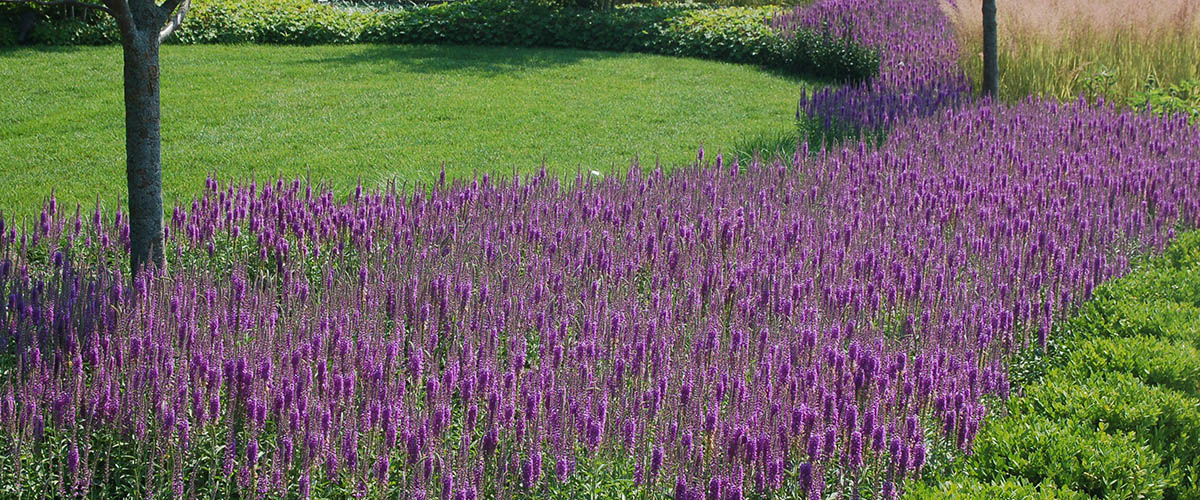
Evaluating Perennials for Chicagoland Gardens
Perennials in Focus is a plant evaluation program that examines new and underused plants for Chicagoland, the third largest metropolitan area in the country. A group of horticultural experts trials and evaluates plants at numerous locations across the region. Results help consumers, public gardens, growers, landscape designers, breeders, and other industry professionals make informed plant choices.
Arrange Perennials by Height for Better Sun in Dense Borders
A dense perennial border can look richly layered, yet still leave half its plants reaching, flopping or flowering sparsely. The usual problem is not a lack of sunlight in the garden as a whole. It is the way taller plants cast shade over shorter neighbours as the sun moves across the sky.
Arranging plants by mature height helps each layer receive useful light. The aim is not a rigid staircase from tallest at the back to shortest at the front, but a planned pattern of height, spacing and seasonal change that keeps foliage and flowers exposed.
For Australian gardeners, the same principle applies across very different conditions, from a Melbourne garden with winter dormancy to a Brisbane border that grows for much longer. Plant performance trials from other regions can guide choices, but the final arrangement should reflect local sun, soil, rainfall and the mature size of each perennial.
Read The Border’s Sun Pattern
Begin by watching the border during the growing season rather than relying only on a plant label saying “full sun”. A north-facing bed usually receives the strongest light in Australia, while a south-facing bed may have cooler, filtered conditions. In Sydney or Brisbane, intense summer light can also scorch foliage, especially beside pale paving or rendered walls.
Mark where shadows fall at 9am, midday and 3pm. The position of the sun changes significantly through the year, and a plant that receives spring sun may be shaded by a taller clump in late summer. Check the effect of fences, pergolas, neighbouring buildings and established shrubs before deciding where the tallest perennials belong.
A simple rule is to place the highest plants where they will cast shadows away from the main viewing area and away from sun-loving plants. In many Australian gardens, that means taller perennials on the southern or south-eastern side of a bed, although the exact answer depends on the border’s orientation and surrounding structures.
Use Mature Height Instead Of Nursery Size
A young perennial in a 140mm pot tells you very little about its eventual role. Use the plant’s mature height and spread, then allow room for its flower stems, arching foliage and seasonal expansion. A plant listed at 1.2 metres may occupy far more visual and physical space once it is in flower.
Divide the border into broad height bands: low plants from 15 to 40 centimetres, medium plants from 40 to 90 centimetres, and tall plants above 90 centimetres. These categories are flexible, but they make it easier to identify gaps where a lower layer is being swallowed by a taller one.
Avoid placing a solid row of tall plants at the rear. Repeat groups of two or three plants, then leave openings where shorter perennials can borrow light. A staggered pattern creates pockets of sun and allows air to move through the planting, which is especially useful in humid coastal areas and during wet summers.
Build A Layered Planting Rhythm
The front edge should contain low mounding or spreading plants, but it should not become a continuous wall of foliage. Leave small windows between clumps so morning and afternoon light can reach the middle layer. Gravel, mulch or low-growing groundcovers can occupy these spaces while plants establish.
Medium-height perennials do the visual connecting work. Place them in groups between the low and tall layers, with some plants pushed forward and others tucked behind. This broken rhythm prevents a flat “short, medium, tall” strip and gives each plant a better chance of receiving angled sunlight.
Use tall plants as accents rather than a permanent backdrop. A few upright stems can provide structure, while airy plants with open branching cast less dense shade than broad, solid leaves. When a tall clump becomes too wide, divide it after dormancy or remove a portion rather than allowing it to dominate the entire bed.
Match Exposure With Plant Behaviour
Height is only one part of light management. Leaf shape, plant habit and bloom timing also determine how much sun reaches neighbouring plants. An upright, narrow plant may be taller but less obstructive than a broad, bushy perennial of the same height.
Some plants tolerate bright light on their flowers but prefer cooler roots. Place these where taller neighbours provide light afternoon shade without blocking morning sun. Moisture-loving plants need extra care: a sunny position can increase evaporation, while dense shade and poor airflow can encourage fungal problems.
When selecting cultivars, look for regional evidence rather than relying solely on catalogue photographs. The evaluation of wetland lobelia findings is useful when considering cardinal flower for a damp, partly shaded position, particularly where height and moisture tolerance must work together.
Plan For Seasonal Changes
A border’s light pattern changes when deciduous trees leaf out, early perennials finish flowering or tall stems are cut back. Map the border across spring, summer and autumn so one successful month does not hide a later problem.
Spring bulbs and early-flowering perennials can occupy spaces beneath plants that emerge late. Once the taller plants develop, the earlier layer may be dormant or naturally fading. This succession makes efficient use of space without forcing every plant to compete for light at the same time.
In cooler parts of Australia, such as the Dandenong Ranges or inland Tasmania, frost and shorter winter days can slow growth. In warmer areas, including Perth and southeast Queensland, long seasons may produce larger clumps sooner than expected. Review the border each year and thin plants before they become a dense canopy.
Space, Stagger And Review
Plant spacing should balance quick coverage with long-term access to light and air. Close planting can suppress weeds, but overcrowding encourages taller stems to lean outward in search of sunlight. Follow the wider end of the recommended spacing range if the site has humid weather, heavy soil or limited airflow.
Use a triangular arrangement rather than straight rows. Three plants set at slightly different depths can share available light more evenly than three plants placed directly behind one another. Repeat the same arrangement at intervals to create cohesion without producing a crowded mass.
The following guide helps translate mature size into a practical border layout. Treat the distances as starting points, then adjust for soil fertility, irrigation and the plant’s actual vigour in your garden.
| Planting Layer | Approximate Mature Height | Placement | Sun-Exposure Strategy |
|---|---|---|---|
| Low | 15–40 cm | Front edge and gaps | Keep open spaces between clumps so light reaches the soil and middle layer |
| Medium | 40–90 cm | Middle and staggered front positions | Use groups with varied widths to prevent a solid shade line |
| Tall | 90 cm–1.8 m | Rear, southern side or scattered accents | Leave openings and avoid placing dense clumps directly south of shorter sun lovers |
| Airy structural plants | 80 cm–1.5 m | Between medium and tall layers | Choose open stems that filter rather than block light |
| Seasonal fillers | Variable | Temporary gaps around emerging plants | Use early or late performers to occupy space before larger perennials peak |
A plant’s reputation for reliability still needs to be matched with the right location. For example, reliable Baptisia selections can provide early-summer vertical interest, but their eventual width and dense foliage should be considered before placing smaller sun-demanding plants directly in front.
In Australian retail nurseries, labels and pot sizes often make a border look easy to fill in one visit. Resist that temptation. Buy for the mature composition, especially when shopping during spring sales or planning a large suburban block in Melbourne, Adelaide or Canberra. A little bare mulch in the first year is usually easier to manage than a border that becomes overcrowded by its third season.
Walk the planting from the direction it will usually be viewed, then inspect it from the opposite side. Prune only when necessary, remove spent stems selectively and divide vigorous clumps when they begin to shade their neighbours. With regular observation, height becomes a tool for distributing sunlight rather than a fixed set of rows.
Choose perennials by mature dimensions, light tolerance and seasonal performance, then test the arrangement over a full year. Explore region-specific trial information, sketch your border’s sun pattern and make the first planting with enough space for every layer to develop.
In the Garden
Evaluator gardens are located across the Chicagoland area, representing a range of growing conditions. Visit our retail and wholesale partners to find trialled perennials for your own garden.
Retail & Wholesale: Hinsdale Nurseries (Willowbrook, IL), Mariani Nurseries (Kenosha, WI & Garden Prairie, IL), Northwind Perennials (Burlington, WI), The Growing Place (Aurora, IL).
Wholesale Only: Hinsdale Nurseries (Plano, IL), Intrinsic Perennial Gardens (Hebron, IL).
Our Evaluation Program
The 2017–2020 evaluation cycle included Agastache 'Blue Boa', Allium senescens 'Blue Eddy', Amsonia ciliata var. filifolia 'Georgia Pancake', Astilbe 'Chocolate Shogun', Boltonia astroides 'James Crocket', Brunnera 'Alexander's Great', and Geranium cinereum 'Jolly Jewel Purple'. Completed evaluations include Amsonia 'Blue Ice' (2004–07).
On April 10, 2020, the program published snapshot profiles for Vernonia lettermanii 'Iron Butterfly', Stokesia laevis 'Elf', Stachys officinalis 'Pink Cotton Candy', Lobelia 'Monet Moment', Helleborus 'Winter Thrillers', Geum 'Mai Tai', Geranium soboliferum 'Butterfly Kisses', Gentiana x intermedia 'True Blue', Eurybia divaricata, Asparagus 'Purple Passion', and Agastache 'Bolero'.
Browse the full collection of snapshots organized alphabetically — from A–D, E–H, I–Q, and R–Z — to find detailed performance data on perennials trialled across Chicagoland.