Evaluating Perennials for Chicagoland Gardens
Perennials in Focus is a plant evaluation program that examines new and underused plants for Chicagoland, the third largest metropolitan area in the country. A group of horticultural experts trials and evaluates plants at numerous locations across the region. Results help consumers, public gardens, growers, landscape designers, breeders, and other industry professionals make informed plant choices.
Cardinal flower in Chicagoland’s partially shaded wetlands
Lobelia cardinalis, commonly called cardinal flower, brings an intense red display to places where many garden perennials lose vigor. Its upright stems and tubular blooms are especially valuable in damp borders, rain gardens, woodland edges, and the margins of ponds or streams. In the Chicagoland region, however, success depends on more than planting in shade. Moisture, soil texture, winter exposure, and seasonal water levels all influence its performance.
Perennials in Focus evaluates plants across multiple gardens and growing seasons, making regional observations more useful than a single nursery description. For cardinal flower, the central question is how reliably it can produce strong foliage, durable stems, and late-summer flowers in partially shaded wetlands without requiring constant correction from the gardener.
The results are most relevant to homeowners, landscape designers, growers, retailers, and public gardens seeking a native perennial with ecological value and visual impact. They also show why plant selection should account for the exact conditions of a site rather than relying on a broad label such as “shade perennial.”
Growth habit and visual character
Cardinal flower forms a clump of narrow, lance-shaped leaves, often arranged along upright stems that rise well above the surrounding vegetation. In favorable conditions, plants commonly reach about two to four feet tall, although height varies with fertility, moisture, competition, and the age of the planting. The vertical structure gives definition to low wetland plantings that may otherwise appear flat.
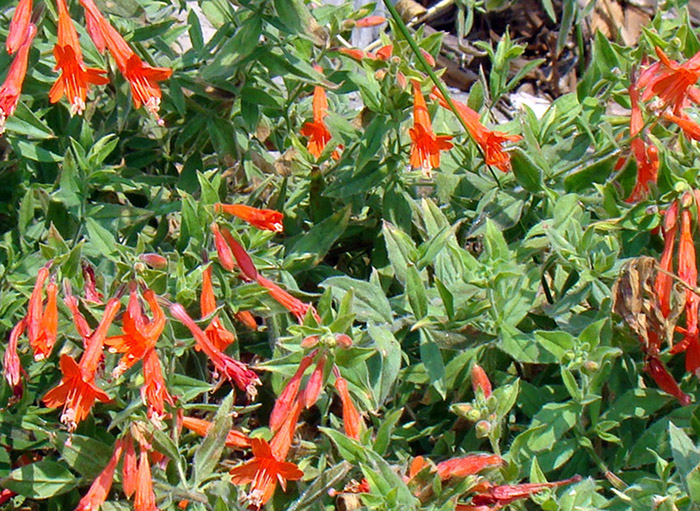
Brilliant scarlet-red flowers open progressively along the upper stems from mid to late summer. Their tubular shape is well suited to hummingbird pollination, while the saturated color remains visible in filtered light. The flowers can be especially striking against sedges, ferns, goldenrods, and the dark foliage of wet woodland companions.
The species often behaves as a short-lived perennial in cultivation. Individual rosettes may decline after flowering, but cardinal flower can persist through self-seeding when seed heads are allowed to mature and nearby soil remains open enough for seedlings to establish. This life cycle is a performance characteristic rather than a defect: a stable population may depend on recruitment as much as on the survival of each original plant.
Moisture, shade, and soil conditions
Part shade is usually the most dependable exposure in the Chicago area. Two to six hours of direct sunlight, especially morning or filtered light, can support sturdy stems and abundant flowers. Dense, dry shade may produce thin growth and reduced flowering, while hot afternoon sun can cause stress if the soil surface dries quickly.
Consistent moisture is the defining requirement. Cardinal flower performs well in rich, moisture-retentive soil beside a downspout, in a rain garden’s lower zone, or along a pond edge that remains damp rather than permanently submerged. It tolerates periodically saturated ground, but prolonged standing water around the crown can reduce longevity and encourage rot.
Organic matter improves moisture retention, yet drainage still matters. Heavy clay may hold water effectively but can become airless when compacted. Incorporating compost into a broad planting area and avoiding foot traffic around the root zone can help. Mulch should conserve moisture without burying the crown, and irrigation is valuable during establishment and during extended summer dry spells.
Flowering performance through the season
The strongest ornamental moment generally arrives after many spring woodland plants have finished and before autumn color dominates the garden. In the Chicago region, flowering may begin in July and continue into August or early September, depending on spring temperatures, available moisture, and the plant’s position in the garden. Plants receiving bright filtered light often flower more heavily than those in deep shade.
Stem strength is closely connected to site quality. Cardinal flower grown in fertile, evenly moist soil tends to form fuller clumps and hold its flower spikes upright. Plants under drought stress may flower briefly, develop shorter stems, or show premature leaf decline. Excessive nitrogen can create lush foliage at the expense of a balanced flowering display, so soil improvement is preferable to routine high-nitrogen feeding.
Deadheading can extend the display modestly and prevent unwanted seed dispersal, but removing every spent flower eliminates a useful method of natural renewal. In designed landscapes, leaving several stems to mature supports self-sowing and provides subtle winter structure. A mixed approach—deadheading some stems while preserving others—often suits both appearance and long-term persistence.
Regional performance compared with common companions
Cardinal flower works best as part of a layered planting rather than as an isolated specimen. Its narrow upright form contrasts with the rounded leaves of water-loving perennials and the fine texture of sedges. Good companions may include swamp milkweed, blue flag iris, turtlehead, marsh marigold, royal fern, and moisture-tolerant native grasses.
Plant spacing should reflect the expected spread of approximately one to two feet, with enough room for air movement and seedling development. A group of three or more plants creates a clearer visual signal than a single specimen, while staggered placement can make the flower spikes appear naturally distributed along a wetland edge.
Selecting reliable plants for a difficult regional site requires the same careful comparison used for other perennials that may struggle in Chicago’s climate. The discussion of phlox alternatives illustrates why disease pressure, humidity, winter conditions, and site exposure should shape plant choices. Cardinal flower has its own requirements, but the principle is similar: regional performance matters more than a plant’s reputation in another climate.
| Characteristic | Cardinal flower in suitable part shade | Cardinal flower in unsuitable conditions |
|---|---|---|
| Soil moisture | Evenly moist to seasonally wet | Dry for long periods or permanently flooded |
| Light | Filtered light or morning sun | Dense shade or intense afternoon exposure |
| Flowering | Strong red display in mid to late summer | Sparse, shortened, or delayed bloom |
| Plant form | Upright stems with a substantial basal clump | Weak stems, thin foliage, or crown decline |
| Long-term persistence | Supported by moisture and occasional self-seeding | Reduced by drought, competition, or poor drainage |
| Maintenance | Supplemental water during dry spells; selective deadheading | Frequent rescue watering or replacement |
Establishment and maintenance in wetland gardens
Planting in spring or early summer gives cardinal flower time to develop roots before winter. Water deeply after planting, then maintain steady moisture while the root system expands. A two- to three-inch layer of leaf mold or compost-based mulch can moderate soil temperature and reduce evaporation, provided it remains clear of the crown.
Weeding is particularly important during the first year. Young cardinal flower plants can be overwhelmed by aggressive ground covers, reed canary grass, or volunteer shrubs that compete for water and light. Once established, the plants become more visible and easier to manage, but regular observation remains worthwhile in a rain garden where moisture patterns can change after grading or nearby construction.
Cutting back old stems in late winter or early spring protects overwintering insects and allows seed to fall naturally. If seedlings appear in inconvenient places, they can be moved while small, as long as the new location is kept evenly moist. Division is possible, though it is usually less important than allowing healthy plants to renew themselves from seed.
Using the plant for habitat and design
The scarlet flowers are a valuable nectar source for hummingbirds and attract other pollinators with their tubular form. Cardinal flower can strengthen a habitat planting by adding a late-season nectar window, especially when paired with native species that provide earlier and later blooms. Its ecological contribution increases when the surrounding garden avoids routine insecticide use and includes sheltering foliage.
In formal landscapes, the plant can mark a drainage swale, frame a shaded path, or create a vivid accent beside a water feature. Its color is strong enough to function as a focal point, so repetition through a drift or small colony usually looks more intentional than scattering isolated plants throughout a border.
Designers should also plan for seasonal change. Cardinal flower may look modest before flowering and less tidy after seed production. Positioning it among plants with attractive foliage, seed heads, or evergreen structure keeps the planting compelling outside its peak bloom period. This approach reflects the full performance of the perennial rather than judging it only during August.
Practical recommendations for growers and gardeners
- Choose a location with filtered light or morning sun and soil that stays consistently moist.
- Improve compacted ground with organic matter across the planting area rather than placing rich material in a small hole.
- Water new plants regularly during their first growing season and during prolonged summer drought.
- Leave some flower stems to produce seed, while deadheading selected stems to maintain a tidy appearance.
- Pair cardinal flower with native wetland companions that offer contrasting texture, height, and bloom timing.
Regional trials can help determine whether a planting site is genuinely suitable, especially when water levels fluctuate from season to season. Record bloom dates, final height, spread, self-sowing, and winter survival over several years; these observations reveal patterns that a single season may conceal.
For a resilient Chicagoland garden, start with one well-chosen moist, partially shaded location and monitor it through the growing season. Use the resulting observations to refine spacing, companion plants, and maintenance, then expand cardinal flower where its strong color and wetland value can perform at their best.
In the Garden
Evaluator gardens are located across the Chicagoland area, representing a range of growing conditions. Visit our retail and wholesale partners to find trialled perennials for your own garden.
Retail & Wholesale: Hinsdale Nurseries (Willowbrook, IL), Mariani Nurseries (Kenosha, WI & Garden Prairie, IL), Northwind Perennials (Burlington, WI), The Growing Place (Aurora, IL).
Wholesale Only: Hinsdale Nurseries (Plano, IL), Intrinsic Perennial Gardens (Hebron, IL).
Our Evaluation Program
The 2017–2020 evaluation cycle included Agastache 'Blue Boa', Allium senescens 'Blue Eddy', Amsonia ciliata var. filifolia 'Georgia Pancake', Astilbe 'Chocolate Shogun', Boltonia astroides 'James Crocket', Brunnera 'Alexander's Great', and Geranium cinereum 'Jolly Jewel Purple'. Completed evaluations include Amsonia 'Blue Ice' (2004–07).
On April 10, 2020, the program published snapshot profiles for Vernonia lettermanii 'Iron Butterfly', Stokesia laevis 'Elf', Stachys officinalis 'Pink Cotton Candy', Lobelia 'Monet Moment', Helleborus 'Winter Thrillers', Geum 'Mai Tai', Geranium soboliferum 'Butterfly Kisses', Gentiana x intermedia 'True Blue', Eurybia divaricata, Asparagus 'Purple Passion', and Agastache 'Bolero'.
Browse the full collection of snapshots organized alphabetically — from A–D, E–H, I–Q, and R–Z — to find detailed performance data on perennials trialled across Chicagoland.