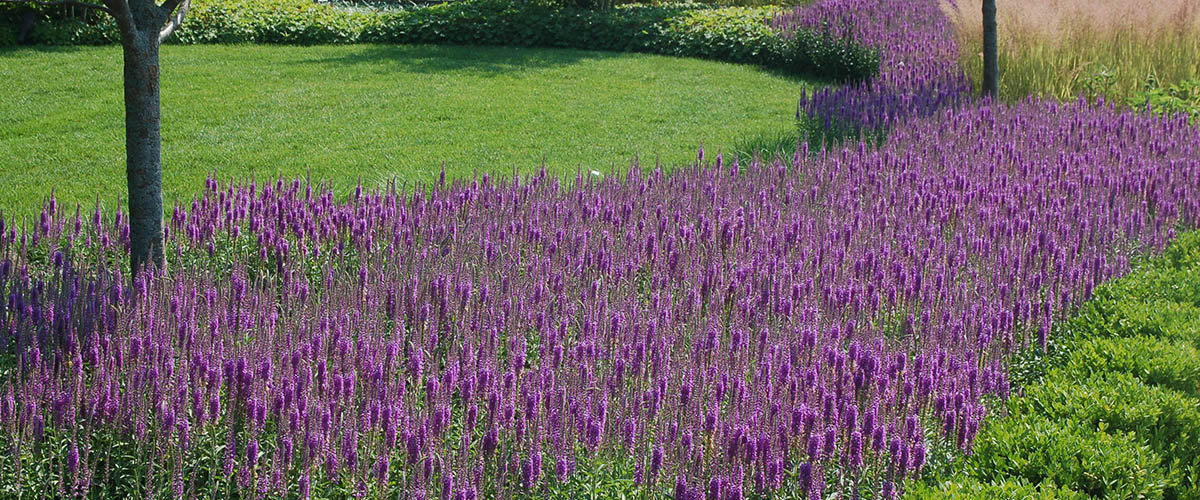
Evaluating Perennials for Chicagoland Gardens
Perennials in Focus is a plant evaluation program that examines new and underused plants for Chicagoland, the third largest metropolitan area in the country. A group of horticultural experts trials and evaluates plants at numerous locations across the region. Results help consumers, public gardens, growers, landscape designers, breeders, and other industry professionals make informed plant choices.
Comparing Coreopsis Tripteris Establishment in Clay Soil
Coreopsis tripteris, commonly called tall tickseed, is a substantial North American perennial with fine foliage, branching stems and yellow daisy flowers. It can bring height and late-season colour to a planting, yet its success from seed depends heavily on the soil’s physical condition. In dense clay, the difference between germination and a well-established plant may be considerable.
For gardeners and professionals assessing plants for regional use, seedling establishment rates offer more useful information than a simple germination percentage. A seed may sprout successfully, then fail because the soil crusts, stays saturated or restricts young roots. A carefully designed comparison can show whether tall tickseed deserves a place in heavy soils, and which preparation methods give it the fairest chance.
Why Tall Tickseed Deserves Close Evaluation
Coreopsis tripteris is valued for its upright habit, airy texture and extended flowering period. Mature plants can provide structure at the rear of a border or in a naturalistic meadow, while their open flowers support pollinating insects. These qualities make the species relevant to public gardens, larger residential landscapes and growers seeking less familiar perennial lines.
Its performance is not determined by flower display alone. The plant must first pass through several vulnerable stages: seed imbibition, emergence, early root development and survival through the first wet or dry cycle. The collaborative evaluation team approach is useful here because repeated observations across gardens can reveal whether a result reflects the plant or one unusually favourable site.
A clay-soil trial is especially valuable because many garden beds contain compacted subsoil rather than a carefully amended growing medium. Results from loose nursery mix may therefore overstate how reliably seedlings will establish after direct sowing or transplanting.
Define Establishment Before Counting Plants
Germination is the appearance of a root or shoot from a seed. Emergence is the point at which a seedling becomes visible above the soil surface. Establishment should be defined more strictly: for example, a seedling that remains alive, produces several true leaves and develops a stable root system after a set period.
A useful study might record emergence at 14 and 28 days, survival at eight weeks, and plant size at the end of the first growing season. Height, leaf number, root mass and the percentage of seedlings surviving a wet period can add context. Recording only the number of sprouts risks favouring a treatment that produces quick but fragile seedlings.
Consistency is essential. Count each plot in the same way, exclude damaged labels from the analysis and record weather, irrigation and soil moisture. Photographs taken from the same angle can help verify written observations, particularly where growth differences are subtle.
How Clay Soil Alters Early Growth
Clay particles are tiny and pack closely together. When wet, clay can hold water around emerging roots and reduce oxygen. When it dries, it may form hard clods or a surface crust that blocks shoots. These conditions can make establishment uneven, with seedlings appearing in small clusters where cracks or pockets of air have formed.
Clay is not automatically unsuitable. It can retain nutrients and moisture for longer than sandy soil, which may benefit seedlings during hot weather. The key variables are structure, compaction, drainage and organic activity. A friable clay loam with surface mulch is very different from a trafficked, waterlogged clay pan.
Treatments should therefore be described precisely. “Clay soil” is too broad unless the trial records texture, pH, drainage class, organic matter and bulk density. Even a simple penetrometer reading or note about how long water remains after rain can make the findings more transferable.
Build A Fair Seedling Comparison
A sound comparison uses the same seed lot, sowing depth, seed quantity, plot size and watering schedule. Replicated plots are preferable to a single bed because clay often varies over short distances. Randomly assigning treatments prevents one method from receiving the best position near a path, downpipe or sheltering wall.
Potential treatments could include undisturbed clay, a shallow compost incorporation, a raised planting strip and a thin surface mulch. Avoid creating a completely different soil profile if the purpose is to assess ordinary garden conditions. Excessive sand or rich potting mix may improve results while making the treatment irrelevant to the intended landscape.
The timing of sowing also matters. In regions with cold winters, a comparison may include natural winter exposure and controlled spring sowing. In Australia, the same seed source may encounter a different seasonal rhythm, so trial notes should distinguish cold stratification, outdoor weathering and any pre-sowing treatment.
Separate Seed Quality From Soil Performance
Variation in seed age, storage and maturity can overwhelm the effect of clay. Use seed from one well-labelled batch where possible, and test a small sample in a reliable, free-draining medium. That baseline gives an estimate of the seed lot’s potential before soil conditions are blamed for poor results.
Data storage deserves equal care. A spreadsheet should preserve the treatment name, replicate, sowing date, emergence count, mortality and observations about crusting or standing water. International readers may encounter unrelated administrative material while researching horticulture, such as this child passport guide; keeping sources and records clearly separated prevents accidental confusion in a shared project archive.
Statistical analysis need not be elaborate. Compare the proportion established in each replicate, report the average and show the range. If one treatment produces 70 per cent establishment in one plot and 25 per cent in another, that inconsistency is itself important evidence for gardeners managing variable clay.
Interpret Results For Australian Gardens
Australian conditions add several practical considerations. In Melbourne and Canberra, cool-season sowing may expose seeds to winter moisture and low temperatures, while Brisbane or Sydney gardeners may contend with warm soils, intense rainfall events and rapid drying at the surface. A method that works in a cool clay loam may behave differently under subtropical summer conditions.
Water restrictions and everyday watering habits also affect outcomes. Gardeners may water early in the morning, use drip systems or rely on rainfall rather than maintaining a constantly damp seedbed. Trials should record whether irrigation was frequent and light or less frequent and deep, since both influence crusting and root development.
Before recommending seed or plants for sale, check Australian import requirements through the Department of Agriculture, Fisheries and Forestry’s BICON system, along with state or territory weed and biosecurity rules. Retail availability varies between local independent nurseries, specialist native and perennial growers, and large chains. A cultivar that performs well in a trial still needs lawful sourcing and a realistic supply chain.
Turn Trial Data Into Planting Decisions
The best treatment is not necessarily the one with the tallest seedlings. A slightly slower treatment may produce sturdier roots, fewer losses during dry weather and better flowering in the second year. Establishment data should therefore be read alongside mature height, spread, flowering time, lodging resistance and maintenance requirements.
Comparisons with other perennial evaluations can help explain site-specific performance. For example, shade-trial findings for hosta cultivars in heavy shade illustrate why a plant’s success must be linked to the conditions being tested rather than reduced to a single ranking. Tall tickseed needs a different interpretation: its value may lie in sun, vertical form and tolerance of heavier ground, not shade performance.
The following framework can help translate observations into recommendations for growers, landscape designers and home gardeners.
| Measurement | What It Shows | Useful Interpretation |
|---|---|---|
| Emergence at 14 days | Speed of early development | Indicates rapid response, not dependable survival |
| Emergence at 28 days | Total visible seedlings | Reveals delayed emergence caused by crusting or cool soil |
| Survival at eight weeks | Early establishment | Stronger basis for comparing clay treatments |
| True-leaf number | Seedling vigour | Helps separate weak survivors from robust plants |
| Root condition | Soil compatibility | Healthy, branched roots suggest better transplant potential |
| First-season flowering | Longer-term performance | Shows whether early establishment leads to useful garden value |
For a practical recommendation, combine the establishment percentage with site notes. A result of 60 per cent survival may be acceptable where seed is inexpensive and direct sowing is easy, but less attractive for commercial production requiring uniform plugs. Conversely, moderate establishment with strong first-year growth may suit a naturalistic planting where variation is desirable.
Use the same framework across several seasons and sites, then publish the raw counts as well as the summary. Gardeners in Perth, Adelaide, Sydney, Melbourne and regional areas can judge whether the soil, rainfall and management resemble their own conditions. That makes the findings more useful than a broad claim that Coreopsis tripteris either “likes” or “dislikes” clay.
Record a seedling trial this season with replicated plots, clear establishment criteria and honest notes on moisture, compaction and weather. Share the results with growers, garden professionals and local plant evaluators so tall tickseed can be assessed on dependable performance rather than appearance alone.
In the Garden
Evaluator gardens are located across the Chicagoland area, representing a range of growing conditions. Visit our retail and wholesale partners to find trialled perennials for your own garden.
Retail & Wholesale: Hinsdale Nurseries (Willowbrook, IL), Mariani Nurseries (Kenosha, WI & Garden Prairie, IL), Northwind Perennials (Burlington, WI), The Growing Place (Aurora, IL).
Wholesale Only: Hinsdale Nurseries (Plano, IL), Intrinsic Perennial Gardens (Hebron, IL).
Our Evaluation Program
The 2017–2020 evaluation cycle included Agastache 'Blue Boa', Allium senescens 'Blue Eddy', Amsonia ciliata var. filifolia 'Georgia Pancake', Astilbe 'Chocolate Shogun', Boltonia astroides 'James Crocket', Brunnera 'Alexander's Great', and Geranium cinereum 'Jolly Jewel Purple'. Completed evaluations include Amsonia 'Blue Ice' (2004–07).
On April 10, 2020, the program published snapshot profiles for Vernonia lettermanii 'Iron Butterfly', Stokesia laevis 'Elf', Stachys officinalis 'Pink Cotton Candy', Lobelia 'Monet Moment', Helleborus 'Winter Thrillers', Geum 'Mai Tai', Geranium soboliferum 'Butterfly Kisses', Gentiana x intermedia 'True Blue', Eurybia divaricata, Asparagus 'Purple Passion', and Agastache 'Bolero'.
Browse the full collection of snapshots organized alphabetically — from A–D, E–H, I–Q, and R–Z — to find detailed performance data on perennials trialled across Chicagoland.