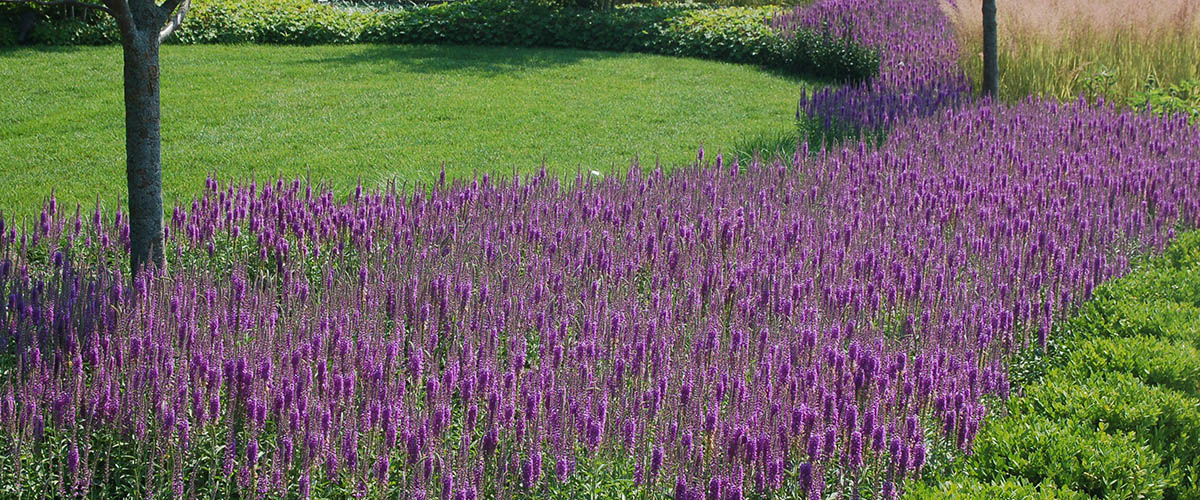
Evaluating Perennials for Chicagoland Gardens
Perennials in Focus is a plant evaluation program that examines new and underused plants for Chicagoland, the third largest metropolitan area in the country. A group of horticultural experts trials and evaluates plants at numerous locations across the region. Results help consumers, public gardens, growers, landscape designers, breeders, and other industry professionals make informed plant choices.
Tiarella Cordifolia And Tiarella Wherryi As Groundcovers
Foamflower, or Tiarella, is valued for its patterned foliage, airy flower spikes and ability to brighten shaded garden spaces. Yet different species create very different groundcover effects. Tiarella cordifolia generally travels through surface runners, while Tiarella wherryi is more likely to form a restrained clump.
That distinction matters when choosing plants for a woodland edge, courtyard border or cool-climate garden. Findings from regional evaluations such as Perennials in Focus can help gardeners compare habit, seasonal performance and landscape usefulness rather than relying on a catalogue photograph alone.
Spreading Habit And Colony Formation
Tiarella cordifolia is the more assertive groundcover of the two. It produces slender stolons that extend from the crown and root at intervals, gradually creating a connected colony. Given consistent moisture and humus-rich soil, several plants can knit together into a low, leafy carpet.
Tiarella wherryi usually has a clumping growth habit. Its crowns expand slowly from the base, but it generally lacks the long, obvious runners associated with T. cordifolia. This makes it easier to keep within a defined planting pocket, although it will take longer to cover bare soil.
The difference is useful in practical design. Cordifolia suits gardeners wanting a naturalised drift beneath deciduous trees, while wherryi is better where individual plants, edging lines or mixed shade borders need clearer spacing.
Height, Width And Ground-Level Coverage
Both species remain relatively low, with foliage commonly forming a mound around 20 to 30 centimetres tall. Flower stems rise above the leaves in spring, often reaching approximately 30 to 45 centimetres depending on soil, moisture and the selected form.
The mature width is less predictable than the height. Tiarella cordifolia can spread well beyond the original planting point as its runners root, eventually filling gaps between hostas, ferns and woodland grasses. Its foliage provides stronger horizontal coverage once a colony becomes established.
Tiarella wherryi tends to stay closer to a rounded crown, often spreading to roughly 30 to 45 centimetres over time. It offers ground-level presence without the same tendency to wander, making it useful beside paths or among slower-growing companion plants.
Foliage And Flowering Performance
Cordifolia commonly carries heart-shaped, softly lobed leaves in green shades, with some selections showing burgundy markings or darker central veining. The foliage is a major part of its groundcover value because it remains attractive outside the flowering period and helps conceal soil between larger perennials.
Wherryi often presents more deeply cut or sharply lobed leaves, creating a finer texture. Depending on the cultivar, the foliage may show bronze, purple or chocolate markings, particularly in spring or in bright filtered light. These contrasting leaf shapes can make a clumping planting appear more detailed than a broad carpet.
Both produce upright racemes of small white to pale pink flowers. Their blooms are delicate rather than showy from a distance, but they attract attention close up and provide a useful seasonal lift before many summer perennials reach full size.
Climate And Soil Considerations
Tiarella prefers cool, shaded conditions with reliable moisture and soil containing plenty of organic matter. It performs best where the ground is moist but not waterlogged, with protection from harsh afternoon sun and drying winds. A mulch of composted leaf material can help maintain even moisture around the crowns.
Australian conditions require careful site selection. In Melbourne or the cooler parts of Tasmania, a sheltered southern or eastern exposure may provide a suitable summer environment, particularly where winter rainfall keeps the soil active. In Sydney, plants may need protection from hot western sun, while Brisbane gardens can find the combination of heat and humidity difficult unless the site is exceptionally cool and well drained.
Neither species should be treated as a carefree substitute for drought-tolerant native groundcovers in Adelaide or inland districts. Irrigation, deep organic soil and shade from trees or structures are important for maintaining foliage quality through Australian summer weather.
Maintenance And Control
Tiarella cordifolia needs occasional boundary management in small gardens. Its runners are not usually aggressive in the manner of a rampant vine, but they can move into neighbouring perennials or across stepping-stone joints. Lift and divide rooted offsets in spring or early autumn when a colony begins to exceed its allotted space.
Wherryi requires less control because its expansion is primarily crown-based. Division is still useful when the centre becomes congested or when new plants are needed, but the process is slower and produces fewer naturally rooted offsets than cordifolia.
Both benefit from removing tired flower stems after blooming and clearing damaged leaves at the end of winter. Good airflow reduces the likelihood of foliar problems, while avoiding overhead watering helps keep the foliage clean in humid conditions.
Landscape Uses And Plant Partnerships
Use Tiarella cordifolia where a soft, spreading layer is desirable. It works beneath deciduous trees, along shaded paths and at the front of a woodland-style border. Pair it with hardy ferns, heucheras, pulmonarias, hostas and low-growing sedges for a layered planting with varied leaf shape.
Tiarella wherryi is more effective as a repeated clump or as a detailed foreground plant. It can sit between larger perennials without quickly engulfing them, and its patterned foliage provides contrast against plain green leaves. In a Melbourne courtyard or a shaded Sydney garden, several plants spaced evenly can create rhythm without looking like a single undifferentiated mass.
Container culture is possible where drainage and moisture can be controlled, though shallow pots dry rapidly. The broader lesson from other perennial evaluations, including trials of compact hibiscus hybrids, is that mature dimensions and growing conditions should guide plant selection rather than the label alone.
Choosing Between The Two Species
The best choice depends on whether the planting needs movement or restraint. Cordifolia is generally the stronger candidate for filling space, suppressing exposed soil and producing a connected groundcover colony. It is especially useful when the gardener is prepared to redirect runners or divide the planting periodically.
Wherryi is preferable when a slower, more composed habit matters. It leaves more room for companion plants, offers strong foliage texture and is easier to position precisely. Its slower coverage can be an advantage in a designed border, even though it may require more plants to achieve a full effect.
Performance will vary among cultivars, nursery selections and sites. Check the expected mature spread, observe how much summer moisture the garden can provide, and favour plants that have been assessed in conditions resembling the intended landscape.
| Characteristic | Tiarella cordifolia | Tiarella wherryi |
|---|---|---|
| Primary habit | Spreading, stolon-forming colony | Clump-forming perennial |
| Groundcover speed | Usually faster once established | Generally slower |
| Mature spread | Can extend beyond the original crown | Usually remains near the planted crown |
| Foliage effect | Broad, heart-shaped leaves; often patterned | More finely lobed leaves; often strongly marked |
| Best landscape role | Naturalised drifts and broad shade cover | Defined clumps and mixed shade borders |
| Maintenance | Divide or redirect runners when needed | Occasional division for crown renewal |
| Australian suitability | Best in cool, moist, protected sites | Best in cool, moist, protected sites with room for slower fill |
For a spreading woodland carpet, start with Tiarella cordifolia and allow space for its stolons to work. For a measured planting with clearer boundaries, choose Tiarella wherryi. Compare regional trial observations, inspect available cultivars through local nurseries, and place the plants where shade, moisture and soil conditions support long-term performance.
In the Garden
Evaluator gardens are located across the Chicagoland area, representing a range of growing conditions. Visit our retail and wholesale partners to find trialled perennials for your own garden.
Retail & Wholesale: Hinsdale Nurseries (Willowbrook, IL), Mariani Nurseries (Kenosha, WI & Garden Prairie, IL), Northwind Perennials (Burlington, WI), The Growing Place (Aurora, IL).
Wholesale Only: Hinsdale Nurseries (Plano, IL), Intrinsic Perennial Gardens (Hebron, IL).
Our Evaluation Program
The 2017–2020 evaluation cycle included Agastache 'Blue Boa', Allium senescens 'Blue Eddy', Amsonia ciliata var. filifolia 'Georgia Pancake', Astilbe 'Chocolate Shogun', Boltonia astroides 'James Crocket', Brunnera 'Alexander's Great', and Geranium cinereum 'Jolly Jewel Purple'. Completed evaluations include Amsonia 'Blue Ice' (2004–07).
On April 10, 2020, the program published snapshot profiles for Vernonia lettermanii 'Iron Butterfly', Stokesia laevis 'Elf', Stachys officinalis 'Pink Cotton Candy', Lobelia 'Monet Moment', Helleborus 'Winter Thrillers', Geum 'Mai Tai', Geranium soboliferum 'Butterfly Kisses', Gentiana x intermedia 'True Blue', Eurybia divaricata, Asparagus 'Purple Passion', and Agastache 'Bolero'.
Browse the full collection of snapshots organized alphabetically — from A–D, E–H, I–Q, and R–Z — to find detailed performance data on perennials trialled across Chicagoland.