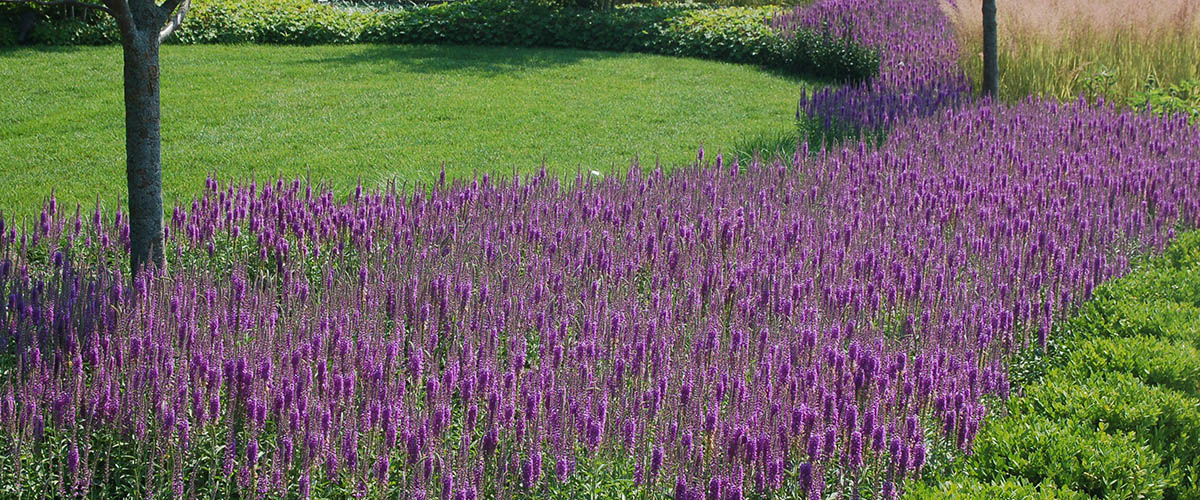
Evaluating Perennials for Chicagoland Gardens
Perennials in Focus is a plant evaluation program that examines new and underused plants for Chicagoland, the third largest metropolitan area in the country. A group of horticultural experts trials and evaluates plants at numerous locations across the region. Results help consumers, public gardens, growers, landscape designers, breeders, and other industry professionals make informed plant choices.
Best Perennials for Green Infrastructure Parkways
Parkways beside footpaths, often called nature strips in Australia, can do much more than separate traffic from homes. With careful grading and planting, they can slow stormwater from pavements, filter sediment, support pollinators and create a cooler, more attractive street edge.
The strongest planting schemes combine dependable perennials with well-designed soil and drainage. Plants need to tolerate brief inundation when rain arrives, then cope with drying, reflected heat, compacted ground and occasional foot traffic. A plant that looks excellent in a garden bed may fail beside a kerb if its roots remain waterlogged or its crown is repeatedly disturbed.
Perennials in Focus offers useful regional trial information from the Chicagoland area, where plants are assessed over multiple seasons for traits such as flowering time, height, spread and garden performance. Australian designers can use those observations as a starting point, then test selections against local rainfall patterns, soil types, council standards and the realities of suburban maintenance.
Why Parkways Need Purpose-Built Planting
A runoff-capture verge usually includes a shallow swale, kerb opening, raingarden or depressed planting bed. During a storm, water moves from the footpath and roadway into the planted area, where mulch, roots and engineered soil help slow and clean it before it enters the drainage network.
This setting creates a demanding cycle. The bed may be saturated for several hours after a summer storm, yet become dry and hot a week later. In Melbourne, a nature strip may face cool winters and dry summers; in Brisbane, intense wet-season downpours can arrive alongside high humidity. Sydney sites may also contend with shallow sandstone-derived soils, while Adelaide gardens often need exceptional drought tolerance.
A sound planting palette therefore includes species with fibrous roots, sturdy crowns and flexible stems. Plants with a long flowering period are valuable, but survival, recovery and manageable spread matter just as much. Hardware also deserves attention: kerb inlets, grates and other fabricated components must remain secure under changing loads, and engineers reviewing lead-angle tolerance can help resolve details where clamping reliability affects public safety.
Match Plants To The Water Regime
Divide the planting area into hydrological zones rather than treating the whole verge as one bed. The lowest point should contain plants that accept temporary wet feet. The shoulder and upper edge need species that prefer free drainage and can withstand radiant heat from concrete or bitumen.
For lower zones, robust moisture-tolerant perennials such as Monarda, Iris, Physostegia and selected sedges can provide structure where water collects briefly. In Australian conditions, local alternatives may include Lomandra cultivars, Dianella, Carex, Juncus and some moisture-tolerant native wildflowers, depending on the region and soil profile. Native plants are not automatically suited to inundation, so confirm their response to both flooding and drought.
Upper slopes can carry plants such as Salvia nemorosa, Nepeta, Rudbeckia, Echinacea and ornamental grasses where drainage is sharper. In warmer Australian districts, these should be trialled carefully, with heat-tolerant local species added where imported perennials struggle through summer.
Build A Layered Pollinator Palette
A visually successful stormwater verge should offer flowers across several months rather than producing one brief flush. Early-season bulbs or low perennials can be followed by salvias, Monarda, coneflowers, asters and seed-bearing grasses. Flower shape matters too: tubular flowers suit bees and butterflies, while open composite flowers provide accessible pollen and nectar.
A mixed planting is more resilient than a single-species block. Repeating three to five dependable plants across the verge gives the design cohesion without creating a monoculture vulnerable to one pest, disease or weather event. Plants with contrasting heights also help drivers and pedestrians see through the landscape, preserving sightlines at crossings and driveways.
Pollinator value should be considered alongside maintenance. Research into butterfly corridor planting demonstrates why connected flowering resources are useful at the neighbourhood scale. In an Australian street, that corridor may link private gardens, school grounds, creek reserves and council raingardens, giving insects a sequence of habitat rather than isolated floral pockets.
Compare Reliable Choices
The following palette is a practical starting point for evaluation, not a universal prescription. Performance will change with cultivar, provenance, irrigation, soil depth and the duration of inundation.
| Plant group | Useful role | Strengths | Points to check in Australia |
|---|---|---|---|
| Monarda and related bee balms | Mid-height flowering layer | Strong summer colour, pollinator appeal, upright habit | Humidity, powdery mildew and spread in fertile soil |
| Rudbeckia and Echinacea | Sunny upper or middle zones | Long flowering season, seed heads, sturdy stems | Cultivar longevity and tolerance of prolonged wetness |
| Iris and moisture-tolerant perennials | Low collection zones | Handles periodic moisture and adds vertical form | Avoid permanently stagnant water; check rhizome rot |
| Carex, Juncus and Lomandra | Structural ground layer | Root mass, foliage cover and erosion control | Select forms suited to local rainfall and ultimate width |
| Salvia and Nepeta | Well-drained shoulders | Extended bloom, aromatic foliage and bee activity | Summer heat, irrigation needs and winter wet |
| Dianella and other strappy natives | Australian-adapted structure | Tough foliage, low pruning demand and habitat value | Cultivar size, leaf dieback and compatibility with wet soils |
Chicagoland trial data can help identify traits worth prioritising, such as strong stems, reliable flowering and restrained spread. It should not be treated as a guarantee for Perth, Canberra or the Gold Coast. Local demonstration beds and small pilot installations are the safest way to verify performance before a council-wide rollout.
Design Soil For Capture And Recovery
Plants cannot compensate for poor water movement. A raingarden needs an appropriate soil media profile, adequate filtration, safe overflow routes and enough depth for roots. The surface should be slightly depressed, but not so low that sediment buries crowns or pedestrians step into the bed.
Compaction is a common failure point in verges because construction equipment, parked cars and utility works disturb the soil. Deep loosening, imported engineered media and clear protection from vehicle access can make a greater difference than selecting an exotic “tough” perennial. Keep mulch away from crowns, and use a coarse, stable material that will not wash into kerb inlets.
Drainage must be tested before planting. A bed that drains too rapidly may not retain enough moisture for establishment, while one that remains saturated can kill plants and create an odour problem. Infiltration rates, groundwater, underground services and overflow behaviour should be checked with the relevant local authority before construction.
Control Spread Without Losing Diversity
A verge planting must stay within its allocated footprint. Aggressive runners can block kerb openings, invade neighbouring properties or overtake slower species. This is particularly important in shared community beds, where the original planting plan may become difficult to recognise after two or three growing seasons.
Monarda is a useful example: it brings height, colour and pollinator value, yet its spread can vary considerably with soil fertility, moisture and cultivar. Observations on Monarda spread are relevant when deciding whether to use it as a repeated matrix plant or as a contained accent.
Specify mature width, not just the size of the nursery pot. Leave access gaps for inspection, keep taller plants away from intersections and divide vigorous clumps on a planned cycle. A dense planting suppresses weeds, but excessive density can reduce airflow and make inlet clearing difficult.
Plan Maintenance Around Real Seasons
The establishment period is the most important maintenance phase. Water deeply and regularly during the first summer, remove weeds before they seed and replace failed plants promptly so bare soil does not erode. Temporary irrigation may be needed even for drought-tolerant species while roots develop.
Once established, many perennials benefit from a late-winter cutback rather than frequent trimming. Retained stems and seed heads provide winter habitat, while a selective tidy-up can keep paths and sightlines clear. Council crews should inspect after major storms for sediment deposits, blocked inlets, scoured soil and plants buried under debris.
Maintenance contracts should define who checks the bed, how often weeds are removed and which plants may be replaced. Australian councils increasingly use WSUD language, but a stormwater garden still needs simple operational instructions that contractors can follow. Clear records of flowering, survival, spread and irrigation demand will improve future plant selection.
Choose a small pilot site, measure water movement and plant performance through wet and dry seasons, then expand the palette with evidence. A well-planned perennial verge can turn ordinary runoff infrastructure into a durable public landscape that supports habitat, protects waterways and makes the street more pleasant to walk.
In the Garden
Evaluator gardens are located across the Chicagoland area, representing a range of growing conditions. Visit our retail and wholesale partners to find trialled perennials for your own garden.
Retail & Wholesale: Hinsdale Nurseries (Willowbrook, IL), Mariani Nurseries (Kenosha, WI & Garden Prairie, IL), Northwind Perennials (Burlington, WI), The Growing Place (Aurora, IL).
Wholesale Only: Hinsdale Nurseries (Plano, IL), Intrinsic Perennial Gardens (Hebron, IL).
Our Evaluation Program
The 2017–2020 evaluation cycle included Agastache 'Blue Boa', Allium senescens 'Blue Eddy', Amsonia ciliata var. filifolia 'Georgia Pancake', Astilbe 'Chocolate Shogun', Boltonia astroides 'James Crocket', Brunnera 'Alexander's Great', and Geranium cinereum 'Jolly Jewel Purple'. Completed evaluations include Amsonia 'Blue Ice' (2004–07).
On April 10, 2020, the program published snapshot profiles for Vernonia lettermanii 'Iron Butterfly', Stokesia laevis 'Elf', Stachys officinalis 'Pink Cotton Candy', Lobelia 'Monet Moment', Helleborus 'Winter Thrillers', Geum 'Mai Tai', Geranium soboliferum 'Butterfly Kisses', Gentiana x intermedia 'True Blue', Eurybia divaricata, Asparagus 'Purple Passion', and Agastache 'Bolero'.
Browse the full collection of snapshots organized alphabetically — from A–D, E–H, I–Q, and R–Z — to find detailed performance data on perennials trialled across Chicagoland.