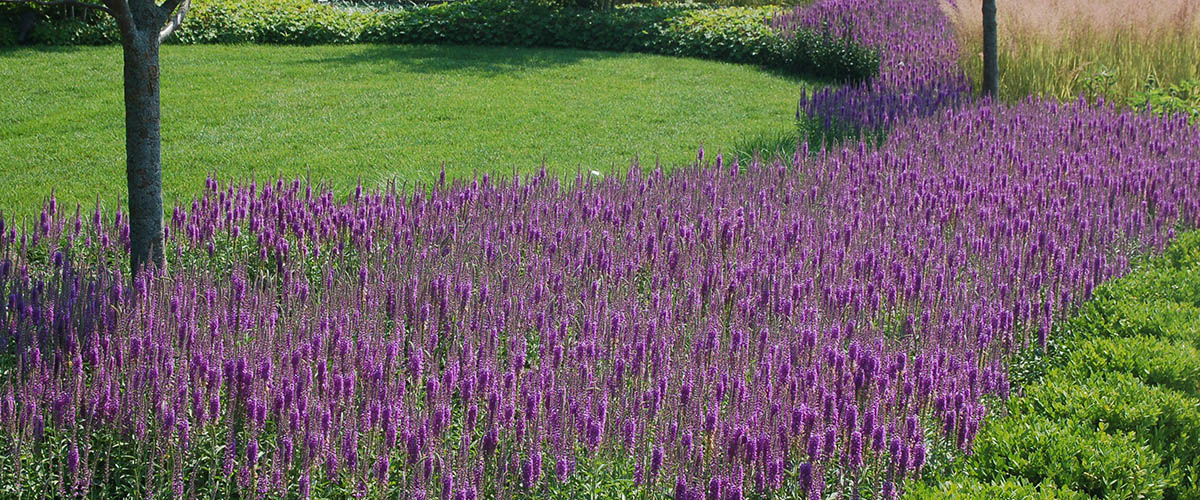
Evaluating Perennials for Chicagoland Gardens
Perennials in Focus is a plant evaluation program that examines new and underused plants for Chicagoland, the third largest metropolitan area in the country. A group of horticultural experts trials and evaluates plants at numerous locations across the region. Results help consumers, public gardens, growers, landscape designers, breeders, and other industry professionals make informed plant choices.
Perennials That Hold Their Line Through Summer Storms
A well-planted border should look composed after a week of heat, wind and sudden downpours. In Australia, that can mean tropical rain in Brisbane, southerly fronts in Melbourne, or a thunderstorm rolling across Sydney after a long dry spell. Plants chosen for a firm, naturally compact habit are far less likely to collapse over paths and lawns.
The best perennials for edging borders combine strong stems, dense basal growth and a moderate mature height. Their foliage helps protect the soil, while flowers remain visible without needing constant staking. Good drainage, sensible spacing and a little seasonal maintenance make an equally important contribution.
Perennials in Focus evaluates plants across multiple gardens and seasons in the Chicagoland region, recording performance traits such as flowering time, height, spread and flower colour. Those observations are especially useful when comparing structure and durability, while Australian gardeners should still check local availability, climate suitability and water needs before planting.
What Makes A Storm-Resistant Border Plant
Plants that resist flopping usually have a low centre of gravity. Clump-forming perennials with leaves emerging from the base are more dependable than tall, loosely branched plants that carry heavy flowers at the tips. A plant that reaches 40 to 70 centimetres and widens gradually is often easier to manage at the front of a border than a taller species with a narrow crown.
Stem strength matters as much as height. Nepeta, compact salvias, coreopsis and many ornamental grasses hold their shape because their stems are numerous and relatively fine. Heuchera and evergreen or semi-evergreen sedges have a lower profile, so rain and wind have less leverage over them. Sedum, now commonly sold as Hylotelephium, stores water in sturdy stems and fleshy leaves, giving it reliable late-season structure.
Avoid judging a plant by its flower photograph alone. Large, densely packed blooms can become heavy when saturated, particularly if the plant is growing in rich soil or receiving excess nitrogen. Look for trial notes that mention habit after flowering, stem resilience, spread and whether the plant needs a support ring. The Perennials in Focus snapshots can help gardeners compare these practical characteristics rather than choosing on colour alone.
Reliable Choices For The Front Edge
Nepeta, especially compact selections, is a dependable edging plant for sunny positions. Its grey-green foliage forms a tidy mound, and the soft blue flower spikes generally recover well after rain. Shearing lightly after the first flush encourages fresh growth and prevents the plant from becoming an untidy, open mass. In Australia, it suits well-drained soil and is especially useful in cooler or temperate districts.
Salvia nemorosa and related compact salvias bring upright flower stems without the exaggerated height of many perennial salvias. Their basal clumps remain relatively neat, while repeated trimming after flowering can promote another flush. Cultivars differ in height, so select forms described as compact or border-sized for a path edge. They are a better fit for sunny Melbourne or Canberra gardens than for permanently humid, poorly drained positions.
Coreopsis verticillata offers fine, airy foliage and a long display of yellow flowers. Its stems are flexible rather than brittle, and the plant tends to spring back after a storm when it is not overcrowded. Compact cultivars can soften the edge of a gravel path or mixed border. In hotter Australian regions, afternoon shade and consistent establishment watering may help it perform more reliably.
Heuchera is valuable where a low, foliage-led edge is needed. Coloured leaves provide interest before and after flowering, and the low crown is rarely pushed flat by heavy rain. Provide excellent drainage, particularly in humid climates, and protect the crown from sitting in wet soil. In the local market, nurseries often stock many heuchera colours, but availability can vary sharply between specialist perennial growers and large garden centres.
Tough Plants For Heat And Drying Winds
Hylotelephium is one of the strongest candidates for a sunny, low-maintenance border. Its upright stems resist casual collapse, and the succulent foliage handles short dry periods once plants are established. Flower heads bring late-season interest and can remain attractive into winter. Avoid rich, heavily irrigated soil, which may produce softer growth and reduce the compact habit that makes these plants useful.
Compact ornamental grasses can form an excellent living edge because their leaves move in wind without falling across a walkway. Carex cultivars are particularly useful for part shade, while smaller Pennisetum types can suit sunny borders where they are non-invasive and permitted. Lomandra and Dianella are familiar Australian alternatives for tougher sites, offering strappy foliage and strong clumping habits, though their ultimate size may be too large for a narrow cottage-garden edge.
For hot, dry gardens around Adelaide, Perth or inland New South Wales, consider plants with a naturally mounded form and restrained water demand. Erigeron, compact gaura selections, salvias and some kangaroo paw cultivars can work when matched to the soil and exposure. Kangaroo paw is better treated as a bold accent than a continuous edging plant, since its flower stems can be taller and less uniform after heavy rain.
A border that drains quickly is essential in regions affected by intense summer rainfall. Raised beds, gravelly soil and organic matter worked into compacted ground can help roots establish without remaining saturated. In sloping gardens, planting in broad bands rather than isolated pockets reduces erosion and creates a more stable visual edge; these sloped garden notes offer useful ideas for combining plants with soil-holding structure.
Spacing And Planting For Better Stability
Spacing determines whether a perennial develops sturdy individual stems or stretches toward light. Plant too closely and competition can produce tall, weak growth. Plant too far apart and each clump may receive wind from every direction before it has filled the border. Use the expected mature spread as a guide, then allow a little extra room in humid areas where airflow helps reduce fungal problems.
A layered edge is usually more resilient than a single row. Place low heuchera, sedges or dianthus beside the path, medium-height nepeta or salvia behind them, and taller accents farther back. The front plants protect soil from erosion, while the middle layer visually supports the taller stems. This arrangement also makes an occasional flattened plant less noticeable.
Planting depth matters for crown-forming species. Set crowns at the same level as they were in the nursery pot, firm the soil around the root ball and water deeply during establishment. A thin mulch layer can reduce evaporation, but keep it away from the crown. In areas with wet summers, coarse mulch or gravel may be safer than a thick, moisture-holding blanket.
Maintenance That Prevents Collapse
Water deeply and less frequently once plants are established, adjusting for local rainfall and soil. Frequent shallow irrigation encourages weak surface roots. Newly planted borders need regular attention during their first summer, especially in Perth’s dry conditions or during heatwaves in western Sydney. Established drought-tolerant plants still need occasional deep watering during prolonged hot weather.
Do not overfeed a storm-prone border. Excess nitrogen produces lush foliage and elongated stems that are more likely to bend. A soil test can identify genuine deficiencies, while a modest application of a suitable slow-release fertiliser in the active growing season is usually enough. Compost improves structure, but large amounts of rich material can make some compact perennials too vigorous.
Trim plants according to their growth cycle. Cutting back nepeta and salvia after flowering encourages fresh basal growth, while leaving hylotelephium stems standing can provide winter structure and protect new shoots. Remove damaged material after a storm rather than tying every plant upright. Supports are most effective when installed early and kept discreet, not added after a clump has already fallen.
Keep records of what survives in your own garden. Note the plant’s position, height before and after storms, flowering period and response to pruning. These observations complement regional trial information and help distinguish a genuinely sturdy cultivar from one that only performs well under ideal conditions.
Choose several compact, clump-forming perennials rather than relying on a single species. Visit local independent nurseries, specialist perennial growers and native plant suppliers to compare mature dimensions and ask how a plant behaves in your region. Build a small trial section, photograph it through summer and replace only the plants that repeatedly sprawl. With careful selection and observation, your border can remain colourful, accessible and orderly through the next burst of Australian summer weather.
In the Garden
Evaluator gardens are located across the Chicagoland area, representing a range of growing conditions. Visit our retail and wholesale partners to find trialled perennials for your own garden.
Retail & Wholesale: Hinsdale Nurseries (Willowbrook, IL), Mariani Nurseries (Kenosha, WI & Garden Prairie, IL), Northwind Perennials (Burlington, WI), The Growing Place (Aurora, IL).
Wholesale Only: Hinsdale Nurseries (Plano, IL), Intrinsic Perennial Gardens (Hebron, IL).
Our Evaluation Program
The 2017–2020 evaluation cycle included Agastache 'Blue Boa', Allium senescens 'Blue Eddy', Amsonia ciliata var. filifolia 'Georgia Pancake', Astilbe 'Chocolate Shogun', Boltonia astroides 'James Crocket', Brunnera 'Alexander's Great', and Geranium cinereum 'Jolly Jewel Purple'. Completed evaluations include Amsonia 'Blue Ice' (2004–07).
On April 10, 2020, the program published snapshot profiles for Vernonia lettermanii 'Iron Butterfly', Stokesia laevis 'Elf', Stachys officinalis 'Pink Cotton Candy', Lobelia 'Monet Moment', Helleborus 'Winter Thrillers', Geum 'Mai Tai', Geranium soboliferum 'Butterfly Kisses', Gentiana x intermedia 'True Blue', Eurybia divaricata, Asparagus 'Purple Passion', and Agastache 'Bolero'.
Browse the full collection of snapshots organized alphabetically — from A–D, E–H, I–Q, and R–Z — to find detailed performance data on perennials trialled across Chicagoland.