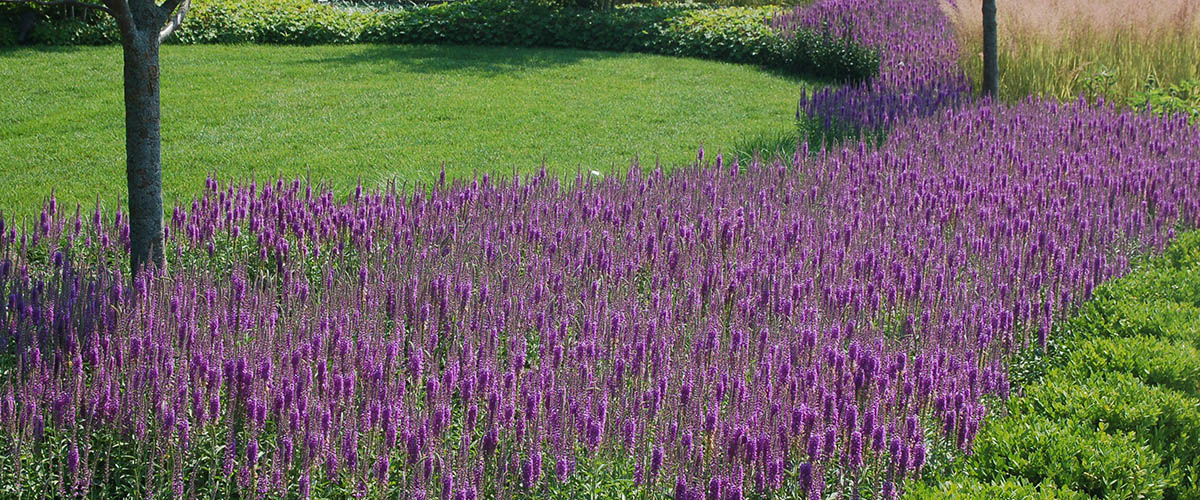
Evaluating Perennials for Chicagoland Gardens
Perennials in Focus is a plant evaluation program that examines new and underused plants for Chicagoland, the third largest metropolitan area in the country. A group of horticultural experts trials and evaluates plants at numerous locations across the region. Results help consumers, public gardens, growers, landscape designers, breeders, and other industry professionals make informed plant choices.
Baptisia cultivars for a longer late-spring border display
Sunny borders can lose momentum after the first flush of spring bulbs and early perennials. Baptisia fills that gap with upright stems, pea-shaped flowers and attractive blue-green foliage, bringing structure and colour from late spring into early summer.
For Australian gardeners, flowering time depends strongly on climate. In Melbourne and Canberra, baptisia may peak from late October to November, while plants in Sydney, Adelaide or Perth can flower earlier in a warm spring. The same cultivar may therefore bridge different seasonal gaps from one garden to another.
The Perennials in Focus programme evaluates plants across multiple gardens and seasons, recording features such as bloom period, flower colour, height and spread. Its regional perennial findings provide a useful model for assessing performance rather than choosing plants from a catalogue photograph alone.
Why baptisia earns a place in sunny borders
Baptisia, commonly called false indigo, is a long-lived North American perennial suited to full sun and well-drained soil. Once established, it develops a substantial root system and can become a reliable anchor plant rather than a short-lived seasonal filler. Its clumping habit also gives a border visual weight before and after flowering.
The flower spikes rise above trifoliate foliage, with colours ranging from deep indigo and violet to cream, yellow, pink and smoky blue. After flowering, inflated seed pods add texture and remain decorative into summer. They can be left in place for winter interest or removed if self-sowing is not wanted.
This is a useful quality in an Australian mixed border, where a plant may need to look good through periods of heat between irrigation cycles. Baptisia is not a native Australian plant and should not be treated as completely drought-proof, but an established specimen can cope with considerably less attention than many soft-stemmed perennials.
How cultivars extend late-spring interest
Cultivar selection can lengthen the display because baptisias vary in flowering time, height and flower colour. Early forms can start the sequence, while later selections keep the border flowering after aquilegias, early salvias and spring bulbs have faded. Combining two cultivars with slightly different peaks is often more effective than planting a large number of identical plants.
The plants generally form their flower buds on established crowns, so the first year may be modest. In southern Australia, autumn is often the best planting season because roots can develop before the following summer. In Sydney or coastal Queensland, planting may also work in late winter or early spring, provided the soil drains freely and the new plant receives regular water while settling in.
Avoid moving an older baptisia. Its deep, woody root can be difficult to lift without setting the plant back. Choose the permanent position carefully, allowing room for the mature clump and keeping it away from narrow paths where the flowering stems may lean into circulation space.
Strong blue and violet performers
‘Blueberry Sundae’ is a compact-to-medium selection with rich blue-violet flowers and a relatively tidy outline. It suits smaller suburban borders, raised beds and the front half of a wide perennial planting. Pair it with pale salvias, silver-leaved artemisia or soft grasses to make the flower colour appear deeper.
‘Purple Smoke’ has dusky violet flowers with darker stems, giving it a more naturalistic appearance than some of the brighter Decadence cultivars. It works well among ornamental grasses and prairie-style plantings, where the vertical flower spikes can rise through softer foliage.
‘Starlite Prairieblues’ offers blue flowers with a lighter, more refined effect. It is a good bridge between strongly coloured plants and white or pastel companions. In a Melbourne or Canberra garden, it can provide a calm transition from late-spring iris and nepeta to early-summer echinacea and grasses.
Yellow, pink and unusual colour forms
‘Carolina Moonlight’ is valued for its soft, pale yellow flowers. The colour is particularly useful in a hot-looking border dominated by orange, red or strong purple, because it lightens the planting without becoming visually harsh. Combine it with white gaura, blue catmint or green-gold foliage.
‘Lemon Meringue’ also brings yellow flowers, generally with a bright, clear appearance. It is an appealing choice for a contemporary garden near pale paving or gravel, although it benefits from darker foliage nearby to prevent the border from looking washed out.
‘Cherries Jubilee’ produces dusky burgundy and yellow flowers, creating a more complex colour effect than a single-tone cultivar. ‘Pink Truffles’ offers pink flowers for gardeners who want to soften a prairie-inspired scheme. These selections are excellent for extending colour range, though local availability may be inconsistent. Australian nurseries often carry only a few named baptisias at a time, so check botanical names and mature dimensions before ordering online.
Matching plants to Australian conditions
Give baptisia at least six hours of direct sun, with protection from reflected heat in the hottest inland or western locations. In Perth and Adelaide, afternoon heat combined with very free-draining soil may require deeper initial watering and a generous organic mulch. Keep mulch slightly away from the crown to reduce the risk of rot.
In Sydney and other humid coastal areas, drainage is especially important during wet periods. A raised bed or mounded position can be safer than heavy clay that remains saturated. In Melbourne, plants usually appreciate summer watering during their establishment phase, while mature specimens may need only occasional deep irrigation when rainfall is low.
Space plants according to their eventual spread rather than the size of the nursery pot. Depending on cultivar and conditions, mature clumps commonly reach roughly 80 centimetres to 1.5 metres in height and a similar width. Cut stems back after flowering if a neat border is preferred, or leave the seed pods to support a longer season of structure.
Comparing cultivars for a sunny border
The figures below are useful planning estimates rather than guarantees. Soil, climate, irrigation and plant age can alter both flowering time and final size.
| Cultivar | Flower colour | Approximate height | Border role | Useful Australian setting |
|---|---|---|---|---|
| ‘Blueberry Sundae’ | Blue-violet | 90–120 cm | Compact focal clump | Smaller Melbourne, Sydney or courtyard borders |
| ‘Purple Smoke’ | Dusky violet | 100–140 cm | Naturalistic middle layer | Grass-based and informal plantings |
| ‘Starlite Prairieblues’ | Soft blue | 100–130 cm | Colour transition | Mixed borders with pastel companions |
| ‘Carolina Moonlight’ | Pale yellow | 100–140 cm | Light-coloured accent | Contemporary schemes and dark foliage combinations |
| ‘Lemon Meringue’ | Clear yellow | 90–120 cm | Bright late-spring highlight | Sunny gravel gardens with reliable drainage |
| ‘Cherries Jubilee’ | Burgundy and yellow | 100–140 cm | Strong seasonal feature | Larger borders needing warm contrast |
| ‘Pink Truffles’ | Pink | 100–130 cm | Softens bold plantings | Cottage-style and pollinator-friendly borders |
When choosing among them, consider the whole border rather than flower colour alone. A tall cultivar may be ideal behind penstemons and salvias but overwhelm a narrow bed. A compact selection can be more effective near a path, even if its flowers are less dramatic from a distance.
Baptisia also contributes to habitat value through its flowers and seed structures, although it should be combined with locally appropriate Australian plants for a broader range of pollinators. Kangaroo daisies, everlasting daisies, correas and other regionally suitable perennials can supply complementary habitat while baptisia provides a distinctive late-spring form.
Choose one or two cultivars that match the scale and drainage of your site, then record flowering dates, height and summer performance over several seasons. Visit a specialist perennial nursery or speak with a local grower before planting, and use those observations to build a sunny border that keeps its colour moving well beyond the spring peak.
In the Garden
Evaluator gardens are located across the Chicagoland area, representing a range of growing conditions. Visit our retail and wholesale partners to find trialled perennials for your own garden.
Retail & Wholesale: Hinsdale Nurseries (Willowbrook, IL), Mariani Nurseries (Kenosha, WI & Garden Prairie, IL), Northwind Perennials (Burlington, WI), The Growing Place (Aurora, IL).
Wholesale Only: Hinsdale Nurseries (Plano, IL), Intrinsic Perennial Gardens (Hebron, IL).
Our Evaluation Program
The 2017–2020 evaluation cycle included Agastache 'Blue Boa', Allium senescens 'Blue Eddy', Amsonia ciliata var. filifolia 'Georgia Pancake', Astilbe 'Chocolate Shogun', Boltonia astroides 'James Crocket', Brunnera 'Alexander's Great', and Geranium cinereum 'Jolly Jewel Purple'. Completed evaluations include Amsonia 'Blue Ice' (2004–07).
On April 10, 2020, the program published snapshot profiles for Vernonia lettermanii 'Iron Butterfly', Stokesia laevis 'Elf', Stachys officinalis 'Pink Cotton Candy', Lobelia 'Monet Moment', Helleborus 'Winter Thrillers', Geum 'Mai Tai', Geranium soboliferum 'Butterfly Kisses', Gentiana x intermedia 'True Blue', Eurybia divaricata, Asparagus 'Purple Passion', and Agastache 'Bolero'.
Browse the full collection of snapshots organized alphabetically — from A–D, E–H, I–Q, and R–Z — to find detailed performance data on perennials trialled across Chicagoland.