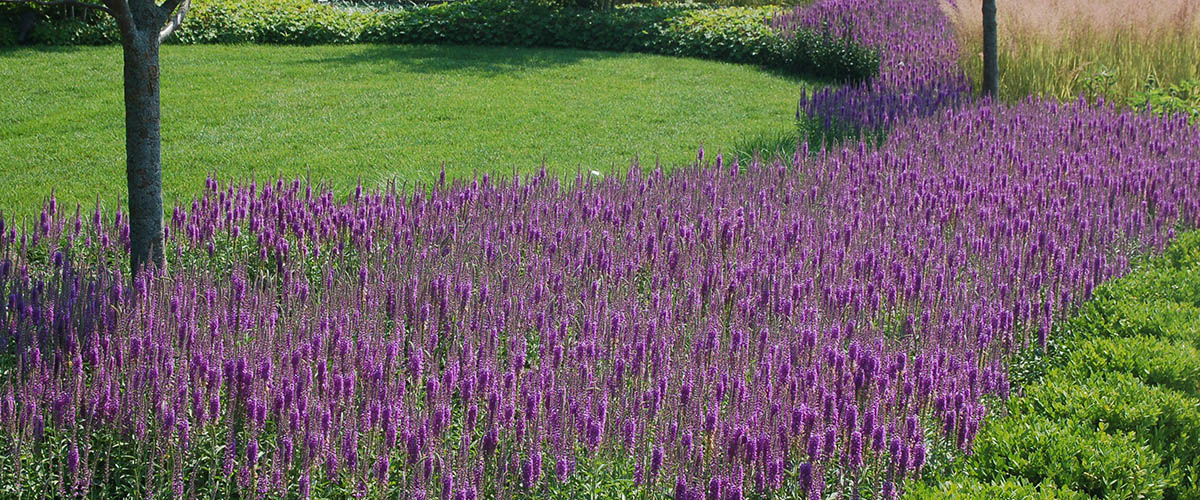
Evaluating Perennials for Chicagoland Gardens
Perennials in Focus is a plant evaluation program that examines new and underused plants for Chicagoland, the third largest metropolitan area in the country. A group of horticultural experts trials and evaluates plants at numerous locations across the region. Results help consumers, public gardens, growers, landscape designers, breeders, and other industry professionals make informed plant choices.
Why Nepeta is a top perennial for Chicago’s hot, dry spots
Chicago-area gardens often contain difficult planting zones: sunny strips beside pavement, dry slopes, reflected heat near masonry, and borders where irrigation is limited. These locations can quickly expose weak perennials, especially during midsummer stretches of heat and low rainfall.
Nepeta, commonly called catmint, is a strong candidate for those conditions. Its aromatic gray-green foliage, long flowering period, and tolerance of lean soil give it a useful combination of toughness and ornamental value. Once established, many varieties continue flowering when more moisture-dependent plants begin to decline.
For gardeners choosing plants by regional performance rather than catalog claims, local observation matters. The Perennials in Focus program evaluates plants across Chicagoland gardens and seasons, offering information that is more relevant to Midwest conditions than a generic hardiness-zone description.
Why catmint suits urban heat
Nepeta’s foliage is adapted to bright, exposed locations. The narrow, slightly fuzzy leaves reduce water loss and give the plant a silvery cast that reflects some sunlight. Its stems and leaves also contain aromatic oils, making the plant less appealing to browsing deer and rabbits than many soft-leaved perennials.
The plant’s tolerance is especially useful in urban landscapes. Concrete, brick, asphalt, and south-facing walls can raise temperatures well above those recorded in a garden bed, while compacted soil can limit root growth. Nepeta generally performs best when its roots receive good drainage and are not kept constantly wet.
This does not mean catmint thrives in neglect from the first day. Newly planted specimens need regular watering while roots expand into surrounding soil. Once established, however, nepeta can handle short dry periods and recover more reliably than many lush, shallow-rooted perennials.
A long season of flowers and foliage
The main bloom period usually begins in late spring or early summer, depending on the cultivar and weather. Flower spikes in blue, lavender, violet, or soft pink rise above the foliage and attract bees, butterflies, and other pollinating insects. In a sunny border, the flowers create a cool visual counterpoint to hot paving and warm-colored blooms.
Many nepeta selections can rebloom after their first flush. Cutting the plant back by roughly one-half after flowering removes tired stems and encourages fresh foliage and another wave of flowers. A light trim is usually more effective than waiting for the entire plant to become tangled or brown.
Its foliage continues to contribute after peak bloom. The rounded or spreading mound can edge a path, soften a retaining wall, or fill the front of a mixed perennial border. Because the leaves remain fragrant when brushed, nepeta also works well beside walkways where visitors can notice its scent.
Choosing the right form for the site
Nepeta is a broad group rather than a single uniform plant. Some cultivars form compact cushions under 18 inches tall, while others produce broad mounds with flowering stems two feet or more in height. The mature spread matters just as much as the listed height, particularly in narrow foundation beds and sidewalk plantings.
| Garden condition | Useful nepeta trait | Planting consideration |
|---|---|---|
| Hot sidewalk edge | Gray-green, aromatic foliage | Allow room for a spreading mound |
| Dry sunny slope | Strong drought tolerance after establishment | Water deeply during the first season |
| Pollinator border | Numerous small tubular flowers | Group several plants for visual impact |
| Narrow front border | Compact growth habit | Choose a shorter cultivar |
| Mixed prairie-style bed | Long bloom and soft texture | Pair with upright grasses or yarrow |
| Heavy or wet soil | Limited tolerance for poor drainage | Improve drainage or select another plant |
Compact forms are often the best choice for formal edging, small gardens, and containers. Taller selections can create a more relaxed effect among ornamental grasses, salvias, coneflowers, and other drought-tolerant perennials. Reading the mature dimensions on a plant label helps prevent excessive crowding, which can reduce airflow and make maintenance less convenient.
Flower color should be considered alongside the surrounding planting palette. Blue and lavender flowers harmonize with silver foliage, yellow yarrow, white penstemon, and warm-toned sedums. A mass of one cultivar usually appears more intentional than scattered individual plants placed wherever a gap occurs.
Where it performs best in Chicago gardens
Full sun is essential for the strongest flowering and most compact growth. Aim for at least six hours of direct light, with additional exposure beneficial if the soil is fast draining. Nepeta can tolerate lighter shade, but plants may become floppy, flower less heavily, and retain moisture around the crown for longer periods.
Drainage is the key soil consideration. Clay soil can support catmint if it does not remain saturated, but amendments should be used thoughtfully. Incorporating compost into the planting area can improve structure, while a raised bed or slight berm may be more effective where water collects after storms.
Good locations include curbside beds, gravel gardens, sunny slopes, rain garden edges above the wettest zone, and borders beside patios. Avoid placing nepeta in a low pocket that stays damp through winter. Excess moisture around the crown can cause decline even when the plant receives plenty of summer sun.
Care that keeps plants compact
Plant nepeta in spring or early fall, spacing it according to the mature width of the chosen cultivar. Water slowly and deeply during establishment, then allow the soil to dry moderately between irrigations. A thin layer of mulch can conserve moisture, but keep it away from the crown to preserve airflow.
Fertilizer is rarely necessary in reasonably fertile soil. Excess nitrogen can produce soft, leafy growth and fewer flowers, while leaner conditions tend to support a sturdier form. If growth is weak, first investigate sunlight, drainage, root competition, and watering patterns before reaching for a general-purpose fertilizer.
Shearing after the first bloom is the main maintenance task. Use clean pruners or hedge shears, and remove the spent flowering stems without cutting deeply into the woody base. In late autumn, leave some structure standing if it provides winter interest or shelter for insects, then remove damaged growth in early spring.
Building a resilient planting around nepeta
Catmint becomes more valuable when it is combined with plants that share its preference for sun and moderate to dry soil. The contrast between its low, spreading shape and upright companions creates structure without requiring frequent irrigation. Repeating the same nepeta variety at intervals can also connect separate parts of a border.
Useful companions include little bluestem, prairie dropseed, yarrow, coreopsis, salvia, coneflower, penstemon, sedum, and ornamental alliums. Grasses contribute movement and seedheads, while late-season perennials extend color after the first nepeta flush. Choose companions with similar drainage needs so that watering one plant does not create stress for another.
For a restrained design, place compact catmint along a path or retaining wall and repeat it in groups of three or more. In a looser pollinator garden, allow the mounds to mingle with grasses and flowering perennials. Removing overly aggressive neighboring plants may be more important than adding fertilizer, since nepeta flowers best when it has adequate light and air circulation.
Practical choices for a low-water border
A successful planting begins with matching the cultivar to the available space and the gardener’s maintenance routine. Before purchasing, check mature height, spread, bloom timing, and whether the plant is described as compact, upright, or spreading.
- Select a full-sun location with sharply drained or moderately dry soil.
- Choose compact forms for edging and taller forms for mixed borders.
- Water new plants consistently during their first growing season.
- Shear after the first bloom to encourage fresh growth and rebloom.
- Combine nepeta with drought-tolerant companions rather than moisture-loving plants.
These simple decisions help catmint remain a deliberate design element instead of becoming an oversized mound that needs repeated correction. They also support the broader goal of selecting perennials that can manage Chicago’s alternating heat, humidity, storms, and winter conditions.
Nepeta is valuable because it solves several landscape problems at once: it tolerates sun and dry soil, supports pollinators, resists much browsing pressure, and provides a long period of attractive texture. Its dependable nature makes it particularly useful in places where frequent watering or intensive maintenance is impractical.
Use regional trial information and mature plant measurements to select the form that fits your garden, then give it the drainage, sunlight, and establishment care it needs. Add a well-chosen nepeta to the next hot, dry planting area and let its flowers, fragrance, and durable foliage carry the border through the Midwest growing season.
In the Garden
Evaluator gardens are located across the Chicagoland area, representing a range of growing conditions. Visit our retail and wholesale partners to find trialled perennials for your own garden.
Retail & Wholesale: Hinsdale Nurseries (Willowbrook, IL), Mariani Nurseries (Kenosha, WI & Garden Prairie, IL), Northwind Perennials (Burlington, WI), The Growing Place (Aurora, IL).
Wholesale Only: Hinsdale Nurseries (Plano, IL), Intrinsic Perennial Gardens (Hebron, IL).
Our Evaluation Program
The 2017–2020 evaluation cycle included Agastache 'Blue Boa', Allium senescens 'Blue Eddy', Amsonia ciliata var. filifolia 'Georgia Pancake', Astilbe 'Chocolate Shogun', Boltonia astroides 'James Crocket', Brunnera 'Alexander's Great', and Geranium cinereum 'Jolly Jewel Purple'. Completed evaluations include Amsonia 'Blue Ice' (2004–07).
On April 10, 2020, the program published snapshot profiles for Vernonia lettermanii 'Iron Butterfly', Stokesia laevis 'Elf', Stachys officinalis 'Pink Cotton Candy', Lobelia 'Monet Moment', Helleborus 'Winter Thrillers', Geum 'Mai Tai', Geranium soboliferum 'Butterfly Kisses', Gentiana x intermedia 'True Blue', Eurybia divaricata, Asparagus 'Purple Passion', and Agastache 'Bolero'.
Browse the full collection of snapshots organized alphabetically — from A–D, E–H, I–Q, and R–Z — to find detailed performance data on perennials trialled across Chicagoland.