Evaluating Perennials for Chicagoland Gardens
Perennials in Focus is a plant evaluation program that examines new and underused plants for Chicagoland, the third largest metropolitan area in the country. A group of horticultural experts trials and evaluates plants at numerous locations across the region. Results help consumers, public gardens, growers, landscape designers, breeders, and other industry professionals make informed plant choices.
Why amsonia belongs in Chicagoland gardens
A well-chosen perennial should earn its space through more than a brief display of flowers. It should offer dependable structure, support seasonal interest, and handle the region’s changing weather without demanding constant attention. Amsonia, commonly called blue star, meets those expectations with a refined appearance and a long garden season.
In late spring, clusters of star-shaped blue flowers cover upright stems. Through summer, the narrow foliage forms a tidy green mound, and in autumn it can turn vivid gold. The plant remains useful after flowering, too, when its stems and seed capsules add texture to the late-season landscape.
For home gardeners, growers, landscape professionals, and public gardens, regional performance matters. A perennial that thrives in a Mid-Atlantic trial may struggle in Chicago’s cold winters, humid summers, heavy clay, or unpredictable spring weather. That is why amsonia deserves attention as a proven, adaptable choice for Chicagoland planting plans.
A long season of ornamental value
Amsonia’s spring flowers are its most recognizable feature. Depending on the species and growing conditions, flowering generally begins in May or June, with clusters of pale to medium blue blooms held above the foliage. The flowers have a clear, cool color that works especially well beside soft yellow, white, pink, and burgundy perennials.
After bloom, the plant does not become an anonymous green filler. Its slender leaves create a fine-textured mound that contrasts with broad-leaved hostas, bold ornamental grasses, and coarse foliage such as that of peonies. The upright form also brings order to mixed borders without looking stiff or overly formal.
Autumn is where established amsonia often becomes especially valuable. The foliage may shift from green to lemon yellow, amber, or warm gold before frost. Leaving the stems standing through winter preserves vertical texture and provides a subtle transition between the growing season and the dormant landscape.
A strong match for local conditions
Chicagoland gardens commonly face clay soil, summer humidity, fluctuating moisture, and winter temperature swings. Amsonia is generally tolerant of these conditions when planted in a sunny location with reasonable drainage. It appreciates consistent moisture while establishing, then becomes more resilient through ordinary periods of dry weather.
Full sun usually produces the best flowering and the strongest autumn color. Plants can tolerate light shade, but too much shade may lead to fewer flowers, looser growth, and less dramatic fall foliage. In heavy soil, incorporating organic matter and avoiding low spots where water remains stagnant can improve long-term performance.
Once established, amsonia is comparatively low maintenance. It is rarely troubled by serious insect or disease problems, and its slightly tough foliage is not a preferred food for many browsing animals. That does not make it completely immune to deer or rabbit damage, but it can be a useful component of a garden where vulnerable plants need reliable companions.
Choosing the right blue star
Several amsonia species and selections can be suitable for northern gardens, though they differ in size, texture, and habit. Amsonia tabernaemontana is valued for its clusters of blue flowers and substantial, upright form. It can become a generous presence in a sunny border, especially where there is room for the plant to mature.
Amsonia hubrichtii is known for exceptionally narrow foliage and strong golden fall color. Its texture is more delicate and threadlike than that of many other blue stars, giving it a distinctive role in contemporary, prairie-inspired, and naturalistic designs. It may take time to establish, but the seasonal payoff can be substantial.
Amsonia ciliata and compact selections may suit smaller beds or the front of a perennial border. Availability varies among nurseries and garden centers, so gardeners should compare mature height and spread rather than choosing by flower color alone. Regionally evaluated plants can provide especially useful guidance because performance depends on more than a hardiness-zone label.
| Feature | What gardeners can generally expect | Placement consideration |
|---|---|---|
| Flowers | Blue, star-shaped clusters in late spring or early summer | Place where the cool color can be seen beside contrasting blooms |
| Mature form | Upright stems with a rounded or spreading clump | Allow room for the selected species or cultivar to fill out |
| Foliage | Narrow green leaves during summer | Use it to contrast with broad or bold-leaved perennials |
| Fall display | Yellow to gold foliage, often strongest in full sun | Avoid crowding it behind plants that hide the autumn color |
| Soil response | Adaptable to average soil with good drainage | Improve compact clay and avoid persistently saturated sites |
| Maintenance | Generally low once established | Cut back in late winter or leave stems for winter structure |
Structure for borders and naturalistic plantings
Amsonia works equally well as a focal clump, a repeated drift, or a transition between low edging plants and taller background perennials. Its upright stems provide definition without overwhelming neighboring plants. Repeating the same cultivar at intervals can create rhythm in a large border and make the planting feel intentional.
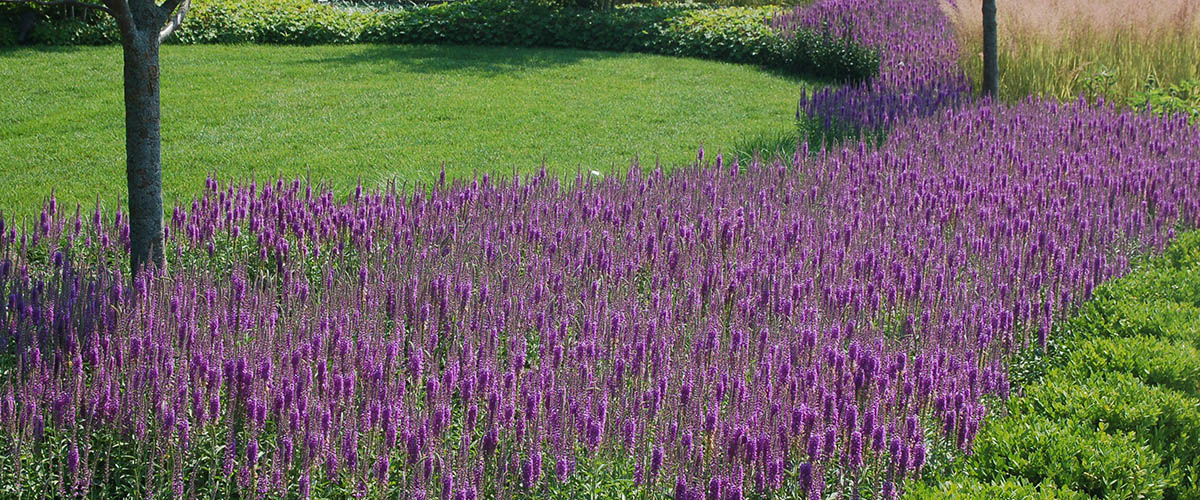
Good companions include prairie dropseed, little bluestem, coneflower, blazing star, catmint, yarrow, and ornamental onions. Purple flowers emphasize amsonia’s blue tones, while grasses add movement and extend interest after the blossoms fade. Gardeners planning for the colder months can explore this winter interest guide when pairing blue star with grasses and other plants that retain useful form.
In a more traditional bed, combine amsonia with peonies, Siberian iris, daylilies, and sedums. The plant’s fine foliage softens large leaves, while its autumn color helps connect summer bloomers with late-season asters and chrysanthemums. Because it is attractive without being showy at every moment, amsonia can also serve as a visual pause between brighter plant groupings.
What regional trials can reveal
Plant descriptions often provide a general picture, but multi-site evaluation reveals how a perennial behaves across real gardens and several seasons. Differences in soil, exposure, irrigation, winter conditions, and maintenance can affect height, spread, bloom timing, and plant density. Those details are particularly important for designers and retailers selecting plants for local customers.
A regional trial can also identify whether a selection remains upright, fills in at a practical rate, and delivers consistent ornamental value after its first year. New and underused perennials may look promising in a container or nursery row but need time to show their mature habit. Observations from horticultural professionals help separate temporary novelty from dependable garden performance.
For Chicagoland gardeners, those findings offer a more useful basis for plant selection than a generic national description. Look for information about bloom period, mature dimensions, flower color, seasonal foliage, and performance across multiple locations. These details make it easier to match an amsonia selection to a residential border, commercial landscape, rain garden edge, or public planting.
Planting and maintenance essentials
Plant amsonia in spring or early fall, giving the root system time to develop before extreme heat or deep winter. Water new plants regularly during the first growing season, especially in full sun and sandy or disturbed soil. A two-inch layer of mulch can moderate moisture and temperature, but keep it away from the crown to reduce rot risk.
Mature clumps may be slow to reach their full size, so avoid moving or dividing them too soon. If stems become floppy, the site may be too shady, the soil may be excessively fertile, or neighboring plants may be crowding the clump. Cutting stems back in late winter is usually preferable to removing them in autumn, since the standing growth adds winter texture.
Use these practical guidelines when adding blue star to a new or established bed:
- Choose full sun or light shade with good air circulation.
- Check the selected species’ mature height and spread before planting.
- Improve compact soil drainage without creating a rich, overly lush growing site.
- Water consistently during establishment, then reduce irrigation as roots mature.
- Leave stems through winter and cut them back before fresh spring growth begins.
Amsonia offers the combination that many Chicagoland gardens need: attractive flowers, durable foliage, memorable fall color, and a manageable maintenance profile. Add it to a planting plan as a specimen, repeat it through a border, or pair it with grasses and prairie perennials for a garden that remains engaging long after spring bloom has passed. Evaluate the available selections carefully, then give this adaptable blue star a place where its full seasonal character can develop.
In the Garden
Evaluator gardens are located across the Chicagoland area, representing a range of growing conditions. Visit our retail and wholesale partners to find trialled perennials for your own garden.
Retail & Wholesale: Hinsdale Nurseries (Willowbrook, IL), Mariani Nurseries (Kenosha, WI & Garden Prairie, IL), Northwind Perennials (Burlington, WI), The Growing Place (Aurora, IL).
Wholesale Only: Hinsdale Nurseries (Plano, IL), Intrinsic Perennial Gardens (Hebron, IL).
Our Evaluation Program
The 2017–2020 evaluation cycle included Agastache 'Blue Boa', Allium senescens 'Blue Eddy', Amsonia ciliata var. filifolia 'Georgia Pancake', Astilbe 'Chocolate Shogun', Boltonia astroides 'James Crocket', Brunnera 'Alexander's Great', and Geranium cinereum 'Jolly Jewel Purple'. Completed evaluations include Amsonia 'Blue Ice' (2004–07).
On April 10, 2020, the program published snapshot profiles for Vernonia lettermanii 'Iron Butterfly', Stokesia laevis 'Elf', Stachys officinalis 'Pink Cotton Candy', Lobelia 'Monet Moment', Helleborus 'Winter Thrillers', Geum 'Mai Tai', Geranium soboliferum 'Butterfly Kisses', Gentiana x intermedia 'True Blue', Eurybia divaricata, Asparagus 'Purple Passion', and Agastache 'Bolero'.
Browse the full collection of snapshots organized alphabetically — from A–D, E–H, I–Q, and R–Z — to find detailed performance data on perennials trialled across Chicagoland.