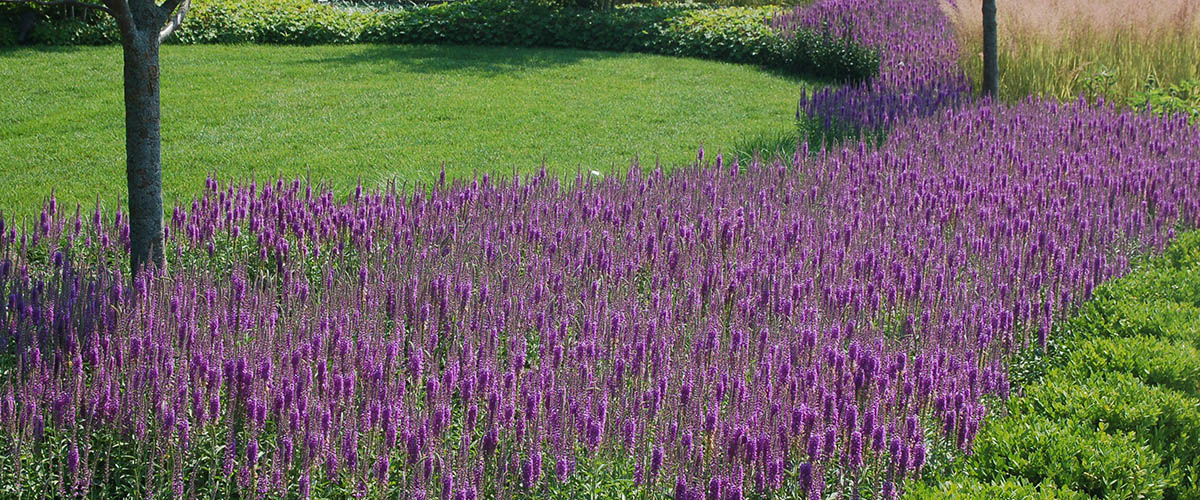
Evaluating Perennials for Chicagoland Gardens
Perennials in Focus is a plant evaluation program that examines new and underused plants for Chicagoland, the third largest metropolitan area in the country. A group of horticultural experts trials and evaluates plants at numerous locations across the region. Results help consumers, public gardens, growers, landscape designers, breeders, and other industry professionals make informed plant choices.
What to Plant with Russian Sage for a Long-Lasting Border
Russian sage brings a valuable combination of height, airy texture, silver foliage, and late-summer color to a sunny perennial border. Its lavender-blue flowers can continue for weeks, often carrying the planting from midsummer into early fall. In the Chicagoland region, however, the best companion plants are those that can handle humid summers, cold winters, variable spring moisture, and occasional heavy snow.
A successful planting pairs Russian sage with plants that bloom before, during, and after its main display. Strong foliage contrast matters just as much as flower color: broad leaves, upright stems, low mounds, and fine grasses help the border remain interesting when individual plants are between bloom cycles.
The most reliable design also respects the plant’s growing preferences. Russian sage performs best in full sun and sharply drained soil, so companions should tolerate similar conditions rather than requiring regular irrigation or rich, moisture-retentive ground.
Match Plants To The Growing Conditions
Choose a location with at least six hours of direct sun and enough air movement to dry foliage after rain. Russian sage is especially useful on slopes, raised beds, gravel gardens, and other places where water drains quickly. In heavy clay, amend the planting area broadly and avoid creating a small pocket of excessively rich soil surrounded by compacted ground.
Plant companions with comparable water needs. Coneflower, yarrow, catmint, threadleaf coreopsis, and many ornamental grasses can share a relatively dry border once established. Plants that need consistently moist soil may struggle beside Russian sage, particularly when the sage’s roots become established and irrigation is reduced.
Give the central plant room to develop. Depending on cultivar and pruning, Russian sage may reach roughly three to five feet tall and spread several feet wide. Position lower plants toward the front, medium-height perennials beside it, and taller grasses or structural plants toward the rear. This prevents the border from becoming a crowded wall of stems.
Create A Sequence Of Bloom And Texture
Early-season companions keep the planting active before Russian sage reaches its peak. Alliums provide round flower heads in late spring, while catmint and salvia can begin blooming in late spring or early summer. Peonies, bearded iris, and Baptisia add a stronger architectural presence, though their foliage and flower timing should be considered when planning the overall composition.
At midsummer, echinacea, yarrow, and black-eyed Susan create a warm contrast against the cool blue flowers. Gold, apricot, white, and rose-pink cultivars work especially well with the sage’s lavender tones. Repeating one or two colors through the border gives the design cohesion without making it appear overly formal.
For late-season interest, combine Russian sage with sedum, perennial asters, and ornamental grasses. Upright switchgrass, little bluestem, and prairie dropseed add movement and seed heads after flowers fade. Late sedums contribute dense foliage and broad flower clusters that remain attractive into autumn and often provide useful winter structure.
Compare Reliable Companion Plants
The strongest plant combinations balance bloom time, height, form, and maintenance. The following options suit a sunny, well-drained Chicagoland border and offer different visual effects.
| Companion Plant | Seasonal Role | Approximate Height | Border Benefit |
|---|---|---|---|
| Catmint | Late spring to summer flowers | 18–30 inches | Softens the base with fragrant gray-green foliage |
| Yarrow | Early summer through fall | 18–36 inches | Adds flat flower clusters and strong drought tolerance |
| Coneflower | Summer into fall | 24–48 inches | Brings sturdy stems and warm or pale flower colors |
| Threadleaf Coreopsis | Early to midsummer | 12–24 inches | Fills the front edge with fine foliage and bright blooms |
| Sedum | Late summer into fall | 18–24 inches | Adds dense form and durable flower heads |
| Little Bluestem | Summer through winter | 24–48 inches | Supplies upright texture and coppery fall color |
| Black-Eyed Susan | Midsummer to fall | 24–36 inches | Extends yellow color through the sage’s bloom period |
| Perennial Aster | Late summer to fall | 18–36 inches | Provides a final wave of cool-season flowers |
Sedum is particularly valuable in regions where winter conditions can flatten or split less sturdy plants. Several cultivars hold their shape well through snow and freezing weather; this guide to snow-tested sedums can help narrow the choices for exposed Chicagoland sites.
Use Contrast At The Border Edge
Russian sage has an open, cloudlike habit, so it benefits from companions with denser or more clearly defined forms. Rounded catmint, compact yarrow, and clumping grasses create a visual transition between the tall stems and the path. Threadleaf coreopsis is especially effective near the front because its narrow foliage echoes the fine texture of Russian sage without competing for attention.
Groundcovers can fill spaces between larger perennials, suppress weeds, and keep the border from looking bare early in the season. Creeping thyme suits hot, dry edges, while low sedums work well in gravelly soil. For partly shaded areas near the edge of a mixed bed, compare the habits and coverage of spotted deadnettle and bugleweed before selecting one; neither is a universal match for the full-sun conditions preferred by Russian sage.
Avoid placing an aggressive spreader directly against the sage. A companion that rapidly expands may hide the lower stems, reduce airflow, and make seasonal maintenance harder. Use contained clumps and repeat them at intervals instead of filling every gap with one vigorous groundcover.
Design For Winter And Spring Recovery
A long-lasting border should continue to offer structure after flowering ends. Leave seed heads on coneflowers, rudbeckias, and ornamental grasses through winter where they remain upright and do not obstruct paths. Their stems provide visual interest and food for birds, while the muted tones complement the pale stems of Russian sage.
In late winter or early spring, cut Russian sage back to about six to twelve inches before new growth accelerates. Do the same with most ornamental grasses according to their specific requirements. Removing old stems at this time protects overwintering insects better than an excessively tidy autumn cleanup and makes it easier to see emerging perennials.
Winter drainage is essential. A site that remains waterlogged beneath snow or freezing rain can damage plants that tolerate summer drought. Raised beds, gravel mulch, and modest soil improvement are often more useful than frequent watering or heavy fertilization.
Keep The Color Palette Intentional
A restrained palette helps a mixed perennial border appear designed rather than assembled. Lavender-blue Russian sage pairs naturally with silver foliage, white flowers, soft pink, warm yellow, and deep wine tones. White yarrow and pale echinacea create a calm, luminous scheme, while yellow coreopsis and rudbeckia make the planting more energetic.
Repeat companion plants in groups of three or more when space allows. One isolated plant can look accidental, but a repeated drift of sedum, catmint, or little bluestem ties separate sections together. Vary the height and bloom form within each group so the border has rhythm instead of a series of identical blocks.
Use annuals sparingly if you need quick coverage during the first year. Russian sage and many drought-tolerant perennials take time to reach their mature size, but temporary fillers should not be allowed to create excessive moisture or shade. A layer of mineral mulch can keep the soil surface tidy while the permanent planting develops.
Planting Choices That Usually Work Best
- Pair Russian sage with coneflower and yarrow for a durable, pollinator-friendly summer display.
- Add sedum and perennial asters to extend color into early fall.
- Use little bluestem, switchgrass, or prairie dropseed for movement and winter form.
- Place catmint, threadleaf coreopsis, or creeping thyme along the sunny front edge.
- Repeat two or three companion plants rather than mixing a different perennial into every space.
A well-planned Russian sage border should change gradually rather than peak for only a few weeks. Begin with spring bulbs or early perennials, build the midsummer display around coneflower and yarrow, then let sedum, asters, and grasses carry the planting into fall and winter.
Use regional trial information to compare mature size, bloom duration, winter performance, and behavior before purchasing. Select plants that match your site’s sun and drainage, group them with enough room to mature, and record which combinations remain attractive across several Chicagoland seasons.
In the Garden
Evaluator gardens are located across the Chicagoland area, representing a range of growing conditions. Visit our retail and wholesale partners to find trialled perennials for your own garden.
Retail & Wholesale: Hinsdale Nurseries (Willowbrook, IL), Mariani Nurseries (Kenosha, WI & Garden Prairie, IL), Northwind Perennials (Burlington, WI), The Growing Place (Aurora, IL).
Wholesale Only: Hinsdale Nurseries (Plano, IL), Intrinsic Perennial Gardens (Hebron, IL).
Our Evaluation Program
The 2017–2020 evaluation cycle included Agastache 'Blue Boa', Allium senescens 'Blue Eddy', Amsonia ciliata var. filifolia 'Georgia Pancake', Astilbe 'Chocolate Shogun', Boltonia astroides 'James Crocket', Brunnera 'Alexander's Great', and Geranium cinereum 'Jolly Jewel Purple'. Completed evaluations include Amsonia 'Blue Ice' (2004–07).
On April 10, 2020, the program published snapshot profiles for Vernonia lettermanii 'Iron Butterfly', Stokesia laevis 'Elf', Stachys officinalis 'Pink Cotton Candy', Lobelia 'Monet Moment', Helleborus 'Winter Thrillers', Geum 'Mai Tai', Geranium soboliferum 'Butterfly Kisses', Gentiana x intermedia 'True Blue', Eurybia divaricata, Asparagus 'Purple Passion', and Agastache 'Bolero'.
Browse the full collection of snapshots organized alphabetically — from A–D, E–H, I–Q, and R–Z — to find detailed performance data on perennials trialled across Chicagoland.