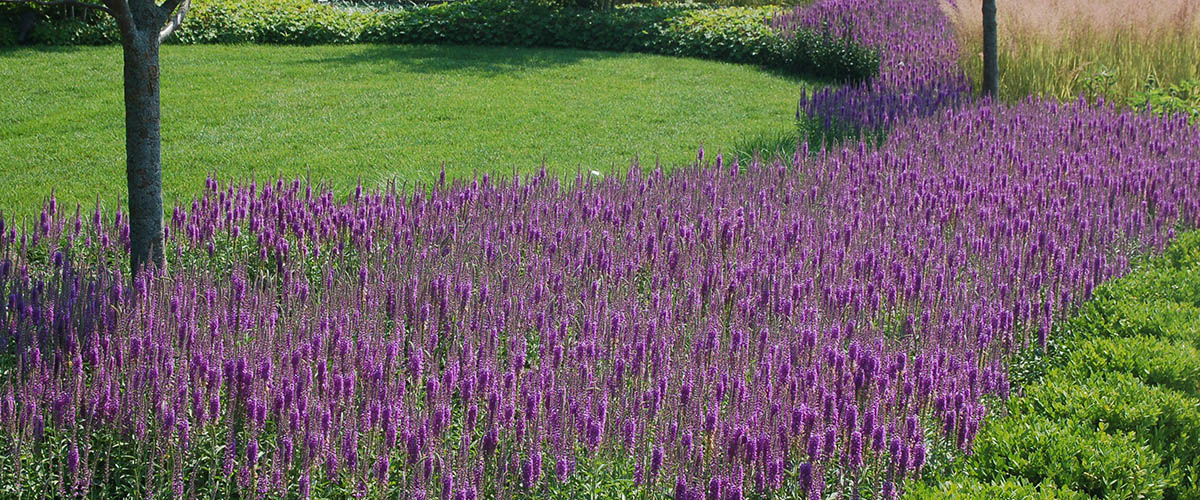
Evaluating Perennials for Chicagoland Gardens
Perennials in Focus is a plant evaluation program that examines new and underused plants for Chicagoland, the third largest metropolitan area in the country. A group of horticultural experts trials and evaluates plants at numerous locations across the region. Results help consumers, public gardens, growers, landscape designers, breeders, and other industry professionals make informed plant choices.
Using perennials to replace lawns in suburban Chicago yards
A traditional lawn can be useful, but it is not the only way to create an attractive, walkable ground layer in a suburban Chicago yard. Turf often struggles beneath mature trees, along drainage areas, beside foundations, and on slopes where mowing is awkward. A thoughtfully planted perennial landscape can fill those spaces with texture, seasonal color, and habitat while reducing mowing and fertilizing.
Replacing grass does not mean covering every square foot with flowers. The most successful designs use plants suited to specific site conditions, with paths, seating areas, mulch, and carefully selected groundcovers creating a practical garden framework. Local trials are especially valuable because a plant that looks promising in a catalog may behave very differently through Chicagoland’s winter, clay soil, humid summers, and variable rainfall.
Start with the site rather than the plant
Observe the proposed lawn replacement through the day and across the seasons. Record hours of direct sun, areas that remain wet after rain, slopes where soil erodes, and places where tree roots compete aggressively for moisture. Soil compaction is common in suburban yards, particularly near driveways, construction zones, and frequently used play areas.
A simple soil test can reveal pH, organic matter, and nutrient levels, but drainage and light are equally important. Many perennials tolerate average soil once established, while very few thrive in a spot that stays saturated or receives far less light than expected. Avoid amending an entire planting area with rich compost before understanding the existing soil; excessive improvement in isolated pockets can create uneven moisture conditions.
Think about how the space will be used. A low-growing planting may suit a front-yard verge, while a backyard pathway needs durable stepping stones and plants that recover from occasional foot traffic. The goal is a functional ground plane, not a collection of attractive plants competing for attention.
Match perennial forms to suburban conditions
For sunny locations, low-growing sedges, creeping perennials, and compact ornamental grasses can provide a soft lawn-like appearance without weekly mowing. Pennsylvania sedge and other native Carex species are useful beneath open tree canopies or in areas with filtered light. Prairie dropseed and little bluestem bring fine foliage and strong winter structure, although they are better suited to informal areas than to a closely clipped turf substitute.
Flowering plants can occupy spaces where uniform green coverage is less important. Wild geranium, prairie smoke, pussytoes, and low-growing asters offer seasonal interest and support pollinators. For a neater edge near a walk, combine a reliable foliage plant with a few flowering accents rather than scattering individual specimens throughout the entire yard.
Shade requires a different palette. Dry shade beneath established trees may suit Pennsylvania sedge, wild ginger, Jacob’s ladder, or woodland phlox, while moist shade opens possibilities for heuchera, golden ragwort, and several fern species. Review this shade perennial guide before choosing plants for a north-facing bed or an area beneath mature oaks.
Design for coverage, access, and succession
A lawn replacement looks intentional when plants are arranged in broad groups instead of repeated as isolated dots. Use drifts of three, five, or more plants, depending on the available space, and repeat key species to connect separate beds. Groundcovers should be planted close enough to knit together, but not so densely that they remain wet and prone to disease.
Layering improves both appearance and ecological value. A low sedge or groundcover can form the base, medium-height perennials can provide summer flowers, and taller grasses or late-season plants can add vertical structure. Leave room for mature spread; a planting that appears sparse in its first year may become crowded after two growing seasons.
Include access before planting. Narrow mown paths, stepping stones, or a durable gravel walk make weeding and seasonal maintenance easier. They also prevent people from cutting across the beds. In a front yard, a simple path through perennial groundcover can preserve a welcoming route from the sidewalk while reducing the area that must be maintained as turf.
| Site condition | Perennial direction | Useful design role | Main consideration |
|---|---|---|---|
| Full sun with average drainage | Sedges, prairie grasses, low asters | Open groundcover or broad drifts | Allow mature spread and seedhead height |
| Filtered shade beneath trees | Woodland sedges, wild geranium, heuchera | Lawn alternative under canopy | Competing roots may require supplemental water |
| Dry, shallow, or sloped soil | Pussytoes, prairie smoke, little bluestem | Erosion control and low-input planting | Establishment watering is essential |
| Moist shade or rain garden edge | Ferns, golden ragwort, woodland phlox | Soft transition around drainage areas | Avoid plants that dislike winter wet |
| Frequently crossed area | Stepping stones with durable groundcover | Pathway or access route | Plants still need protection from regular foot traffic |
| Visible front-yard planting | Repeated sedges, grasses, and flowering accents | Structured curb appeal | Define edges to keep the design tidy |
Choose plants with regional evidence
Plant labels often describe hardiness, but hardiness alone does not predict performance in suburban Chicago. A perennial may survive the coldest winter yet fail because it cannot handle summer humidity, poor drainage, intense competition from tree roots, or repeated freeze-thaw cycles. Bloom duration, mature height, foliage quality, and tendency to flop matter just as much.
Regional evaluation programs provide a more useful picture of how plants perform across real gardens and multiple seasons. Observations from Chicagoland sites can help identify plants that hold their form, bloom reliably, and maintain attractive foliage under local conditions. This information is valuable when selecting newer cultivars, underused species, and plants that have not yet become familiar at local garden centers.
Prioritize dependable structure over constant bloom. A planting with attractive leaves, seedheads, or winter stems can remain appealing long after flowers fade. Combine spring, summer, and fall interest so that the former lawn does not become visually empty in midsummer or after the first frost.
Prepare the ground and establish plants carefully
Removing turf is often the most labor-intensive part of the project. Smothering grass with overlapping cardboard and several inches of compost or mulch can work for a small area, while sod removal may be preferable where grades, drainage, or existing paths must remain precise. Do not bury turf against tree trunks or create a mulch layer that holds moisture against siding and foundations.
Loosen compacted soil without damaging major tree roots. In heavy clay, improve the planting zone gradually with organic matter and select plants that tolerate the existing conditions rather than attempting to recreate woodland soil throughout the yard. A modest mulch layer helps conserve moisture and suppress weeds, but crowns and stems should remain uncovered.
Water new plants deeply during the first growing season, especially during hot, dry periods. Perennial groundcovers often need more establishment care than a homeowner expects because their shallow roots dry quickly. Once rooted, many species require less irrigation than turf, but drought tolerance should never be assumed during the first year.
Manage the planting as a living landscape
A perennial lawn replacement still needs maintenance, though the tasks change. Plan for spring cleanup, selective weeding, division when clumps become crowded, and occasional trimming of grasses or spent stems. Leaving some seedheads standing through winter provides food and shelter for wildlife, while cutting back portions of the planting can keep paths and sightlines clear.
Edges strongly influence how neighbors and visitors perceive an informal planting. A crisp border beside pavement, a narrow mown strip, or a consistent mulch line signals that the design is deliberate. Without an edge, vigorous groundcovers may creep into the lawn and grass may invade the perennial bed.
Watch for plants that spread more aggressively than expected. A successful groundcover can become a maintenance problem if it moves into paths or overwhelms slower neighbors. Monitor the planting during the first few years and remove unwanted seedlings before they mature. Selecting tested, well-behaved plants at the beginning reduces corrective work later.
Build a practical replacement in stages
A complete conversion is not always necessary. Begin with the most difficult turf area, such as a shady side yard, steep bank, or tree-filled corner. Keep lawn where it is useful for play, pets, gatherings, or access, and connect the new perennial areas with compatible forms and repeated plants.
Use these priorities when developing the planting:
- Match every plant to actual light, moisture, soil, and mature space.
- Select regional performers with documented seasonal qualities.
- Combine low groundcovers with medium and taller perennials for layered coverage.
- Add paths, stepping stones, and defined edges before planting densely.
- Give new plants regular first-year watering and monitor their spread.
A phased approach also makes it easier to evaluate what works. Photograph the site during spring, summer, and fall, note bloom times and maintenance needs, and adjust later purchases based on observed performance rather than appearance at the garden center.
A well-planned perennial landscape can make a suburban Chicago yard more resilient, diverse, and visually engaging while reducing dependence on mowed turf. Start with one manageable section, use regional performance information to guide plant choices, and give the planting time to establish. Explore the Perennials in Focus evaluations and apply those findings to a site-specific design that can thrive for years.
In the Garden
Evaluator gardens are located across the Chicagoland area, representing a range of growing conditions. Visit our retail and wholesale partners to find trialled perennials for your own garden.
Retail & Wholesale: Hinsdale Nurseries (Willowbrook, IL), Mariani Nurseries (Kenosha, WI & Garden Prairie, IL), Northwind Perennials (Burlington, WI), The Growing Place (Aurora, IL).
Wholesale Only: Hinsdale Nurseries (Plano, IL), Intrinsic Perennial Gardens (Hebron, IL).
Our Evaluation Program
The 2017–2020 evaluation cycle included Agastache 'Blue Boa', Allium senescens 'Blue Eddy', Amsonia ciliata var. filifolia 'Georgia Pancake', Astilbe 'Chocolate Shogun', Boltonia astroides 'James Crocket', Brunnera 'Alexander's Great', and Geranium cinereum 'Jolly Jewel Purple'. Completed evaluations include Amsonia 'Blue Ice' (2004–07).
On April 10, 2020, the program published snapshot profiles for Vernonia lettermanii 'Iron Butterfly', Stokesia laevis 'Elf', Stachys officinalis 'Pink Cotton Candy', Lobelia 'Monet Moment', Helleborus 'Winter Thrillers', Geum 'Mai Tai', Geranium soboliferum 'Butterfly Kisses', Gentiana x intermedia 'True Blue', Eurybia divaricata, Asparagus 'Purple Passion', and Agastache 'Bolero'.
Browse the full collection of snapshots organized alphabetically — from A–D, E–H, I–Q, and R–Z — to find detailed performance data on perennials trialled across Chicagoland.