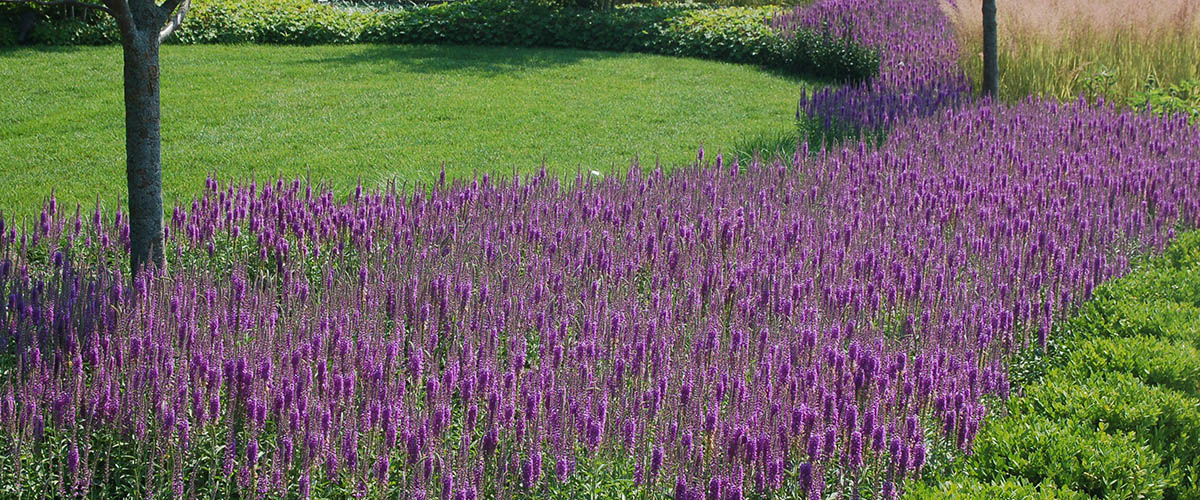
Evaluating Perennials for Chicagoland Gardens
Perennials in Focus is a plant evaluation program that examines new and underused plants for Chicagoland, the third largest metropolitan area in the country. A group of horticultural experts trials and evaluates plants at numerous locations across the region. Results help consumers, public gardens, growers, landscape designers, breeders, and other industry professionals make informed plant choices.
Trialing Thalictrum Aquilegifolium as a Fine-Textured Backdrop
Gardeners often rely on bold foliage and large flowers to create structure, yet a planting can feel heavy when every perennial has the same visual weight. Thalictrum aquilegifolium, commonly called columbine meadow rue, offers a different approach. Its finely divided, blue-green leaves and airy flower clusters can add height, movement, and a translucent layer behind more substantial plants.
That quality makes it worth evaluating in the Chicagoland region, where winter survival, wet spring soils, summer humidity, and fluctuating temperatures can quickly expose weaknesses. A plant that looks graceful in a catalog must also emerge reliably, maintain a useful form, and perform across several garden settings.
A regional trial can reveal whether this meadow rue is best used as a background perennial, a soft screen, or a seasonal accent. The findings published by Perennials in Focus help place those observations in a practical local context, connecting plant performance with the conditions gardeners actually face.
Why Fine Texture Matters In A Border
Fine-textured perennials occupy visual space without creating a solid wall. Thalictrum aquilegifolium produces upright stems carrying deeply divided leaflets, giving the plant a cloudlike appearance. Light passes through the foliage, so neighboring plants remain visible rather than disappearing behind a dense mass.
This transparency is especially useful in mixed borders and woodland-edge plantings. The meadow rue can soften the broad leaves of hostas, ligularias, and Rodgersia, while its vertical stems provide contrast for rounded peonies, sedges, or low ground covers. Its foliage also helps connect plants with very different forms into a more cohesive composition.
The plant’s flower clusters continue that effect. Small flowers are held in loose, elevated sprays rather than carried as large, heavy heads. Depending on the selection, blooms may appear white, pink, lavender, or purple, often creating a haze of color from late spring into early summer.
Traits To Record During A Regional Trial
Height and spread should be measured at several points in the season. A plant may begin as a narrow clump but widen as stems develop, and flower height can differ substantially from foliage height. Recording both measurements helps determine whether a selection belongs at the rear of a border or closer to the middle.
Stem strength deserves equal attention. A fine-textured backdrop should rise above companion plants without collapsing after rain or becoming distorted by wind. Some plants remain upright in open conditions, while others perform best when supported by neighboring perennials or positioned where they receive protection from prevailing winds.
Bloom timing can also determine how useful the plant becomes in a designed border. Early-season flowering may bridge the gap between spring bulbs and summer perennials. Observers should note the first flowers, peak display, fading period, and whether the spent stems retain enough form to contribute after bloom.
Site Conditions And Companion Planting
In Chicagoland, Thalictrum aquilegifolium is likely to perform best in full sun to light shade with consistent moisture and good drainage. Morning sun or filtered light may be helpful in hotter sites, while deeper shade can reduce stem strength and flower production. Soil enriched with organic matter can support steady growth, provided it does not remain waterlogged.
Moisture is particularly important during establishment and flowering. A dry site may produce shorter stems and less impressive flower sprays, while excessive fertility can encourage lush growth that needs staking. A two- to three-inch organic mulch layer can moderate soil temperature and conserve moisture, but it should be kept away from the crown.
The plant pairs well with perennials that have contrasting leaf shapes and compatible bloom periods. Broad-leaved companions can emphasize its airy foliage, while grasses and fernlike plants can extend the fine-textured theme. Strong candidates include hosta, heuchera, Japanese forest grass, Siberian iris, hardy geranium, and late-blooming asters.
Comparing Useful Characteristics
The value of a trial is clearer when observations are consistent. The following framework can help evaluators compare plants across gardens, soil types, and exposure levels.
| Characteristic | What To Observe | Why It Matters |
|---|---|---|
| Emergence | Date and uniformity of spring growth | Indicates winter survival and reliability |
| Mature height | Foliage height and flowering height | Determines placement in a border |
| Spread | Width of the clump during the season | Helps estimate spacing and density |
| Stem strength | Upright form after wind and rain | Reveals whether staking is needed |
| Flower display | Color, fullness, timing, and duration | Measures ornamental impact |
| Foliage quality | Color, density, and persistence | Shows value before and after bloom |
| Self-sowing | Seedling frequency and location | Helps assess maintenance requirements |
| Pest and disease pressure | Leaf damage, mildew, or decline | Supports realistic garden recommendations |
Repeated observations are more informative than a single peak-season impression. A selection that flowers beautifully but flops every year may have limited use as a backdrop. Another with a slightly less dramatic bloom could prove more valuable if it maintains a clean, upright silhouette with little intervention.
Trial notes should include weather patterns and neighboring plants. A crowded planting can conceal weak stems, while a specimen grown alone may appear less stable than it would in a naturalistic border. Photographs taken from the front and side can document transparency, scale, and the way flower sprays interact with companion plants.
Seasonal Performance And Maintenance
Spring emergence is an important part of the evaluation because late or uneven growth can affect the entire border design. Once established, the plant generally forms a dependable clump, though site conditions and winter extremes may influence its return. Marking the planting location prevents accidental disturbance while the crown is dormant.
During the flowering period, selective support may be appropriate if stems lean into paths or neighboring plants. Positioning can often solve the problem: surrounding the meadow rue with sturdy companions may provide enough structure without visible stakes. Excessive nitrogen should be avoided because it can produce soft, elongated growth.
After flowering, gardeners can decide whether to remove the stems or allow them to contribute texture and seed. Deadheading may reduce self-sowing and keep the border tidy, while leaving some seedheads can support a looser, more naturalistic design. Any seedlings should be monitored before they become numerous, especially in gardens where precise spacing is important.
How The Plant Fits Different Garden Styles
In a formal perennial border, Thalictrum aquilegifolium can serve as a light screen behind plants with larger flowers. Its subdued foliage and open flower structure prevent the back row from becoming visually dense. Repetition of the plant in several locations can create rhythm without producing a rigid hedge.
In a woodland-edge or rain garden setting, the plant can appear more relaxed. Grouped in drifts, it creates a veil above lower plants and responds well to layered planting. Its upright habit can also provide a transition between ground-level foliage and small ornamental trees or shrubs.
For growers and retailers, the most useful trial information will include mature dimensions, bloom reliability, support needs, and customer-friendly placement advice. Gardeners need to know whether the plant will fill a narrow space, tolerate a particular light level, and remain attractive after flowering. Clear regional observations make those decisions more dependable than generalized descriptions.
Recommendations For Using Meadow Rue
- Place it toward the middle or rear of a border where its flowering stems can rise above shorter companions.
- Give it full sun or light shade, steady moisture, and soil that drains freely after rain.
- Combine it with broad-leaved perennials to highlight its divided foliage and open silhouette.
- Record height, spread, bloom timing, and lodging over several seasons before judging a selection.
- Monitor self-sown seedlings and remove unwanted plants while they are small.
The strongest use of Thalictrum aquilegifolium may be as a connective layer rather than a solitary focal point. Its fine texture gives bold plantings breathing room, while its flowers add a seasonal veil of color above the foliage line. Regional trial results can show which selections deliver that effect consistently in Chicagoland gardens.
Use these observations when selecting plants for a border, evaluating a new cultivar, or planning a multi-season perennial display. Track performance in your own site, compare it with regional trial data, and give this graceful meadow rue a considered place where height, movement, and transparency can improve the planting.
In the Garden
Evaluator gardens are located across the Chicagoland area, representing a range of growing conditions. Visit our retail and wholesale partners to find trialled perennials for your own garden.
Retail & Wholesale: Hinsdale Nurseries (Willowbrook, IL), Mariani Nurseries (Kenosha, WI & Garden Prairie, IL), Northwind Perennials (Burlington, WI), The Growing Place (Aurora, IL).
Wholesale Only: Hinsdale Nurseries (Plano, IL), Intrinsic Perennial Gardens (Hebron, IL).
Our Evaluation Program
The 2017–2020 evaluation cycle included Agastache 'Blue Boa', Allium senescens 'Blue Eddy', Amsonia ciliata var. filifolia 'Georgia Pancake', Astilbe 'Chocolate Shogun', Boltonia astroides 'James Crocket', Brunnera 'Alexander's Great', and Geranium cinereum 'Jolly Jewel Purple'. Completed evaluations include Amsonia 'Blue Ice' (2004–07).
On April 10, 2020, the program published snapshot profiles for Vernonia lettermanii 'Iron Butterfly', Stokesia laevis 'Elf', Stachys officinalis 'Pink Cotton Candy', Lobelia 'Monet Moment', Helleborus 'Winter Thrillers', Geum 'Mai Tai', Geranium soboliferum 'Butterfly Kisses', Gentiana x intermedia 'True Blue', Eurybia divaricata, Asparagus 'Purple Passion', and Agastache 'Bolero'.
Browse the full collection of snapshots organized alphabetically — from A–D, E–H, I–Q, and R–Z — to find detailed performance data on perennials trialled across Chicagoland.