Evaluating Perennials for Chicagoland Gardens
Perennials in Focus is a plant evaluation program that examines new and underused plants for Chicagoland, the third largest metropolitan area in the country. A group of horticultural experts trials and evaluates plants at numerous locations across the region. Results help consumers, public gardens, growers, landscape designers, breeders, and other industry professionals make informed plant choices.
Trialing Shade Tolerance in Chelone Glabra and Lobelia Cardinalis
Shade gardens in the Chicagoland region can be productive, colorful, and ecologically valuable, especially when their soil remains consistently moist. Yet “shade tolerant” is not a single performance trait. A perennial may survive beneath trees while producing few flowers, or it may bloom well in spring and decline during summer heat.
Chelone glabra, commonly called white turtlehead, and Lobelia cardinalis, or cardinal flower, are useful subjects for regional comparison. Both favor damp conditions and attract pollinators, but they differ in flower color, growth habit, seasonal timing, and their response to reduced light.
A structured evaluation can show where each plant fits in a residential border, rain garden, woodland edge, or public planting. Recording performance across several Chicagoland gardens also helps separate genuine adaptability from results caused by one unusually favorable site.
Why these moisture-loving perennials belong together
White turtlehead is an upright, clump-forming perennial with dark green foliage and pale flowers shaped like a turtle’s head. It commonly flowers from late summer into early fall, when many shade borders are losing color. The stems provide reliable structure and generally remain attractive through changing weather.
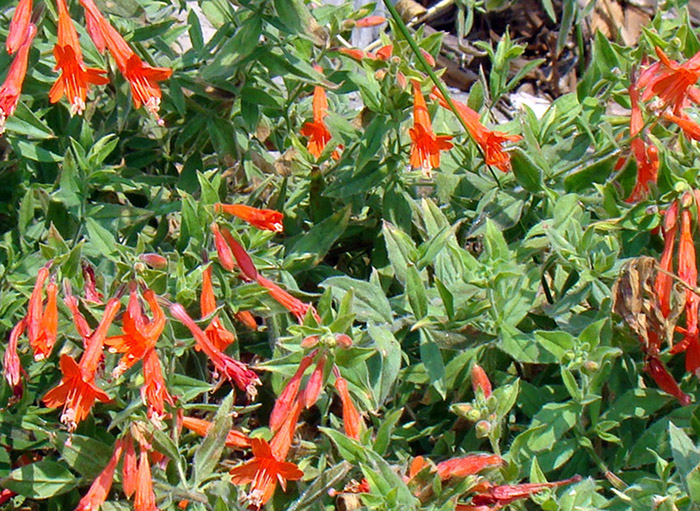
Cardinal flower offers a sharper visual contrast. Its intense red flower spikes are especially noticeable in filtered light, and hummingbirds frequently visit the blooms. The species often performs best in rich, moisture-retentive soil with good air circulation, though individual plants can vary in longevity and vigor.
Comparing the two reveals more than which plant grows in shade. It shows how light level affects flowering, whether stems remain upright after heavy rain, and how reliably each perennial returns after a Midwestern winter.
Defining shade tolerance for a regional trial
A practical trial should distinguish between deep shade, open shade, and part shade. Deep shade may receive less than two hours of direct sun, while open shade can receive bright reflected light throughout the day. Part shade often includes several hours of morning or late-afternoon sun.
The position of the shade matters as well. Deciduous trees create changing light conditions and intense root competition, while buildings may produce steady shade with less competition but poorer air movement. Trial sites should document canopy type, nearby roots, soil texture, irrigation, and the number of hours of direct sunlight during the growing season.
The broader wetland perennial context is also useful. Observations from Vernonia wet meadow trials can help evaluators think about moisture patterns, seasonal durability, and the difference between consistently wet soil and brief periods of saturation.
What evaluators should record
The most useful observations combine measurements with repeated visual assessments. Height and spread can be recorded at peak growth, while flowering data should include the first bloom date, peak display, duration, and the number of flowering stems. A plant that flowers briefly but intensely may serve a different purpose from one with a longer, quieter display.
Foliage quality deserves equal attention. Evaluators can note leaf density, chlorosis, insect damage, mildew, lodging, and damage from drought between rain events. In shade, a plant may remain alive but produce thin stems and sparse leaves, so survival alone should not determine success.
The trial should continue for several seasons. First-year plants may be establishing roots, while second- and third-year plants reveal mature height, clump expansion, winter survival, and self-seeding behavior. Consistent scoring makes results easier to compare across gardens and years.
| Characteristic | Chelone glabra | Lobelia cardinalis |
|---|---|---|
| Common name | White turtlehead | Cardinal flower |
| Typical flower color | White to pale pink | Brilliant red |
| Usual bloom period | Late summer to early fall | Mid- to late summer |
| Mature habit | Upright, sturdy clump | Upright rosette with flower spikes |
| Moisture preference | Evenly moist to wet soil | Moist to wet, rich soil |
| Shade response to evaluate | Flowering and stem strength in open to deep shade | Flowering intensity and longevity in filtered shade |
| Pollinator value | Bees and other flower visitors | Strong hummingbird attraction |
| Key trial concern | Excessive spread or weak growth in dry shade | Short-term persistence and reduced bloom in heavy shade |
Reading differences in flower production
Chelone glabra may prove more dependable where light is limited but soil stays moist. Its flowers are less visually forceful than cardinal flower’s red blooms, yet the pale color can show well against dark foliage and shaded backgrounds. Evaluators should record whether the plant maintains a full flower display or produces only scattered blooms under a tree canopy.
Lobelia cardinalis often makes a dramatic statement when it receives bright filtered light or a small amount of direct sun. In very dense shade, it may produce foliage without developing a strong flowering spike. That response does not make it unsuitable; it identifies the conditions needed for its best ornamental performance.
Flowering height is another important comparison. Cardinal flower can create a narrow vertical accent, while turtlehead often forms a broader, more substantial mass. A trial should document whether either plant becomes hidden by neighboring perennials or whether its stems remain visible through the border’s late-season growth.
Soil, competition, and winter behavior
Moisture-loving plants still need a well-considered root environment. Heavy clay may hold water during spring but become hard and dry in summer. Organic matter can improve structure, but planting beds should not be treated as permanently wet simply because they receive runoff. Irrigation records and soil observations help explain poor performance.
Tree roots may be the strongest source of competition. A plant located beneath mature maples or other thirsty trees can receive less water than the same species planted beside a downspout or pond edge. Trial results should therefore identify whether failure is associated with shade itself or with root competition and drought stress.
Winter survival is especially relevant in the Chicago area, where freeze-thaw cycles, saturated soil, and exposed stems can affect perennial crowns. A successful entry should return evenly, retain a healthy base, and avoid substantial crown loss. Late-season cleanup should be consistent among sites so that maintenance does not distort the comparison.
Turning trial results into planting guidance
The value of a shade trial lies in practical recommendations rather than a single winner. If turtlehead maintains flowering and structure across several low-light sites, it may be the stronger choice for dependable late-season massing. If cardinal flower performs best in bright, moist shade, it can be positioned where its color and hummingbird appeal receive maximum attention.
Home gardeners can use these distinctions to match plants with existing conditions instead of trying to force a perennial into an unsuitable location. Retailers and growers can also use regional observations to describe light and moisture needs more precisely, reducing disappointing purchases.
- Plant Chelone glabra where moist soil, late-season structure, and a durable clump are priorities.
- Reserve Lobelia cardinalis for rich, consistently moist locations with bright filtered light.
- Track bloom timing and flowering density instead of judging shade performance by survival alone.
- Repeat observations for at least two growing seasons before making broad recommendations.
- Pair trial records with notes on tree-root competition, irrigation, and winter return.
Applying the findings across Chicagoland
Results should be presented with site context. A perennial that excels beside a pond may perform differently in a dry suburban foundation bed, even if both locations are described as shaded. Reporting soil moisture, light exposure, maintenance, and winter conditions allows readers to transfer the findings responsibly.
The comparison can also support resilient planting design. Turtlehead may anchor a late-season rain garden or woodland edge, while cardinal flower can supply a vivid vertical accent near a drainage swale, stream margin, or lightly shaded pollinator garden. Combining them with sedges, ferns, and other moisture-tolerant perennials can create layered habitat and extend seasonal interest.
Regional evaluation is most useful when observations remain specific, repeatable, and accessible. By documenting how these species respond to real Chicagoland conditions, growers, designers, public gardens, and home gardeners gain a clearer basis for selecting plants that will perform beyond the catalog description.
Use these trial criteria when assessing your own shaded planting areas, and share observations on bloom, vigor, moisture, and winter return with local horticultural networks. Careful records from individual gardens can strengthen the collective understanding of which perennials truly belong in the region.
In the Garden
Evaluator gardens are located across the Chicagoland area, representing a range of growing conditions. Visit our retail and wholesale partners to find trialled perennials for your own garden.
Retail & Wholesale: Hinsdale Nurseries (Willowbrook, IL), Mariani Nurseries (Kenosha, WI & Garden Prairie, IL), Northwind Perennials (Burlington, WI), The Growing Place (Aurora, IL).
Wholesale Only: Hinsdale Nurseries (Plano, IL), Intrinsic Perennial Gardens (Hebron, IL).
Our Evaluation Program
The 2017–2020 evaluation cycle included Agastache 'Blue Boa', Allium senescens 'Blue Eddy', Amsonia ciliata var. filifolia 'Georgia Pancake', Astilbe 'Chocolate Shogun', Boltonia astroides 'James Crocket', Brunnera 'Alexander's Great', and Geranium cinereum 'Jolly Jewel Purple'. Completed evaluations include Amsonia 'Blue Ice' (2004–07).
On April 10, 2020, the program published snapshot profiles for Vernonia lettermanii 'Iron Butterfly', Stokesia laevis 'Elf', Stachys officinalis 'Pink Cotton Candy', Lobelia 'Monet Moment', Helleborus 'Winter Thrillers', Geum 'Mai Tai', Geranium soboliferum 'Butterfly Kisses', Gentiana x intermedia 'True Blue', Eurybia divaricata, Asparagus 'Purple Passion', and Agastache 'Bolero'.
Browse the full collection of snapshots organized alphabetically — from A–D, E–H, I–Q, and R–Z — to find detailed performance data on perennials trialled across Chicagoland.