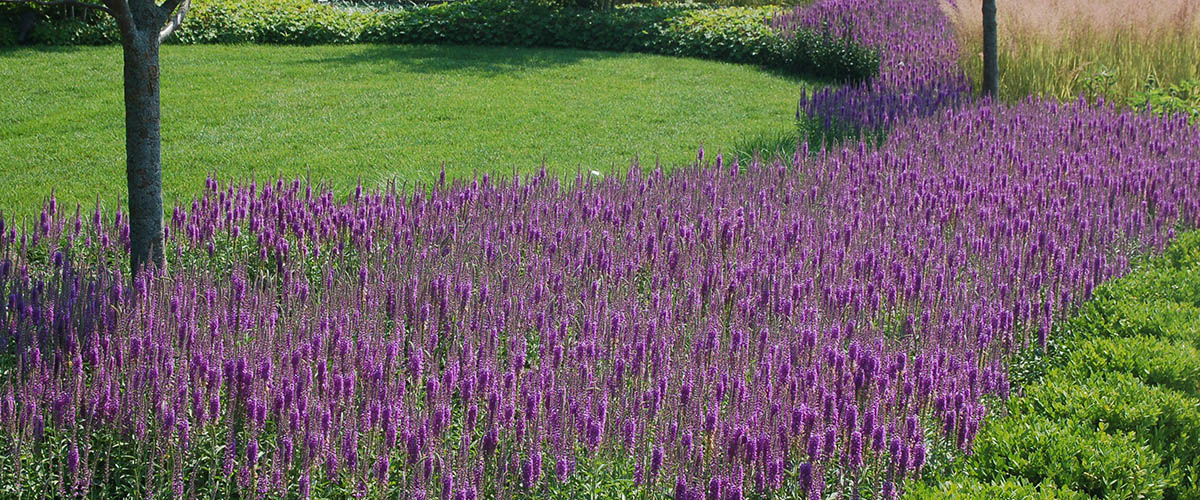
Evaluating Perennials for Chicagoland Gardens
Perennials in Focus is a plant evaluation program that examines new and underused plants for Chicagoland, the third largest metropolitan area in the country. A group of horticultural experts trials and evaluates plants at numerous locations across the region. Results help consumers, public gardens, growers, landscape designers, breeders, and other industry professionals make informed plant choices.
Trialing Campanula Persicifolia In Dappled Light
Campanula persicifolia, commonly called peach-leaved bellflower, is valued for its upright stems, narrow foliage, and open bell-shaped flowers in shades of blue, violet, or white. It is often associated with sunny borders, yet many Chicagoland gardens offer filtered light rather than full sun. Testing how this perennial responds to those conditions can reveal useful options for woodland edges, north-facing borders, and spaces beneath open-canopy trees.
Dappled light is not a single growing condition. Bright morning light filtered through branches differs from deep afternoon shade beside a building. Soil moisture, root competition, air movement, and seasonal changes in the tree canopy can alter the plant’s performance as much as the number of hours of direct sun.
A regional evaluation can therefore provide more practical guidance than a generic hardiness or light rating. By observing peach-leaved bellflower over multiple seasons and locations, horticultural professionals can identify which selections maintain strong stems, reliable flowering, and attractive foliage in the variable conditions common across the Chicago area.
Why Shade Trialing Matters
Campanula persicifolia generally performs best in fertile, well-drained soil with full sun to partial shade. In filtered light, the plant may continue to grow well, but its height, flower quantity, stem strength, and bloom timing can change. These differences matter when selecting plants for mixed borders or public landscapes where consistent performance is important.
A plant that tolerates dappled light may fill a niche between sun-loving perennials and woodland species. It can add vertical structure without the dense foliage associated with many large shade plants. However, tolerance should be judged by overall garden value rather than survival alone. A weak, floppy plant that produces few flowers is less useful than a compact specimen with dependable bloom.
Chicagoland trials are especially valuable because the growing season includes rapid spring temperature changes, humid summers, heavy rainfall events, and occasional dry periods. A selection that looks promising in a controlled nursery setting may respond differently when exposed to local winter conditions and mature-tree competition.
Defining Dappled Light
For a useful trial, dappled light should be described precisely. The term may refer to moving patches of sunlight beneath deciduous trees, bright shade beside a reflective wall, or several hours of direct morning sun followed by filtered afternoon light. Recording the location, nearby vegetation, and seasonal canopy density helps explain differences between sites.
Light levels should be monitored through spring, summer, and early autumn. Bare branches can allow considerably more sun in April than in July, while late-season leaf drop may increase exposure again. A bed that appears shaded during peak summer may provide enough early-season energy for strong growth and flower initiation.
Soil conditions should be documented alongside light. Campanula persicifolia dislikes prolonged waterlogging, even when planted in shade, and tree roots can create intense competition for moisture. Mulch depth, irrigation practices, soil texture, and drainage should be noted so that weak performance is not incorrectly attributed to insufficient sunlight.
Building A Consistent Trial
A reliable evaluation begins with comparable plants. Use plants of similar age and size, label each selection clearly, and establish them during the same planting window. Spacing should allow the mature clump to develop without crowding, while nearby perennials should be recorded because competition can influence height and flowering.
Observations should begin at planting and continue through at least one complete flowering season. Useful records include emergence date, winter survival, number of flowering stems, average stem height, flower color, bloom duration, lodging, foliage quality, and signs of pest or disease pressure. Repeated notes are more informative than a single impression made at peak bloom.
Photographs taken from the same position can support written evaluations. A series showing spring emergence, pre-bloom growth, peak flowering, and late-season form makes it easier to compare selections. Regional plant trial snapshots can provide a helpful model for presenting concise, visually supported observations.
Comparing Performance Across Sites
The strongest evidence comes from multiple gardens rather than one favored planting bed. A selection that excels in bright, moist dappled light may be less successful under dense tree roots. Comparing several settings helps distinguish genetic performance from site effects and reveals where each plant is most likely to succeed.
The following framework can organize observations without treating shade adaptability as a simple pass-or-fail characteristic. Ratings should be supported by notes, photographs, and measurements collected during the same season.
| Trial Condition | Growth Signals To Record | Flowering Signals To Record | Interpretation |
|---|---|---|---|
| Bright dappled light with moist soil | Full clump, sturdy stems, healthy leaves | Abundant flowers and strong color | Indicates broad adaptability under favorable filtered light |
| Morning sun and afternoon shade | Balanced height and limited lodging | Early, sustained flowering | Useful for east-facing borders and open woodland edges |
| Light shade beneath mature trees | Root competition, leaf size, and moisture stress | Reduced or delayed bloom | Helps define the plant’s lower tolerance limit |
| Seasonal shade with spring exposure | Emergence, winter recovery, and stem development | Bloom timing and duration | Shows how changing canopy cover affects the full season |
| Dense shade or poorly drained soil | Sparse growth, yellowing, or dieback | Few flowers or no flowering | May indicate unsuitable conditions rather than poor genetics |
Height and spread should be measured at maturity rather than estimated from a plant tag. A tall selection may create valuable vertical emphasis, but excessive elongation in low light can lead to leaning stems and a disorderly appearance. Flower color should be assessed in both sunlight and shade because filtered light can change how blue and violet tones are perceived.
Recognizing Useful Adaptation
Good performance in dappled light includes more than continued survival. Look for a well-filled crown, firm flowering stems, and leaves that remain green without excessive stretching. A plant that maintains a balanced shape can integrate into a border even if it is slightly shorter than the same selection grown in full sun.
Flowering is another important measure. Shade-adapted plants may bloom later or produce fewer stems, but reliable flowers over several weeks can still make them valuable. Record whether buds open evenly, whether flowers face outward or become hidden in surrounding vegetation, and whether stems remain upright after rain.
Late-season appearance also deserves attention. Some selections decline quickly after flowering, while others retain an attractive basal clump or produce viable seed without becoming invasive. In public gardens and commercial landscapes, clean foliage and manageable spread can be as important as peak bloom.
Turning Results Into Planting Choices
Trial findings become most useful when translated into clear recommendations for gardeners, growers, retailers, and landscape designers. Instead of describing a selection simply as “shade tolerant,” reports can identify the light range, soil conditions, and design role where it performed best.
For home and professional plantings, consider these practical recommendations:
- Place Campanula persicifolia in bright filtered light where it receives some direct morning or late-day sun.
- Improve drainage before planting, especially in shaded beds that remain wet after rain.
- Monitor moisture beneath trees and water during extended dry periods while avoiding constantly saturated soil.
- Use sturdy or naturally compact selections near paths, where leaning stems can interfere with circulation.
- Pair peach-leaved bellflower with ferns, brunnera, heuchera, and other perennials that appreciate similar soil moisture and light.
Growers can use repeated regional observations to prioritize selections for propagation and retail availability. Garden designers can match plant form and bloom timing to specific microclimates rather than relying on a broad “part shade” label. Home gardeners can also use trial data to set realistic expectations: a plant may flower successfully in dappled light without matching the height or bloom density it achieves in full sun.
A shared evaluation system strengthens those decisions because observations from several gardens can be compared over time. The broader regional evaluation program connects plant performance with the conditions that matter most to local landscapes, making trial results more relevant than generic descriptions.
Use the recorded findings to identify the best light range for each Campanula persicifolia selection, then test promising plants in a small, well-documented area of your own garden. Sharing observations across Chicagoland gardens will help build a clearer picture of which peach-leaved bellflowers bring dependable form and bloom to dappled light.
In the Garden
Evaluator gardens are located across the Chicagoland area, representing a range of growing conditions. Visit our retail and wholesale partners to find trialled perennials for your own garden.
Retail & Wholesale: Hinsdale Nurseries (Willowbrook, IL), Mariani Nurseries (Kenosha, WI & Garden Prairie, IL), Northwind Perennials (Burlington, WI), The Growing Place (Aurora, IL).
Wholesale Only: Hinsdale Nurseries (Plano, IL), Intrinsic Perennial Gardens (Hebron, IL).
Our Evaluation Program
The 2017–2020 evaluation cycle included Agastache 'Blue Boa', Allium senescens 'Blue Eddy', Amsonia ciliata var. filifolia 'Georgia Pancake', Astilbe 'Chocolate Shogun', Boltonia astroides 'James Crocket', Brunnera 'Alexander's Great', and Geranium cinereum 'Jolly Jewel Purple'. Completed evaluations include Amsonia 'Blue Ice' (2004–07).
On April 10, 2020, the program published snapshot profiles for Vernonia lettermanii 'Iron Butterfly', Stokesia laevis 'Elf', Stachys officinalis 'Pink Cotton Candy', Lobelia 'Monet Moment', Helleborus 'Winter Thrillers', Geum 'Mai Tai', Geranium soboliferum 'Butterfly Kisses', Gentiana x intermedia 'True Blue', Eurybia divaricata, Asparagus 'Purple Passion', and Agastache 'Bolero'.
Browse the full collection of snapshots organized alphabetically — from A–D, E–H, I–Q, and R–Z — to find detailed performance data on perennials trialled across Chicagoland.