Evaluating Perennials for Chicagoland Gardens
Perennials in Focus is a plant evaluation program that examines new and underused plants for Chicagoland, the third largest metropolitan area in the country. A group of horticultural experts trials and evaluates plants at numerous locations across the region. Results help consumers, public gardens, growers, landscape designers, breeders, and other industry professionals make informed plant choices.
Measuring salvia rebloom after an early summer cut
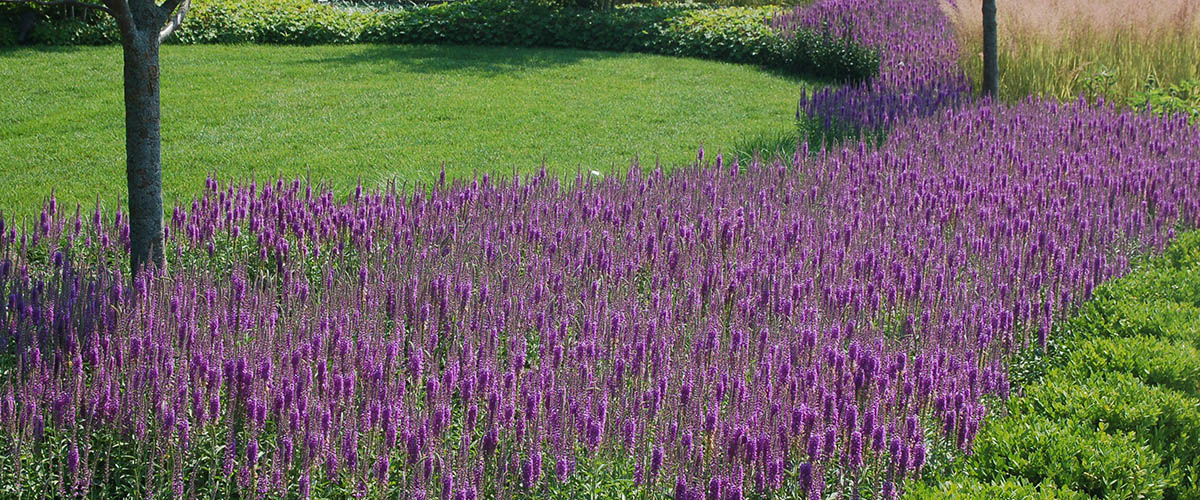
Salvia nemorosa is valued for its upright flower spikes, aromatic foliage and reliable performance in sunny perennial borders. Many cultivars produce their strongest display in late spring or early summer, then pause as spent stems and seed heads accumulate. A well-timed shear can encourage fresh shoots and a second flush, but the speed and strength of that recovery vary between plants.
Trialing the reblooming frequency of Salvia nemerosa after early summer shearing requires more than recording whether a plant flowers again. A useful evaluation tracks how quickly new buds appear, how many flowering stems develop, how long the second display lasts and whether the plant maintains a tidy, vigorous habit.
The results can guide gardeners and growers well beyond the original trial region. Chicagoland data reflects cold winters, warm summers and variable rainfall, while Australian gardens may experience very different seasonal rhythms. The core method still helps compare cultivars for conditions in Melbourne, Adelaide, Sydney or other regions when local observations are added.
Defining a useful reblooming trial
The first step is to establish a consistent starting point. Plants should be similar in age, container size, planting position and general health. Record the date of peak first flowering, then shear all trial plants within a narrow window immediately after the initial flush fades. Cutting back by roughly one-third to one-half, while retaining healthy basal foliage, usually provides a practical treatment for garden conditions.
A more severe cut may remove too much active leaf area, particularly during hot weather or drought. A light trim may leave untidy stems and reduce the uniformity of the comparison. The chosen height should be recorded precisely, along with irrigation, fertiliser, rainfall and any pest or disease issues.
“Reblooming frequency” can describe several related outcomes. Count the number of plants that flower again, the number of flowering flushes within a set period and the days from shearing to the first open flower. Record the duration of each flush as well, since a quick but sparse flowering event may be less valuable than a later, fuller display.
Choosing plants and trial sites
Include several cultivars with different habits, colours and mature sizes. Compact selections may recover quickly because their branching is naturally dense, while taller forms may take longer to rebuild flowering stems. Blue-violet flowers are common, but pink, white and darker purple cultivars can be assessed together if flower colour and visual impact are recorded separately.
Trials should use replicated plants rather than a single specimen of each cultivar. Three to five plants per selection, repeated across more than one garden, will reveal whether a result is consistent or simply caused by one unusually vigorous plant. Randomising positions within each bed reduces the influence of shade, soil variation and nearby competition.
The regional trial findings from Perennials in Focus provide a useful model for this approach. Its evaluations consider performance across gardens and seasons, which is especially important when a perennial responds differently to soil moisture, winter temperatures or exposure.
For Australian growers, site selection deserves close attention. A plant that reblooms reliably in a cool Melbourne garden may behave differently in Brisbane’s warmer, more humid conditions. In Perth, rapid drying and sandy soil can shorten the recovery period unless irrigation is dependable. These differences should be treated as part of the evidence rather than as inconvenient variation.
Recording the second flowering flush
Begin observations on the day of shearing and continue at regular intervals, such as twice weekly during active regrowth. Record the date when new basal shoots become visible, when flower spikes emerge and when the first individual flowers open. The interval between cutting and flowering is one of the clearest measures of recovery speed.
At each observation, count flowering stems on every plant or use a defined sample area for large clumps. Note stem height, branching, flower-spike length and the proportion of stems carrying open flowers. A simple score for visual fullness, such as one to five, can complement the numerical data, provided the same observer and criteria are used throughout the trial.
| Measure | What to record | Why it matters |
|---|---|---|
| Recovery time | Days from shearing to visible shoots and first open flowers | Shows how quickly a cultivar resumes growth |
| Rebloom rate | Percentage of plants producing a second flush | Separates dependable cultivars from occasional performers |
| Flowering density | Number of flowering stems per plant or measured area | Indicates the strength of the display |
| Display duration | Days from first to final useful flowers | Captures garden value beyond the first opening |
| Plant habit | Height, spread, lodging and foliage quality | Shows whether the cut produces an attractive plant |
| Health response | Wilt, scorch, disease or pest damage | Helps explain poor recovery and regional limits |
Photographs taken from the same distance and direction add valuable visual evidence. Use a reference object or marked frame so that images can be compared across dates. Avoid judging a cultivar solely by its best day; a plant that opens unevenly or collapses after heavy rain may have lower landscape value than its peak photograph suggests.
Interpreting climate and maintenance effects
Temperature and moisture strongly influence post-shear recovery. In a Chicagoland evaluation, early summer shearing may be followed by warm days that support rapid regrowth, but drought or extreme heat can delay flowering. In Australian gardens, the timing may need to shift with local seasons. A Melbourne trial might shear after the first spring flush, whereas a cool-climate garden at higher elevation may wait until conditions are consistently warm.
Watering should be applied consistently during the recovery phase, particularly in newly planted beds. However, excessive irrigation or poor drainage can encourage weak growth and root problems. Salvia nemorosa generally performs best in full sun and free-draining soil, so a cultivar should not be labelled a poor rebloomer when the trial site remains waterlogged or shaded.
Maintenance customs also affect the result. Australian home gardeners often give perennial borders a substantial tidy-up before summer holidays, while commercial nurseries may shear blocks for uniform presentation and timed sales. The trial should distinguish between a scheduled evaluation cut and routine maintenance. Fertiliser applications, mulch depth and nearby irrigation should be documented so that results can be repeated.
The programme’s evaluation committee offers an example of the professional oversight useful in plant assessments. Independent observations help reduce the chance that a particularly attractive colour, brand reputation or strong first flush will overshadow weaker performance after cutting.
Turning observations into planting decisions
The best cultivar will depend on the intended use. A public garden may prefer long display duration and a strong, uniform second flush. A small suburban border may value compact growth, sturdy stems and a quick return to bloom. Retailers may also need clear information about expected height, spread and rebloom timing so customers can match plants to realistic garden conditions.
Results should be reported with the weather and management details attached. Instead of stating that a cultivar “reblooms well”, describe the proportion of plants that flowered again, the average number of days to flowering and the number of useful flowering stems. Include the range between plants, since uniformity is often as important as the average result.
For Australian consumers, regional qualification is essential. A cultivar that performs strongly in a northern Victorian trial should not automatically be promoted as equally reliable in tropical Queensland. Nursery labels, local demonstration beds and independent trial notes can build a more accurate market picture over several seasons.
The final assessment should combine rebloom data with year-round performance. Winter survival, spring emergence, foliage health, drought tolerance and resistance to lodging all contribute to the plant’s value. A second flush is worthwhile when it adds a substantial period of colour without demanding repeated cutting, constant watering or intensive correction.
Gardeners and professionals can put this method into practice by selecting a small group of Salvia nemorosa cultivars, applying the same early-season shear and keeping dated records through the following flowering cycle. Share results with local growing groups, nurseries and evaluation networks so that regional knowledge becomes more useful over time. Use the findings from Perennials in Focus alongside observations from your own Australian garden to choose plants that deliver dependable colour after the first display has passed.
In the Garden
Evaluator gardens are located across the Chicagoland area, representing a range of growing conditions. Visit our retail and wholesale partners to find trialled perennials for your own garden.
Retail & Wholesale: Hinsdale Nurseries (Willowbrook, IL), Mariani Nurseries (Kenosha, WI & Garden Prairie, IL), Northwind Perennials (Burlington, WI), The Growing Place (Aurora, IL).
Wholesale Only: Hinsdale Nurseries (Plano, IL), Intrinsic Perennial Gardens (Hebron, IL).
Our Evaluation Program
The 2017–2020 evaluation cycle included Agastache 'Blue Boa', Allium senescens 'Blue Eddy', Amsonia ciliata var. filifolia 'Georgia Pancake', Astilbe 'Chocolate Shogun', Boltonia astroides 'James Crocket', Brunnera 'Alexander's Great', and Geranium cinereum 'Jolly Jewel Purple'. Completed evaluations include Amsonia 'Blue Ice' (2004–07).
On April 10, 2020, the program published snapshot profiles for Vernonia lettermanii 'Iron Butterfly', Stokesia laevis 'Elf', Stachys officinalis 'Pink Cotton Candy', Lobelia 'Monet Moment', Helleborus 'Winter Thrillers', Geum 'Mai Tai', Geranium soboliferum 'Butterfly Kisses', Gentiana x intermedia 'True Blue', Eurybia divaricata, Asparagus 'Purple Passion', and Agastache 'Bolero'.
Browse the full collection of snapshots organized alphabetically — from A–D, E–H, I–Q, and R–Z — to find detailed performance data on perennials trialled across Chicagoland.