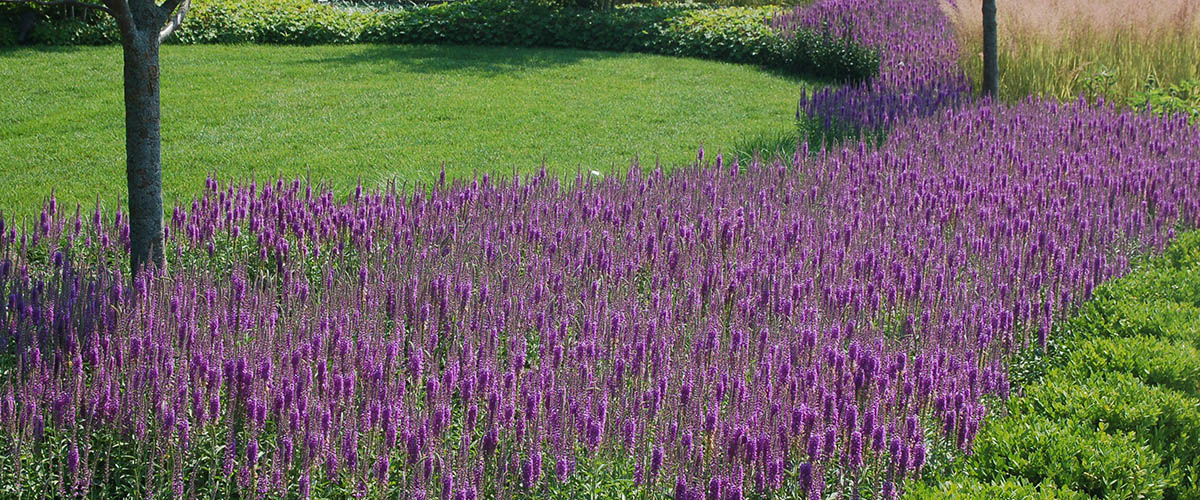
Evaluating Perennials for Chicagoland Gardens
Perennials in Focus is a plant evaluation program that examines new and underused plants for Chicagoland, the third largest metropolitan area in the country. A group of horticultural experts trials and evaluates plants at numerous locations across the region. Results help consumers, public gardens, growers, landscape designers, breeders, and other industry professionals make informed plant choices.
Chelone lyonii evaluated for moist meadow plantings
Chelone lyonii, commonly known as turtlehead, is a moisture-loving perennial native to the woodlands and wet meadows of eastern North America. The plant produces hooded, snapdragon-like flowers in soft pink to rose tones during late summer, offering colour precisely when many perennial borders begin to fade. Its glossy, lance-shaped foliage remains attractive throughout the growing season, and the upright stems typically reach between 60 and 90 centimetres under favourable conditions.
Perennials in Focus conducts systematic evaluations of new and underused perennials across multiple trial sites in the Chicago region. The program records detailed information on growth rate, bloom duration, winter hardiness, and aesthetic qualities, then publishes region-specific results to support informed decisions by gardeners and landscape professionals. While the primary trial network sits in the United States Midwest, the data offers relevant insights for Australian growers in temperate climates, particularly those gardening in Melbourne, Hobart, Canberra, and the elevated areas of southern New South Wales where cold winters and moist conditions mirror the original evaluation environment.
Interest in moisture-loving perennials has grown steadily among Australian gardeners responding to both climate variability and stricter stormwater management requirements. Many local councils now encourage or require bioswales, rain gardens, and water-sensitive urban design features in suburbs undergoing new development. Plants that tolerate periodic saturation while still delivering ornamental value have therefore shifted from niche curiosities to practical landscape solutions.
The current evaluation focuses on how Chelone lyonii performs when planted in deliberately wet meadow contexts rather than conventional perennial borders. Trial coordinators are tracking how the species competes with neighbouring perennials, how it responds to seasonal flooding, and whether observed disease pressures in North American sites appear in similar temperate zones abroad.
Growth habits and morphological traits
The species emerges from winter dormancy in mid to late spring, producing sturdy stems clothed in opposite, deep green leaves with serrated margins. Mature clumps gradually expand through rhizomatous growth, forming dense colonies that can reach 45 to 60 centimetres across within three seasons. Unlike some vigorous moisture perennials, Chelone lyonii spreads at a measured pace, rarely overwhelming neighbouring plants when given adequate space.
Foliage remains largely blemish-free throughout the growing season in trial observations, with only minor signs of black spot or powdery mildew appearing during extended periods of high humidity. Stems hold their upright form without staking in most exposure conditions, though trial plots in partial shade recorded slightly taller and more lax stems than those receiving full morning sun.
Root architecture appears well suited to clay and loam soils that retain moisture without becoming anaerobic. Trial coordinators noted that plants installed in compacted urban soils performed adequately when organic matter was incorporated at planting, but showed reduced vigour in heavy, unamended clay. For Australian gardeners dealing with the reactive clay soils common across parts of Melbourne and western Sydney, generous soil preparation pays clear dividends.
Trial methodology and garden contexts
The evaluation protocol follows standardised procedures across multiple cooperating gardens, with each site recording environmental conditions, soil characteristics, and maintenance inputs. Plant material is propagated from the same stock to ensure genetic uniformity, and each trial plot includes at least three replicate plants per cultivar. Observations are logged at two-week intervals throughout the growing season, capturing phenological data, pest and disease incidence, and overall plant vigour ratings.
In Chicago-area trial gardens, Chelone lyonii was planted in raised beds designed to hold moisture, as well as in lower-lying meadow plantings where natural rainfall occasionally caused temporary standing water. Results from these contrasting settings have informed recommendations about suitable garden positions. Readers interested in the detailed methodology can review the full trialing framework used across all evaluation projects.
Australian gardeners replicating similar conditions might look to the Royal Botanic Gardens Melbourne or trial beds at ABC Gardening Australia host gardens in coastal New South Wales as reference sites. The cool, moist conditions of Tasmania and the Southern Highlands provide particularly apt analogues to the original trial environment, allowing direct comparison of plant behaviour across hemispheres.
Flowering performance and seasonal interest
Bloom initiation typically occurs in late January through early February in the trial sites, aligning with late summer in the Northern Hemisphere and the equivalent late summer to early autumn window in Australian temperate zones. Individual flowers persist for roughly two weeks on the stem, with the overall bloom period extending across four to six weeks depending on temperature and moisture availability. The soft pink tones provide a gentle counterpoint to the strong yellows and oranges of late-season Rudbeckia, Helenium, and Solidago often grown in similar settings.
Pollinator observations recorded frequent visits from bumblebees and honeybees, which are capable of forcing open the closed flower lips to access nectar. The flowers also attract native Australian bees when grown locally, particularly in garden trials conducted in the Adelaide Hills and parts of Victoria. Butterflies, including the common brown and cabbage white, occasionally visit the blooms though they are not primary pollinators.
Seed heads develop modestly after flowering and offer minimal ornamental value compared with the fresh blooms. Most trial coordinators recommend light deadheading only where self-seeding is a concern, as the seed heads do not detract significantly from the late-season foliage display.
Challenges and maintenance observations
Disease pressure remained generally low across trial sites, though powdery mildew appeared in gardens with overhead irrigation and poor air circulation. Sites that provided morning sun, adequate spacing, and drip irrigation recorded the cleanest foliage through to autumn. Australian gardeners in humid coastal suburbs should pay particular attention to these factors, as conditions around Sydney's northern beaches and parts of Brisbane can favour fungal development.
Slugs and snails occasionally damaged young shoots in trial plots, particularly during wet springs. In Australia, the introduced common garden snail poses a familiar challenge in temperate regions, and protective measures such as iron-based baits or copper collars may be warranted for new plantings. No significant browsing damage from larger animals was observed, though Australian gardeners should remain mindful of possum activity in established gardens, as these native animals sometimes sample unfamiliar perennials.
The plant demonstrated strong winter hardiness in Chicago-area trials, with consistent emergence following soil temperatures that regularly fell below minus 20 degrees Celsius. Australian gardeners in alpine regions can expect similarly reliable dormancy, while those in subtropical climates such as Brisbane or Perth may find the plant struggles during hot, dry summers without supplementary irrigation and afternoon shade.
Landscape applications and companion planting
Chelone lyonii excels in landscape applications where moisture is reliably present. The species works effectively in rain gardens, bioswales, pond margins, and naturalised meadow plantings where seasonal flooding occurs. The upright form and late-season colour also suit commercial landscapes, public park plantings, and golf course rough areas.
Companion plants that share similar moisture requirements include Lobelia cardinalis, Eupatorium maculatum, Vernonia noveboracensis, and various iris species adapted to wet soils. Recent evaluation of iris cultivars offers complementary guidance for gardeners designing moist meadow plantings, and the sibirica trial basics provide a useful starting point for plant selection. Designers in Australia might pair Chelone lyonii with local alternatives such as native Dampiera or Wahlenbergia species for regional authenticity, while still capitalising on the turtlehead's distinctive floral form.
In naturalistic garden designs gaining popularity across Australian suburbs from Fremantle to Fitzroy, Chelone lyonii offers a structural counterpoint to finer-textured grasses such as Carex species and Poa labillardieri. The combination delivers movement, late-season colour, and ecological value in a single planting scheme that requires relatively little intervention once established.
Trial findings continue to be updated as new seasons of data accumulate, providing an evolving picture of perennial performance in challenging landscape settings. For ongoing evaluation results, planting recommendations, and opportunities to participate in citizen science reporting, explore the full range of resources published by Perennials in Focus. Readers keen to contribute observational notes from Australian garden trials or suggest species for future evaluation cycles can connect with the program through its online portal, helping expand the practical relevance of trialing work beyond the original North American trial network.
In the Garden
Evaluator gardens are located across the Chicagoland area, representing a range of growing conditions. Visit our retail and wholesale partners to find trialled perennials for your own garden.
Retail & Wholesale: Hinsdale Nurseries (Willowbrook, IL), Mariani Nurseries (Kenosha, WI & Garden Prairie, IL), Northwind Perennials (Burlington, WI), The Growing Place (Aurora, IL).
Wholesale Only: Hinsdale Nurseries (Plano, IL), Intrinsic Perennial Gardens (Hebron, IL).
Our Evaluation Program
The 2017–2020 evaluation cycle included Agastache 'Blue Boa', Allium senescens 'Blue Eddy', Amsonia ciliata var. filifolia 'Georgia Pancake', Astilbe 'Chocolate Shogun', Boltonia astroides 'James Crocket', Brunnera 'Alexander's Great', and Geranium cinereum 'Jolly Jewel Purple'. Completed evaluations include Amsonia 'Blue Ice' (2004–07).
On April 10, 2020, the program published snapshot profiles for Vernonia lettermanii 'Iron Butterfly', Stokesia laevis 'Elf', Stachys officinalis 'Pink Cotton Candy', Lobelia 'Monet Moment', Helleborus 'Winter Thrillers', Geum 'Mai Tai', Geranium soboliferum 'Butterfly Kisses', Gentiana x intermedia 'True Blue', Eurybia divaricata, Asparagus 'Purple Passion', and Agastache 'Bolero'.
Browse the full collection of snapshots organized alphabetically — from A–D, E–H, I–Q, and R–Z — to find detailed performance data on perennials trialled across Chicagoland.