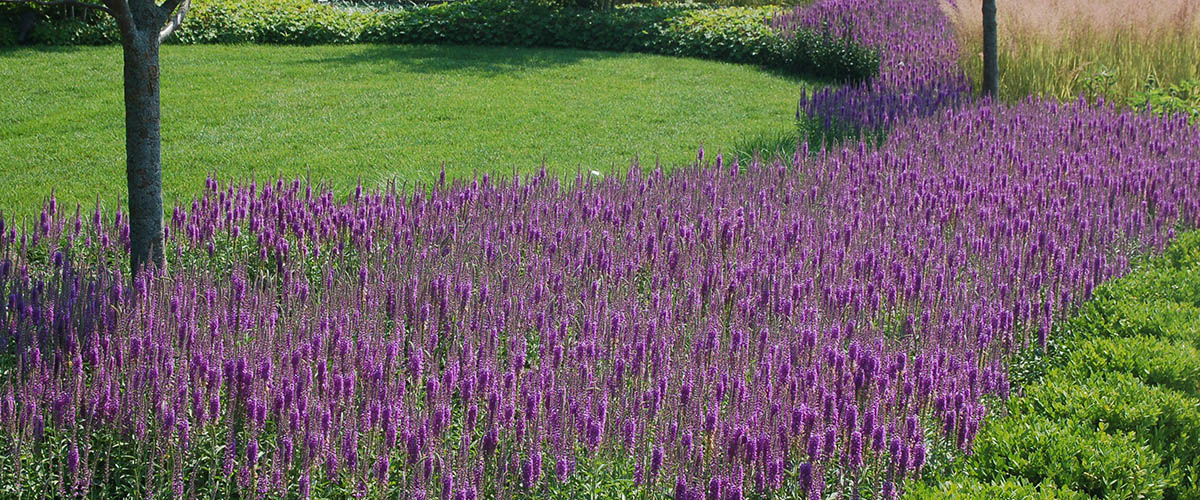
Evaluating Perennials for Chicagoland Gardens
Perennials in Focus is a plant evaluation program that examines new and underused plants for Chicagoland, the third largest metropolitan area in the country. A group of horticultural experts trials and evaluates plants at numerous locations across the region. Results help consumers, public gardens, growers, landscape designers, breeders, and other industry professionals make informed plant choices.
Alchemilla Mollis: Dry Shade Versus Moist Sun
Alchemilla mollis, commonly called lady’s mantle, is valued for its rounded, pleated foliage, frothy lime-green flowers and ability to soften the edges of paths and borders. Its leaves catch dew and rain in silvery beads, giving the plant a distinctive quality that keeps it useful after flowering has finished. Yet its performance changes considerably according to light, soil moisture and summer heat.
A trial comparing dry shade with moist sun can reveal where this perennial earns a place in Australian gardens. Findings from the Perennials in Focus program are generated in the Chicagoland region, so they should be treated as a disciplined reference rather than a direct prediction for Sydney, Melbourne or Brisbane. The underlying method—comparing growth, flowering, plant form and seasonal durability—remains valuable for gardeners working with different climates.
| Growing situation | Likely growth pattern | Main advantage | Main risk |
|---|---|---|---|
| Dry shade | Slower spread, smaller leaves and reduced flowering | Useful foliage for difficult areas | Summer stress, scorch and premature collapse |
| Moist sun | Fuller clumps, stronger stems and more flowers | Best overall display where drainage is sound | Leaf scorch, mildew or flopping in intense heat |
| Bright filtered light | Balanced growth with moderate flowering | Often a practical compromise | Results depend on afternoon heat |
| Cool, well-drained soil | Long-lived, vigorous foliage | Supports reliable establishment | Crown problems if soil stays saturated |
What The Trial Should Measure
A useful evaluation begins with consistent plants, matching soil preparation and clearly defined observations. Record establishment speed, clump width, plant height, flowering dates, flower-stem strength and foliage quality. A plant that flowers heavily for three weeks but collapses in January may be less useful than one with a restrained display and attractive leaves for most of the year.
The comparison should include at least several plants in each location, rather than relying on a single specimen. Measure soil moisture at planting, during establishment and through the hottest part of summer. Notes should also record whether shade comes from a deciduous tree, evergreen canopy, fence or building, because each creates a different pattern of rainfall, root competition and seasonal light.
Performance In Dry Shade
Alchemilla mollis can tolerate shade, but “dry shade” describes a demanding combination rather than a gentle refuge. Mature trees may remove substantial water from the root zone, while overhanging foliage intercepts rainfall. Under these conditions, lady’s mantle may produce a smaller canopy, fewer flower stems and a looser habit than it shows in fertile, evenly moist soil.
In Australian gardens, this setting is common beneath established eucalypts in Melbourne, Canberra and parts of Adelaide, where summer soils can become hard and hydrophobic. Mulching with composted organic matter can improve moisture retention, but it will not replace irrigation during prolonged heat. Water should be applied deeply during establishment, with the crown kept clear of constantly wet mulch.
Dry shade may still be worthwhile when the goal is ground-level texture rather than maximum bloom. The pleated leaves can brighten a dark border, especially beside ferns, hellebores or fine-leaved grasses. In very hot districts such as western Sydney or Brisbane, however, dense afternoon shade may protect the foliage while high humidity increases the need for airflow.
Performance In Moist Sun
Moist sun is likely to produce the strongest trial result when the soil drains freely. Consistent moisture supports broad leaves, a fuller clump and more numerous sprays of yellow-green flowers. Morning sun with protection from fierce afternoon heat may be especially effective in Australia, where summer radiation can be considerably more intense than conditions suggested by a cool-climate trial.
The phrase “moist sun” should not be confused with waterlogged ground. Alchemilla mollis dislikes a stagnant crown, and heavy clay that remains saturated can lead to root and crown decline. Raised beds, improved soil structure and a position with reliable drainage are preferable to planting directly into a boggy depression.
Flowering stems may need support where plants receive rich soil, regular irrigation and long growing seasons. Cutting the spent flower sprays can improve the appearance of the clump and encourage fresh basal foliage. In cooler southern cities, the flowers can contribute to a soft early-summer palette; in hotter areas, the display may finish earlier and require more careful water management.
Soil, Water And Establishment
The best soil for lady’s mantle is moisture-retentive yet open, with enough organic matter to hold water without excluding air. Before planting, incorporate well-aged compost into poor soil and break up compacted layers. Avoid placing the crown too deeply, as buried growth points are vulnerable to rot and slow recovery.
Regular watering during the first growing season is more important than frequent shallow sprinkling. This is familiar to Australian gardeners who already use drip irrigation or water early in the morning to reduce evaporation. A 50–75 millimetre layer of mulch can moderate soil temperature, but it should be pulled back slightly from the plant base.
Once established, plants in moist sun may need less intervention than those in dry shade, provided the soil is deep enough. In water-conscious gardens, group lady’s mantle with other perennials that accept periodic irrigation rather than planting it beside drought specialists such as lavender, westringia or many ornamental salvias.
Seasonal Results Across Australia
A Chicagoland evaluation captures cold winters, snow exposure and a distinct seasonal rhythm. Australian results will vary widely. Melbourne and Hobart may offer cool conditions that favour foliage quality, while Perth and Adelaide can impose long, dry summers. Sydney combines warm temperatures with variable rainfall, and Brisbane adds humidity that can change disease pressure and flowering duration.
The contrast between sites is precisely why recorded trials are useful. A plant may perform impressively in a Melbourne courtyard with afternoon shade but struggle in an exposed Adelaide border. Gardeners can review regional plant snapshots for a model of concise, trait-based observation, then adapt those categories to their own garden conditions.
Trial notes should separate seasonal damage from permanent weakness. A plant that wilts during a heatwave but recovers after deep watering has a different value from one that loses its crown. Likewise, winter wet in Tasmania or frost in Canberra may reveal limitations that are invisible during a mild coastal season.
Design And Maintenance Value
Lady’s mantle works well at the front of mixed borders, along informal paths and beneath taller perennials. Its scalloped leaves create a broad, low layer that contrasts with upright flower spikes and narrow foliage. The airy flower sprays can also act as a transition between bold colours, particularly blues, purples and soft pinks.
In the Australian retail market, it is more likely to appear as a specialist or seasonal offering than as a universal garden-centre staple. Availability can vary between independent nurseries, mail-order growers and larger chains. Plants purchased in small pots need careful aftercare, especially if they move from protected nursery conditions into exposed suburban beds.
A tidy annual cutback removes tired foliage and old flower stems, but timing should reflect local climate. In a mild area, cutting after flowering may encourage fresh leaves; in a hot, dry district, retaining some foliage can protect the crown until cooler weather. Divide mature clumps in a mild season when plants are actively growing, avoiding periods of extreme heat or water restriction.
Interpreting The Evidence Carefully
The strongest conclusion from a dry-shade versus moist-sun comparison is unlikely to be that one location suits every garden. Moist sun generally offers better growth potential, while dry shade tests the plant’s tolerance and practical usefulness in spaces where choices are limited. A high-quality trial should report both strengths and failures instead of treating survival alone as success.
This approach also places local regulation and responsible sourcing in context. Australian gardeners should check state or territory biosecurity rules before importing plant material, sharing plants across borders or purchasing from overseas sellers. Weed status and permitted plant movement can vary, so availability should be confirmed through local authorities and reputable nurseries rather than assumed from an online listing.
The same careful thinking applies to weather extremes. Research on snow-load performance demonstrates how a plant’s value can depend on a specific environmental pressure. For Australian gardeners, the equivalent pressures may be heatwaves, water restrictions, intense sun, humid nights or prolonged winter wet.
Use the trial as a guide when selecting Alchemilla mollis, then test it in the conditions that matter locally. Record light, soil moisture, flowering, spread and recovery after heat, and share reliable observations with growers, retailers and garden evaluators so future recommendations become more useful across Australia.
In the Garden
Evaluator gardens are located across the Chicagoland area, representing a range of growing conditions. Visit our retail and wholesale partners to find trialled perennials for your own garden.
Retail & Wholesale: Hinsdale Nurseries (Willowbrook, IL), Mariani Nurseries (Kenosha, WI & Garden Prairie, IL), Northwind Perennials (Burlington, WI), The Growing Place (Aurora, IL).
Wholesale Only: Hinsdale Nurseries (Plano, IL), Intrinsic Perennial Gardens (Hebron, IL).
Our Evaluation Program
The 2017–2020 evaluation cycle included Agastache 'Blue Boa', Allium senescens 'Blue Eddy', Amsonia ciliata var. filifolia 'Georgia Pancake', Astilbe 'Chocolate Shogun', Boltonia astroides 'James Crocket', Brunnera 'Alexander's Great', and Geranium cinereum 'Jolly Jewel Purple'. Completed evaluations include Amsonia 'Blue Ice' (2004–07).
On April 10, 2020, the program published snapshot profiles for Vernonia lettermanii 'Iron Butterfly', Stokesia laevis 'Elf', Stachys officinalis 'Pink Cotton Candy', Lobelia 'Monet Moment', Helleborus 'Winter Thrillers', Geum 'Mai Tai', Geranium soboliferum 'Butterfly Kisses', Gentiana x intermedia 'True Blue', Eurybia divaricata, Asparagus 'Purple Passion', and Agastache 'Bolero'.
Browse the full collection of snapshots organized alphabetically — from A–D, E–H, I–Q, and R–Z — to find detailed performance data on perennials trialled across Chicagoland.