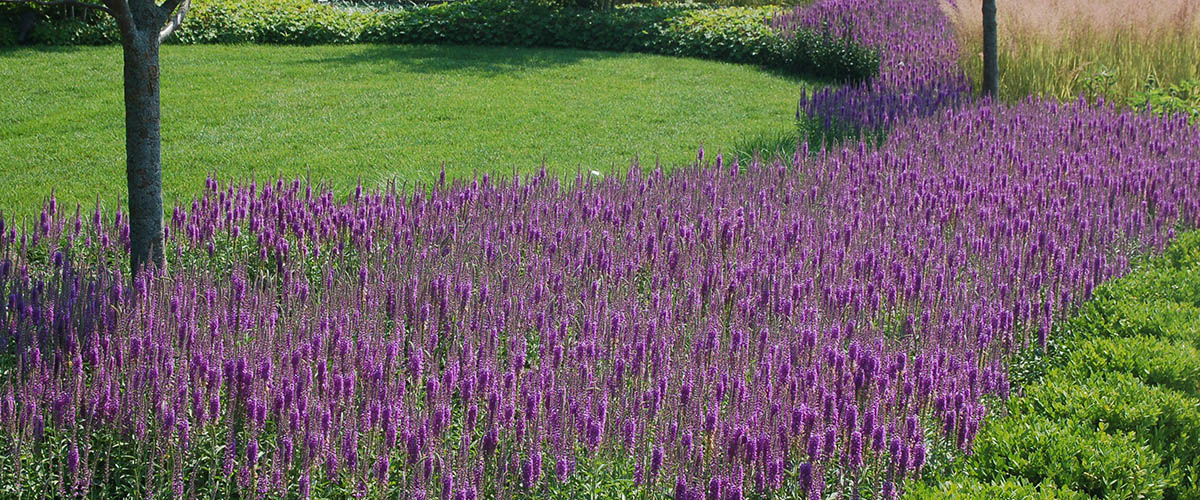
Evaluating Perennials for Chicagoland Gardens
Perennials in Focus is a plant evaluation program that examines new and underused plants for Chicagoland, the third largest metropolitan area in the country. A group of horticultural experts trials and evaluates plants at numerous locations across the region. Results help consumers, public gardens, growers, landscape designers, breeders, and other industry professionals make informed plant choices.
Five Ferns That Thrive in Chicagoland Shade Gardens
Shade can be one of the most rewarding conditions in a Chicagoland garden. Beneath mature trees, along north-facing foundations, and beside woodland paths, ferns provide dependable foliage when flowering plants may struggle with limited sunlight. Their textures range from finely divided and airy to broad, bold, and architectural.
The best choices for the region must tolerate cold winters, humid summers, spring moisture, and the competition created by tree roots. Soil type also matters: some ferns prefer consistently moist woodland ground, while others handle drier shade once established.
These five species offer a useful starting point for gardeners, growers, landscape professionals, and public gardens evaluating shade plants. Their differences in height, spread, seasonal interest, and moisture tolerance make it possible to create a layered planting rather than relying on a single fern throughout the landscape.
Why Ferns Work So Well in Regional Shade
Ferns are valued primarily for foliage, but their contribution extends beyond simple greenery. Their fronds bring rhythm and contrast to hostas, woodland sedges, heucheras, Solomon’s seal, and spring ephemerals. Many also support a naturalistic character that suits the mature trees and ravines found across the Chicagoland area.
Once established, several native or regionally adapted ferns can handle the low light beneath deciduous trees. They are especially useful where gardeners want a long-lived ground layer without annual planting. Ferns do not produce showy flowers, yet their changing textures remain attractive from spring emergence through autumn dormancy.
Regional evaluation is important because a plant that performs well in a cooler or wetter climate may behave differently in northeastern Illinois. The regional evaluation mission emphasizes observations that help translate plant performance into practical garden decisions.
Christmas Fern and Lady Fern
Christmas fern, Polystichum acrostichoides, is one of the most reliable choices for dry to average shade. Its leathery, dark green fronds are often semi-evergreen, giving beds structure after many deciduous perennials have disappeared. It forms neat clumps rather than spreading aggressively, making it useful near paths, beneath shrubs, or in smaller woodland borders.
This fern prefers well-drained soil enriched with organic matter. It is a strong candidate for established gardens where tree roots create competition and summer moisture is inconsistent. Avoid burying the crown beneath mulch, and provide occasional deep watering during prolonged drought. Its restrained habit pairs well with plants that have brighter leaves or more open forms.
Lady fern, Athyrium filix-femina, offers a softer, more delicate appearance. Its finely divided fronds emerge in spring and can create a graceful mass in moist, light shade. Depending on selection and growing conditions, it may reach roughly two to three feet tall and spread into a substantial clump.
Lady fern is especially effective beside streams, rain gardens, and naturally moist woodland edges. It generally prefers more consistent moisture than Christmas fern, although good drainage remains important. Morning sun or filtered light can improve vigor, while intense afternoon exposure may scorch the foliage.
Cinnamon Fern and Royal Fern
Cinnamon fern, Osmundastrum cinnamomeum, is a bold native fern for damp ground. It produces a vase-shaped clump of tall green fronds, followed by fertile, cinnamon-colored spikes that rise from the center in spring. The fertile fronds fade earlier than the sterile foliage, adding seasonal character even after spores have matured.
In a Chicagoland landscape, cinnamon fern works well in low areas, beside ponds, at the edge of rain gardens, or in consistently moist soil beneath trees. It can become a substantial plant over time, so allow room for expansion. It is less suitable for dry foundation beds or compact spaces where irrigation is limited.
Royal fern, Osmunda regalis, has an even more architectural presence. Its upright fronds can reach three to six feet in favorable conditions, and the fertile sections at the tips create a distinctive plume-like effect. This is a plant for the back of a border, the edge of a water feature, or a spacious naturalistic planting.
Royal fern requires moisture-retentive soil and performs best when its roots do not dry out. It appreciates organic matter and a site with protection from strong wind. Because of its size, it should be evaluated for mature spread rather than selected based only on the appearance of a small container plant.
Sensitive Fern for Naturalistic Plantings
Sensitive fern, Onoclea sensibilis, is a dependable option for moist, partly shaded sites. Its broad, fresh green sterile fronds have a more open and informal appearance than the narrow fronds of Christmas fern. The plant spreads by rhizomes and can form an effective colony where erosion control or a broad ground layer is needed.
The name reflects its tendency to blacken after the first hard frost, so it does not provide winter-green foliage. However, the dried fertile fronds can remain upright and add texture through the colder months. This seasonal shift makes sensitive fern especially attractive in wildlife gardens and low-maintenance woodland plantings.
Because it can spread steadily in favorable soil, place it where natural expansion is welcome. It combines well with sedges, native grasses, golden ragwort, blue wood aster, and other plants that tolerate moist shade. In a formal border, edging or periodic division may be needed to keep the colony within bounds.
Comparing Form, Moisture, and Seasonal Interest
The following overview summarizes how these ferns differ in a typical Chicagoland garden. Actual size and vigor depend on soil, rainfall, competition from tree roots, and the amount of filtered light reaching the planting.
| Fern | Typical mature height | Moisture preference | Seasonal feature | Best garden use |
|---|---|---|---|---|
| Christmas fern | 1–2 feet | Average to dry shade | Semi-evergreen fronds | Paths, shrub borders, woodland edges |
| Lady fern | 2–3 feet | Average to moist | Fine-textured summer foliage | Perennial borders and light woodland |
| Cinnamon fern | 2–4 feet | Moist to wet | Cinnamon-colored fertile fronds | Rain gardens and pond margins |
| Royal fern | 3–6 feet | Moist to wet | Tall, architectural fronds | Back of borders and water features |
| Sensitive fern | 1–3 feet | Moist to average | Broad fronds and persistent fertile spikes | Naturalistic colonies and erosion control |
A mixed planting can create several layers of texture. Use Christmas fern toward the front, lady fern through the middle, and cinnamon or royal fern where moisture and space allow. Sensitive fern can fill broader areas, particularly where a relaxed woodland effect is more important than tight control.
For additional regional observations, gardeners can review plant trial snapshots alongside their own site conditions. Photographs and performance notes are most useful when interpreted with information about exposure, soil moisture, mature size, and seasonal timing.
Establishing Ferns in Chicagoland Soil
Prepare the site by loosening compacted soil and incorporating leaf mold, compost, or other stable organic matter. Do not create a sharply different pocket of rich soil around each plant if the surrounding ground is poor; roots may remain confined to that pocket. A broad improvement across the planting area encourages better establishment.
Water new ferns regularly during their first growing season, particularly from late spring through summer. A two-inch layer of shredded leaves or fine bark can help moderate soil temperature and conserve moisture, but keep mulch away from the crown. Irrigation is especially important beneath mature trees, where rainfall may be intercepted by the canopy.
Most ferns need little pruning. Remove damaged or collapsed fronds in late winter or early spring, taking care not to disturb emerging fiddleheads. Divide crowded clumps in spring when necessary, and monitor plants during extended dry periods even if they are described as shade tolerant.
A Practical Planting Shortlist
Match the fern to the site rather than choosing solely by appearance. A dry north-side foundation bed calls for a different plant than a wet depression at the edge of a rain garden. Mature height and spread should also guide placement, especially for royal fern and sensitive fern.
For a balanced shade planting, consider these recommendations:
- Choose Christmas fern for dependable structure in dry or average shade.
- Use lady fern where delicate texture and moderate moisture are available.
- Reserve cinnamon fern for consistently damp soil and generous planting space.
- Select royal fern for a tall focal point beside water or in a moist woodland border.
- Plant sensitive fern where a spreading, naturalistic ground layer is desirable.
Combining two or three species often produces a more resilient display than planting one fern repeatedly. Varying frond shape, height, and seasonal behavior can make a shaded garden feel intentional from spring through frost.
Build a More Resilient Shade Garden
The strongest fern choices are those that fit the site’s actual moisture, available space, and maintenance pattern. Christmas fern offers stability, lady fern adds softness, cinnamon and royal ferns bring height, and sensitive fern provides broad, naturalistic coverage.
Use these plants as part of a broader regional evaluation process: observe how they perform through winter, drought, heavy rain, and seasonal competition. Begin with one or two well-matched species, record their growth and spread, and expand the planting as you learn which ferns perform best in your own Chicagoland garden.
In the Garden
Evaluator gardens are located across the Chicagoland area, representing a range of growing conditions. Visit our retail and wholesale partners to find trialled perennials for your own garden.
Retail & Wholesale: Hinsdale Nurseries (Willowbrook, IL), Mariani Nurseries (Kenosha, WI & Garden Prairie, IL), Northwind Perennials (Burlington, WI), The Growing Place (Aurora, IL).
Wholesale Only: Hinsdale Nurseries (Plano, IL), Intrinsic Perennial Gardens (Hebron, IL).
Our Evaluation Program
The 2017–2020 evaluation cycle included Agastache 'Blue Boa', Allium senescens 'Blue Eddy', Amsonia ciliata var. filifolia 'Georgia Pancake', Astilbe 'Chocolate Shogun', Boltonia astroides 'James Crocket', Brunnera 'Alexander's Great', and Geranium cinereum 'Jolly Jewel Purple'. Completed evaluations include Amsonia 'Blue Ice' (2004–07).
On April 10, 2020, the program published snapshot profiles for Vernonia lettermanii 'Iron Butterfly', Stokesia laevis 'Elf', Stachys officinalis 'Pink Cotton Candy', Lobelia 'Monet Moment', Helleborus 'Winter Thrillers', Geum 'Mai Tai', Geranium soboliferum 'Butterfly Kisses', Gentiana x intermedia 'True Blue', Eurybia divaricata, Asparagus 'Purple Passion', and Agastache 'Bolero'.
Browse the full collection of snapshots organized alphabetically — from A–D, E–H, I–Q, and R–Z — to find detailed performance data on perennials trialled across Chicagoland.