Evaluating Perennials for Chicagoland Gardens
Perennials in Focus is a plant evaluation program that examines new and underused plants for Chicagoland, the third largest metropolitan area in the country. A group of horticultural experts trials and evaluates plants at numerous locations across the region. Results help consumers, public gardens, growers, landscape designers, breeders, and other industry professionals make informed plant choices.
How New England Aster Performs in Sunny Chicagoland Borders
Symphyotrichum novae-angliae, commonly called New England aster, is a dependable late-season perennial for gardens around Chicago. Its generous display of daisy-like flowers arrives when many early and midsummer plants are fading, giving full-sun borders fresh color from late summer into fall.
The species is especially valuable for its regional adaptability. It tolerates cold winters, handles the seasonal swings typical of the Midwest, and supports pollinators when many other nectar sources are becoming scarce. Still, performance varies considerably among cultivars, soil conditions, and maintenance routines.
A successful planting depends on more than choosing a sunny location. Mature height, stem strength, disease resistance, bloom timing, and tendency to spread all affect how New England aster fits into a designed border. Regional trials help distinguish plants that merely survive from those that remain attractive and useful throughout the growing season.
Regional fit and growing conditions
Full sun is the strongest starting point for this aster. Six or more hours of direct light encourages sturdy stems, abundant branching, and the dense flowering that makes the plant effective in a border. Plants grown in too much shade may lean toward neighboring perennials and produce fewer flowers.
New England aster prefers evenly moist, reasonably fertile soil, although established plants can tolerate short periods of dryness. Good drainage is important during winter, particularly in heavy clay or areas where melting snow remains saturated. Incorporating organic matter before planting can improve soil structure, but overly rich fertility may promote excessive leafy growth and weaker stems.
Chicagoland gardeners can also evaluate this perennial alongside other plants known for enduring local winters, including the surprising hardiness of yucca. The comparison highlights an important regional lesson: winter survival is valuable, but a plant’s moisture tolerance, seasonal appearance, and role in the border matter just as much.
Flowering, form, and seasonal value
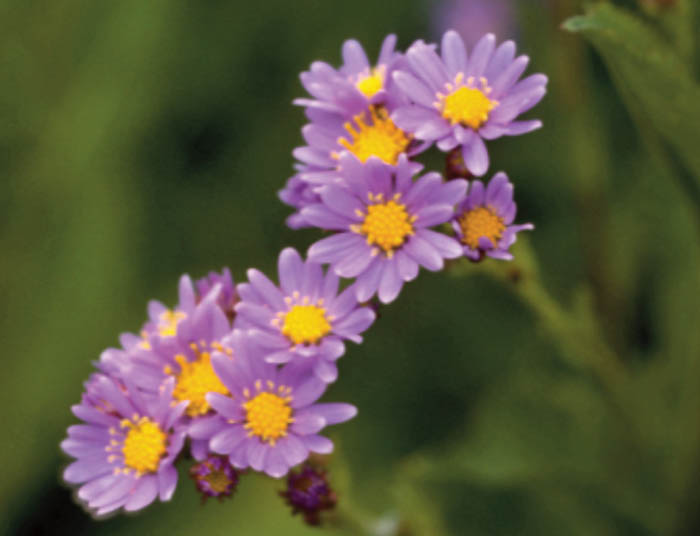
The typical bloom period begins in late August or September and can continue well into October, depending on the cultivar and weather. Flower colors range from lavender and violet to pink, rose, and white, usually with yellow central discs that attract bees and butterflies. In a mixed border, this timing bridges the gap between summer bloomers and ornamental grasses at their autumn peak.
Plants often reach between three and six feet in height, although modern selections may be shorter and more compact. The upright form is useful toward the back or middle of a border, where it can provide a strong vertical layer. Taller plants may need support in exposed sites, especially after heavy rain or when late-season stems carry a full canopy of flowers.
The foliage contributes texture before flowering, but it may become less attractive when plants experience drought, crowding, or poor air circulation. Placing aster where surrounding plants do not smother the lower stems helps preserve its appearance. A light mulch layer can conserve moisture while leaving the crown uncovered.
Choosing cultivars for a managed border
Cultivar selection should reflect the scale of the planting. Tall, traditional forms create a dramatic autumn mass, while compact selections are easier to integrate near paths, patios, and smaller foundation beds. Gardeners should verify mature height and spread rather than relying only on the size of the container at purchase.
Stem strength is another important performance trait. A plant that flowers heavily but collapses outward may require staking or repeated cutting back. Pinching or shearing stems in early summer can produce a shorter, bushier plant, though late pruning may delay flowering. Trial observations that record height, spread, flowering window, and habit are particularly helpful when comparing similar varieties.
Color also affects how a cultivar functions in a planting. Violet and purple flowers combine naturally with ornamental grasses, goldenrod, and silver foliage. Pink selections can soften beds containing blue flowers, while white forms brighten the border during shortening autumn days. Repeating one cultivar in groups generally creates more visual impact than scattering isolated plants.
What performance looks like in practice
Regional evaluation is useful because catalog descriptions rarely capture how a plant behaves through an entire Chicagoland season. The most valuable observations include spring emergence, summer foliage quality, resistance to lodging, flowering consistency, and the plant’s condition after heat, drought, storms, and winter.
| Performance trait | Strong garden performance | Potential concern |
|---|---|---|
| Sun exposure | Dense growth and heavy flowering in full sun | Stretching and leaning in partial shade |
| Soil moisture | Even moisture with good drainage | Stress in drought or decline in waterlogged soil |
| Plant habit | Upright stems with manageable spread | Flopping or overcrowding in fertile conditions |
| Bloom period | Late summer through fall color | Shorter display after severe drought |
| Wildlife value | Nectar for bees and butterflies | Flowering may coincide with fewer other nectar plants, requiring thoughtful companion planting |
| Maintenance | Cut back after frost and divide when crowded | Older clumps may develop bare centers |
These traits should be considered together rather than ranked separately. A slightly taller plant with excellent stem strength may be more useful than a shorter cultivar that flops. Similarly, a cultivar with a later bloom window can extend the border’s seasonal interest even if it flowers less heavily at the start.
Seed production and self-sowing also deserve observation. New England aster can produce viable seed, and seedlings may appear near established clumps. This is not inherently a problem in an informal pollinator garden, but it may be undesirable in a tightly edited border. Gardeners familiar with Aquilegia canadensis self-seeding will recognize the value of deciding in advance whether natural spread is an asset or a maintenance issue.
Managing height, moisture, and disease
The simplest way to improve form is to provide enough space. Crowded aster plants dry slowly after rain, creating conditions that can encourage foliar diseases such as powdery mildew. Adequate spacing and direct airflow are more useful than repeatedly treating symptoms after they appear.
Water at the soil level during prolonged dry weather, particularly while plants are establishing and during the weeks before flowering. Removing heavily damaged foliage and clearing old stems after frost can reduce overwintering debris. Avoid frequent high-nitrogen feeding, which may produce lush stems that are more vulnerable to flopping and disease.
Division can rejuvenate old clumps when the center becomes thin or flowering declines. Early spring is generally a practical time to divide, allowing new sections to establish before summer heat. Divided plants should be watered consistently during their first season and placed where mature neighbors will not compete aggressively for moisture.
Building a durable autumn border
New England aster works best as part of a layered planting rather than as a solitary specimen. Shorter sedums, heucheras, and low grasses can cover the base, while medium-height coneflowers, goldenrods, and salvias create a succession of flowers around the aster’s late-season peak. Ornamental grasses add movement and remain attractive after frost.
Use repetition to give the border structure. Three or more plants of one cultivar can form a clear color mass, while smaller groups of companion perennials fill gaps without making the design appear random. Leave enough room for the aster’s mature spread so that it can develop an upright silhouette without constant trimming.
For a reliable planting plan, prioritize these decisions:
- Select a cultivar whose mature height matches its position in the border.
- Plant in full sun with evenly moist, well-drained soil.
- Space plants to encourage airflow around the foliage and stems.
- Pinch tall selections in early summer if a shorter, sturdier habit is needed.
- Remove spent stems after frost and monitor seedlings where natural spread is unwanted.
These practices support both visual quality and long-term plant health. They also make it easier to compare cultivars from year to year, since differences in performance are less likely to be hidden by inconsistent care.
When properly matched to site and scale, New England aster offers one of the most useful late-season displays for a sunny Midwest border. Explore regional trial findings from Perennials in Focus to compare cultivars and identify plants that can bring dependable autumn color, pollinator value, and strong garden presence to your own Chicagoland landscape.
In the Garden
Evaluator gardens are located across the Chicagoland area, representing a range of growing conditions. Visit our retail and wholesale partners to find trialled perennials for your own garden.
Retail & Wholesale: Hinsdale Nurseries (Willowbrook, IL), Mariani Nurseries (Kenosha, WI & Garden Prairie, IL), Northwind Perennials (Burlington, WI), The Growing Place (Aurora, IL).
Wholesale Only: Hinsdale Nurseries (Plano, IL), Intrinsic Perennial Gardens (Hebron, IL).
Our Evaluation Program
The 2017–2020 evaluation cycle included Agastache 'Blue Boa', Allium senescens 'Blue Eddy', Amsonia ciliata var. filifolia 'Georgia Pancake', Astilbe 'Chocolate Shogun', Boltonia astroides 'James Crocket', Brunnera 'Alexander's Great', and Geranium cinereum 'Jolly Jewel Purple'. Completed evaluations include Amsonia 'Blue Ice' (2004–07).
On April 10, 2020, the program published snapshot profiles for Vernonia lettermanii 'Iron Butterfly', Stokesia laevis 'Elf', Stachys officinalis 'Pink Cotton Candy', Lobelia 'Monet Moment', Helleborus 'Winter Thrillers', Geum 'Mai Tai', Geranium soboliferum 'Butterfly Kisses', Gentiana x intermedia 'True Blue', Eurybia divaricata, Asparagus 'Purple Passion', and Agastache 'Bolero'.
Browse the full collection of snapshots organized alphabetically — from A–D, E–H, I–Q, and R–Z — to find detailed performance data on perennials trialled across Chicagoland.