Evaluating Perennials for Chicagoland Gardens
Perennials in Focus is a plant evaluation program that examines new and underused plants for Chicagoland, the third largest metropolitan area in the country. A group of horticultural experts trials and evaluates plants at numerous locations across the region. Results help consumers, public gardens, growers, landscape designers, breeders, and other industry professionals make informed plant choices.
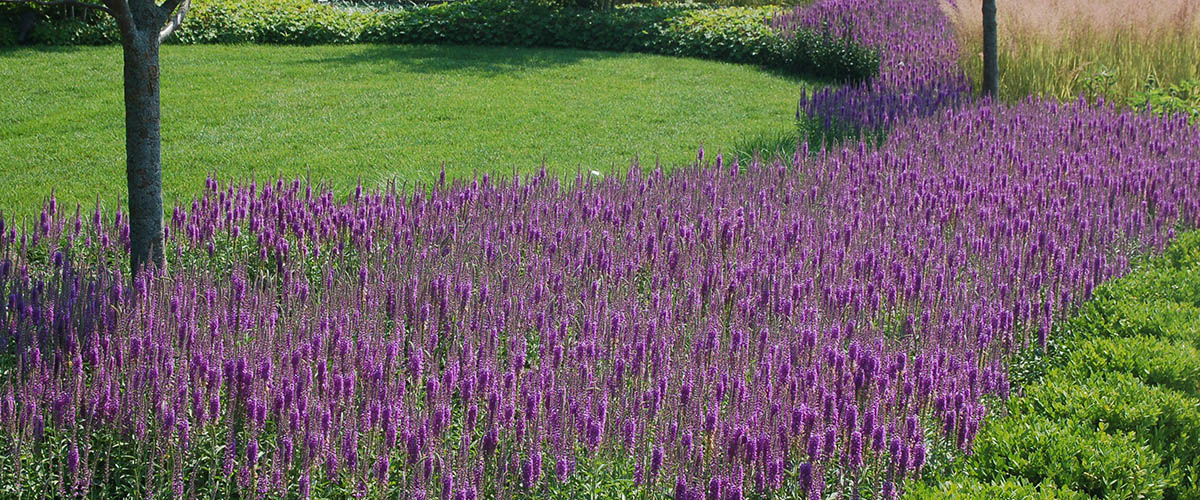
Salvia nemorosa in full-sun Chicagoland trials
Salvia nemorosa has earned a strong reputation as a durable, long-blooming perennial for sunny gardens. Its upright flower spikes bring intense color in early summer, while aromatic foliage forms a tidy mound that remains useful after flowering. In the Chicagoland region, where hot summers, heavy soils, and unpredictable winter conditions can test perennial plants, this species offers a valuable combination of beauty and resilience.
The Performance of Salvia Nemorosa in Full Sun Trials depends on more than flower color alone. Evaluators also consider plant structure, rebloom potential, winter survival, resistance to lodging, response to rainfall, and the amount of maintenance required to keep plants attractive through the season.
These observations are especially useful for gardeners selecting plants for pollinator borders, foundation beds, commercial landscapes, and public gardens. A salvia that performs well in a controlled nursery container may behave differently after several seasons in regional soil, so multi-site trials provide practical information that a catalog description cannot.
What the trials reveal about plant habit
In full sun, Salvia nemorosa generally develops a compact basal clump with flowering stems rising above the foliage. The strongest plants hold their spikes upright without extensive staking, creating a defined vertical accent among lower-growing perennials. This structure makes the species suitable for repeated planting along paths and bed edges.
Height and spread vary by cultivar, but many selections fit comfortably into the middle or front-middle portion of a perennial border. Compact forms can work near walkways, while taller selections create a stronger transition between low ground covers and larger summer plants. Trial observations help distinguish selections that maintain a neat outline from those that become loose after heavy rain.
Foliage quality also matters. The gray-green to medium-green leaves provide texture before flowering and can remain attractive when plants are not in bloom. Healthy clumps tend to fill space without spreading aggressively, making them easier to combine with ornamental grasses, yarrow, catmint, and other sun-loving perennials.
Flowering performance through the growing season
The primary flowering period usually begins in late spring or early summer, depending on spring temperatures and the cultivar being evaluated. Dense whorls of small flowers form around upright stems, producing a strong color display even though each individual flower is modest in size. Purple, violet-blue, pink, and white forms broaden the design possibilities.
A key difference among selections is how they respond after the first flush. Cutting spent flower spikes back to the basal foliage often encourages additional flowering later in summer. Plants with quick regrowth can provide a second display, while slower selections may offer attractive foliage without significant rebloom.
The regional plant snapshots provide a useful model for examining plant traits in a location-specific context. For Salvia nemorosa, bloom timing should be considered alongside height, spread, and the length of time flowers remain present. A cultivar with slightly less intense color may have greater landscape value if it stays upright and continues flowering over a longer period.
Practical comparison of garden performance
The following comparison summarizes common performance tendencies that matter when selecting Salvia nemorosa for sunny Chicagoland landscapes. Exact results can vary with cultivar, soil, irrigation, winter conditions, and the timing of maintenance.
| Selection type | Flower display | Habit in full sun | Rebloom potential | Best landscape use |
|---|---|---|---|---|
| Compact forms | Dense, concentrated spikes | Low and mounded | Often good after shearing | Edges, containers, small beds |
| Medium-height forms | Strong color above foliage | Generally upright | Moderate to good | Mixed borders and mass plantings |
| Tall selections | More prominent vertical spikes | May need closer spacing | Varies by cultivar | Middle of perennial borders |
| Pink or white forms | Softer, less traditional color | Similar species habit | Usually dependent on trimming | Color-themed or cottage-style beds |
| Seed-grown types | Variable flower color and timing | Less uniform | Inconsistent | Informal plantings and larger displays |
Trialing is particularly valuable for identifying uniformity. A planting composed of evenly sized plants is easier to design and maintain, while variable selections may create gaps or uneven flowering. For growers and retailers, consistent habit can be as important as a striking flower color.
Soil, drainage, and winter survival
Full sun is essential for the best flowering, but light exposure cannot compensate for poor drainage. Salvia nemorosa dislikes prolonged winter wetness and saturated summer soil. In heavy Chicagoland clay, raised beds, compost-amended planting areas, or locations with natural slope can improve root health and reduce crown loss.
The plants generally perform best in moderately fertile soil rather than extremely rich conditions. Excessive fertility can produce soft, leafy growth that flops when flower spikes emerge. A balanced fertility program and restrained use of high-nitrogen products help maintain the compact form that makes this perennial so useful.
Winter survival is closely connected to drainage and establishment. Plants installed early enough to develop substantial roots before the ground freezes are more likely to return evenly. A thin layer of mulch can protect the crown from temperature swings, but mulch should not be piled directly over the plant because trapped moisture may encourage crown problems.
Maintenance that protects the display
Deadheading is the most important routine task for extending the ornamental season. Removing faded spikes redirects the plant’s energy toward new growth and prevents the border from looking tired after the first bloom cycle. In larger plantings, shearing the entire clump lightly can be faster than removing individual stems.
Cutting should be timed with the plant’s vigor in mind. A healthy, well-rooted clump can usually recover quickly, while a newly planted or drought-stressed plant may need more conservative treatment. Watering during extended dry periods is especially important after trimming because fresh foliage and flower stems require consistent moisture during regrowth.
Division is rarely needed every year, but older clumps can be divided when the center becomes thin or flowering declines. Early spring is generally a practical time for this work. Removing weak sections and replanting vigorous divisions can restore density without replacing the entire planting.
Uses in regional garden design
Salvia nemorosa is particularly effective when planted in groups of three or more. Repetition emphasizes the upright flower spikes and creates a stronger visual rhythm than scattered individual plants. A broad drift can also make maintenance easier because plants can be trimmed at the same time.
Its flowers attract bees and other pollinating insects, giving it ecological value in addition to ornamental appeal. Pairing it with plants that bloom before or after it creates a continuous sequence of resources. Spring bulbs, peonies, coneflowers, sedums, and ornamental grasses can all help bridge seasonal gaps.
The species also works well in commercial and public landscapes because its moderate footprint supports clear sightlines and predictable spacing. Once established, it can tolerate ordinary summer conditions better than many soft-stemmed flowering perennials, especially when planted in well-drained soil with adequate sunlight.
Recommendations for selecting and growing it
Successful use begins with matching the cultivar to the space rather than choosing solely by flower color. Review mature height and spread, then allow enough room for air movement around each clump. Crowding can reduce flowering and increase the time required for cleanup.
- Plant in at least six hours of direct sun, preferably in soil that drains freely after heavy rain.
- Compare compact, medium, and tall selections with the intended border position before purchasing.
- Water deeply during establishment and during prolonged summer drought.
- Remove spent flower spikes promptly to encourage a second flush.
- Use moderate fertility and avoid excessive nitrogen that can cause weak, floppy growth.
For homeowners, the most reliable approach is to observe how a selection behaves over more than one season. A particularly colorful first-year plant may change as it matures, while a less dramatic cultivar may prove superior through winter, wet weather, and repeated flowering cycles.
Salvia nemorosa deserves consideration whenever a Chicagoland garden needs a sun-loving perennial with strong color, pollinator value, and manageable maintenance. Use regional trial observations to compare habit and seasonal performance, then place the best-matched selection in a well-drained, sunny setting where its upright flowers can remain visible throughout the border.
In the Garden
Evaluator gardens are located across the Chicagoland area, representing a range of growing conditions. Visit our retail and wholesale partners to find trialled perennials for your own garden.
Retail & Wholesale: Hinsdale Nurseries (Willowbrook, IL), Mariani Nurseries (Kenosha, WI & Garden Prairie, IL), Northwind Perennials (Burlington, WI), The Growing Place (Aurora, IL).
Wholesale Only: Hinsdale Nurseries (Plano, IL), Intrinsic Perennial Gardens (Hebron, IL).
Our Evaluation Program
The 2017–2020 evaluation cycle included Agastache 'Blue Boa', Allium senescens 'Blue Eddy', Amsonia ciliata var. filifolia 'Georgia Pancake', Astilbe 'Chocolate Shogun', Boltonia astroides 'James Crocket', Brunnera 'Alexander's Great', and Geranium cinereum 'Jolly Jewel Purple'. Completed evaluations include Amsonia 'Blue Ice' (2004–07).
On April 10, 2020, the program published snapshot profiles for Vernonia lettermanii 'Iron Butterfly', Stokesia laevis 'Elf', Stachys officinalis 'Pink Cotton Candy', Lobelia 'Monet Moment', Helleborus 'Winter Thrillers', Geum 'Mai Tai', Geranium soboliferum 'Butterfly Kisses', Gentiana x intermedia 'True Blue', Eurybia divaricata, Asparagus 'Purple Passion', and Agastache 'Bolero'.
Browse the full collection of snapshots organized alphabetically — from A–D, E–H, I–Q, and R–Z — to find detailed performance data on perennials trialled across Chicagoland.