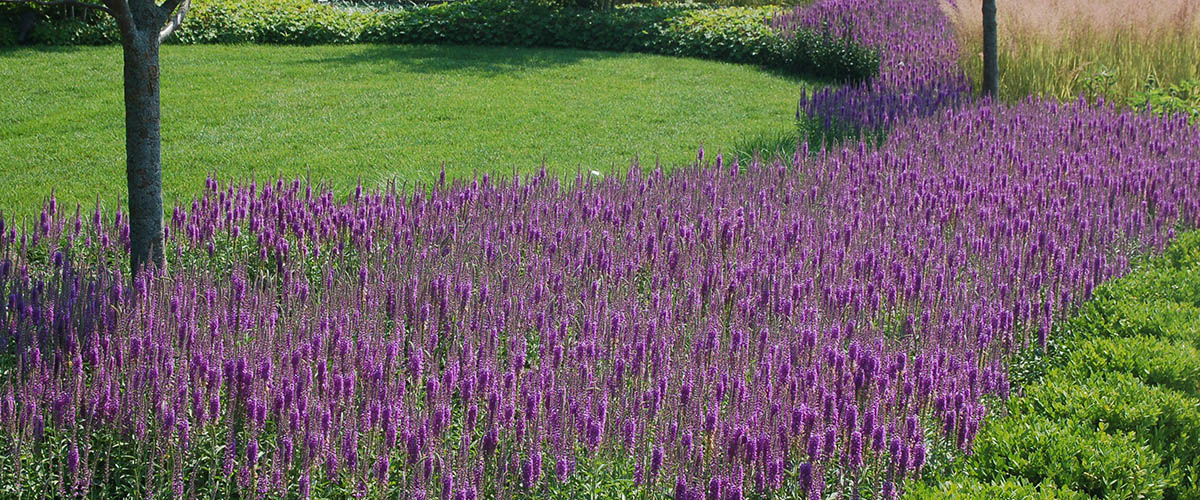
Evaluating Perennials for Chicagoland Gardens
Perennials in Focus is a plant evaluation program that examines new and underused plants for Chicagoland, the third largest metropolitan area in the country. A group of horticultural experts trials and evaluates plants at numerous locations across the region. Results help consumers, public gardens, growers, landscape designers, breeders, and other industry professionals make informed plant choices.
Choosing Mulch for Long-Lived Perennials in Chicago Clay
Chicago-area gardens ask a great deal of perennial plants. They must tolerate humid summers, winter freezes, rapid temperature changes, and soils that can shift from sticky mud to hard, cracked blocks. Heavy clay adds another layer of difficulty because it drains slowly when wet while becoming dense and restrictive when dry.
Mulch can moderate several of these conditions, but the material, depth, and timing matter. A suitable mulch protects crowns and roots, reduces evaporation, limits soil compaction, and gradually contributes organic matter. The wrong mulch, applied too deeply or against plant stems, can hold excess moisture and increase the risk of crown rot.
The impact of mulch type on perennial survival in Chicago clay is therefore less about choosing a universally “best” product and more about matching the mulch to drainage, plant habit, exposure, and seasonal moisture. Local trials can help gardeners assess those choices alongside bloom time, height, spread, and long-term vigor.
Why Chicago clay changes mulch outcomes
Clay soil contains very small mineral particles that pack tightly together. When saturated, it may exclude air from the root zone; when dry, it can resist water penetration. A thick, moisture-retentive mulch layer may intensify these conditions around perennials that already dislike wet feet.
At the same time, bare clay is vulnerable to crusting, erosion, and wide swings in soil temperature. Organic mulch softens those extremes and protects beneficial soil organisms. It also prevents raindrops from sealing the surface, allowing water to enter more gradually rather than running across compacted ground.
The result depends on the planting site. A raised bed with amended clay may benefit from a moisture-conserving mulch, while a low spot with poor drainage may need a thin, loose layer that dries quickly. Perennials native to prairies or dry meadows generally require a different treatment from shade plants adapted to consistently moist woodland soil.
How mulch supports perennial survival
Mulch acts as an insulating blanket around the root zone. In summer, it slows water loss and keeps shallow roots cooler. In winter, it reduces rapid freeze-thaw cycling, which can heave young plants out of the ground. This protection is especially valuable during the first year after planting, when roots have not yet spread deeply or widely.
Organic mulches also improve the physical condition of clay over time. As shredded leaves, composted bark, or partially composted plant material breaks down, it adds carbon and supports organisms that create small channels in the soil. These channels improve air movement and infiltration, although mulch cannot correct severe drainage problems by itself.
Mulch should remain slightly away from crowns, stems, and basal foliage. Contact with wet organic material can create a sheltered environment for fungal diseases, slugs, rodents, and rot. A two- to three-inch layer spread across the root zone is often adequate, with less used around small crowns and in poorly drained locations.
Comparing common mulch materials
Different mulch materials influence moisture, temperature, decomposition, and soil structure in distinct ways. Coarse textures usually allow more air movement, while fine materials can mat together and remain wet. Color and appearance may matter for design, but plant health should guide the primary decision.
| Mulch type | Main benefits | Concerns in clay soil | Useful perennial settings |
|---|---|---|---|
| Shredded leaves | Inexpensive, improves organic matter, moderates temperature | Can mat if applied wet or too thick | Established beds, woodland and shade plantings |
| Composted bark | Stable, attractive, moderate moisture retention | May dry the surface as it decomposes slowly; quality varies | Mixed borders and long-lived ornamental beds |
| Arborist wood chips | Coarse, durable, good weed suppression, excellent surface protection | Can be bulky around small plants; avoid mixing fresh chips into soil | Paths, broad borders, shrubs, and established perennials |
| Straw | Light, insulating, useful for winter protection | Can harbor seed, blow away, and stay damp | Temporary winter cover and exposed sites |
| Gravel or stone | Does not decompose, improves crown dryness, reflects heat | Adds heat, does not build soil, can complicate future planting | Dry-loving perennials and sharply drained beds |
| Compost used as mulch | Adds nutrients and supports soil life | Fine texture may stay wet or crust over; can encourage lush growth | Thin surface dressing on established plantings |
Fresh wood chips are often misunderstood. They generally do not cause nitrogen problems when left on the soil surface, though they may temporarily tie up nitrogen if mixed into the root zone. Their coarse structure makes them useful for pathways and larger, established plantings, but they can overwhelm low-growing perennials or conceal crowns.
Match mulch to plant and planting site
Moisture-loving perennials such as ligularia, cardinal flower, and some astilbes can benefit from shredded leaves or composted organic mulch if the bed drains adequately. These materials help prevent summer drought stress, particularly beneath trees where roots compete for water. Even in these settings, mulch should not turn the planting area into a permanently saturated basin.
Many prairie and steppe plants prefer a drier crown and open air around their lower stems. Sedum, catmint, Baptisia, ornamental alliums, and several species of coneflower often perform better with a thin layer of coarse mulch or fine gravel than with deep, wet leaf mold. Excessive moisture around the crown can cause decline even when the plant appears drought tolerant above ground.
New plantings usually need more careful monitoring than established clumps. A shallow mulch layer protects the root ball while it expands, but soil moisture should be checked beneath the mulch rather than judged from the surface. If the top looks dry but the soil below is cold and wet, adding more material may worsen root stress.
Gardeners seeking plants that can handle regional heat and humidity can also review these underused perennials before deciding how much moisture retention a bed should provide. Plant selection and mulch management work together: a resilient perennial still needs conditions suited to its crown and roots.
Seasonal timing matters in Chicago
Apply or refresh mulch after the soil has warmed in spring and perennial shoots are visible. Applying a heavy layer too early can delay warming and keep crowns wet during cool weather. Pull mulch back as growth emerges, especially around plants with soft stems or dense basal foliage.
Summer is the period when mulch most clearly reduces drought stress. A well-spaced layer limits evaporation during hot, humid weather and reduces competition from annual weeds. Water slowly and deeply when needed, directing moisture toward the soil rather than wetting foliage and flowers.
In autumn, a modest layer can protect roots from temperature fluctuations. Avoid piling insulating material over plants that require winter drainage. For newly planted or shallow-rooted perennials, evergreen boughs or a light, airy cover may be safer than a dense blanket of wet leaves.
What regional trials can reveal
Plant evaluations across multiple gardens help separate a plant’s genetic performance from the effects of one unusually favorable or poor location. When a perennial survives several seasons in different Chicagoland sites, its results become more useful for gardeners deciding how much attention, drainage improvement, and moisture management it may require.
Mulch should be recorded as part of that growing context. Bloom duration, winter survival, spread, and crown health can look different in a heavily mulched clay border than in a lean, gravelly bed. Tracking these details helps identify whether a plant is genuinely adaptable or simply benefiting from carefully controlled conditions.
The program’s regional trial snapshots offer a useful way to examine plant observations in context. Comparing performance notes across seasons can guide choices for home gardens, retail recommendations, public landscapes, and professional planting plans.
Practical mulch recommendations
Good mulch management is an ongoing maintenance practice rather than a one-time installation step. Inspect the soil below the mulch, watch how quickly the bed drains after rain, and note whether crowns remain firm and healthy through spring. A mulch that looks attractive but keeps the root zone persistently wet is not serving the planting.
Use different materials within the same property when conditions vary. A low, damp border may need a sparse organic layer, while a sunny slope may benefit from coarse chips or stone that leaves crowns dry. Keep mulch away from stems and refresh only what has decomposed or washed away.
- Use two to three inches of loose organic mulch in most established perennial beds.
- Reduce depth in heavy, poorly drained clay and around plants prone to crown rot.
- Choose coarse chips or gravel for dry-loving perennials that need excellent crown drainage.
- Apply compost as a thin surface amendment rather than a deep, moisture-holding blanket.
- Reassess mulch after heavy rain, winter damage, and the first hot period of summer.
A thoughtful mulch strategy can make Chicago clay more workable while supporting dependable perennial performance. Observe moisture, drainage, crown health, and seasonal growth in each bed, then record which materials produce strong returns over time. Share those observations through local plant evaluations and use region-specific trial findings to build landscapes with greater resilience.
In the Garden
Evaluator gardens are located across the Chicagoland area, representing a range of growing conditions. Visit our retail and wholesale partners to find trialled perennials for your own garden.
Retail & Wholesale: Hinsdale Nurseries (Willowbrook, IL), Mariani Nurseries (Kenosha, WI & Garden Prairie, IL), Northwind Perennials (Burlington, WI), The Growing Place (Aurora, IL).
Wholesale Only: Hinsdale Nurseries (Plano, IL), Intrinsic Perennial Gardens (Hebron, IL).
Our Evaluation Program
The 2017–2020 evaluation cycle included Agastache 'Blue Boa', Allium senescens 'Blue Eddy', Amsonia ciliata var. filifolia 'Georgia Pancake', Astilbe 'Chocolate Shogun', Boltonia astroides 'James Crocket', Brunnera 'Alexander's Great', and Geranium cinereum 'Jolly Jewel Purple'. Completed evaluations include Amsonia 'Blue Ice' (2004–07).
On April 10, 2020, the program published snapshot profiles for Vernonia lettermanii 'Iron Butterfly', Stokesia laevis 'Elf', Stachys officinalis 'Pink Cotton Candy', Lobelia 'Monet Moment', Helleborus 'Winter Thrillers', Geum 'Mai Tai', Geranium soboliferum 'Butterfly Kisses', Gentiana x intermedia 'True Blue', Eurybia divaricata, Asparagus 'Purple Passion', and Agastache 'Bolero'.
Browse the full collection of snapshots organized alphabetically — from A–D, E–H, I–Q, and R–Z — to find detailed performance data on perennials trialled across Chicagoland.