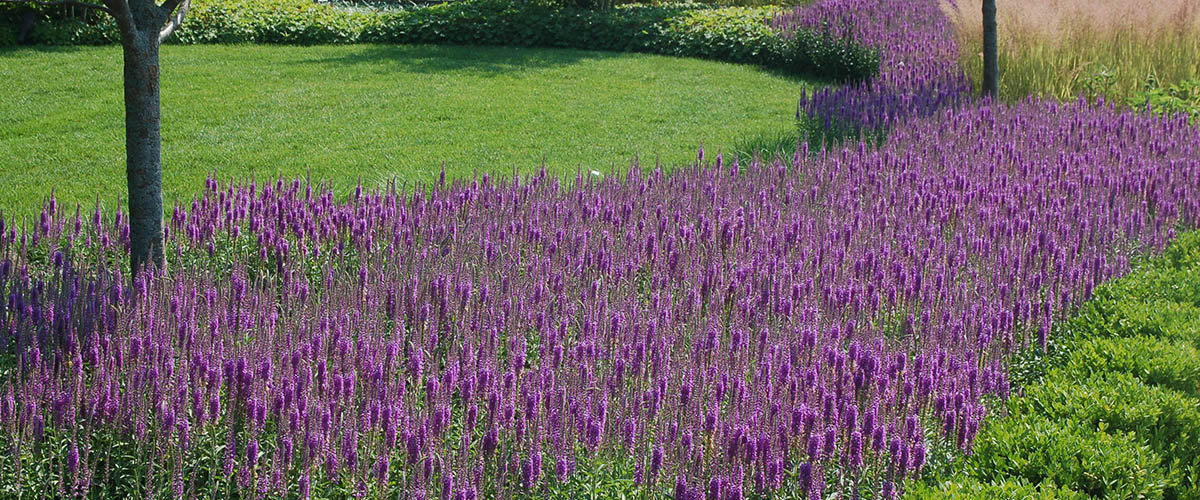
Evaluating Perennials for Chicagoland Gardens
Perennials in Focus is a plant evaluation program that examines new and underused plants for Chicagoland, the third largest metropolitan area in the country. A group of horticultural experts trials and evaluates plants at numerous locations across the region. Results help consumers, public gardens, growers, landscape designers, breeders, and other industry professionals make informed plant choices.
Testing the spread rate of Phalaris arundinacea
Reed canary grass (Phalaris arundinacea) is a rhizomatous perennial that can turn a small planting into a dense stand. Its upright shoots, creeping rhizomes and seed heads make growth obvious, while underground extension is often the greater concern in wet soil. In Chicagoland, spread should therefore be measured as a process rather than inferred from an impression of vigorous growth.
Chicago results can guide Australian trials, but they cannot be transferred directly. The seasons are reversed, rainfall and irrigation differ, and reed canary grass is introduced to Australia and subject to weed controls in some jurisdictions. A sound evaluation combines North American field data with local climate, council requirements and strict containment.
Defining spread for wetland trials
Spread rate needs a working definition before plants enter a trial. Separate lateral expansion, measured from the original planting edge, from changes in occupied area and shoot density. Record seed production separately because a stable-looking rhizome can still produce new plants. This turns a general claim of “running” into a result that can be repeated.
That distinction matters in a managed wetland. A grass advancing 40 centimetres into a planted margin may be tolerable within a designed buffer, while the same movement beside a drainage channel can obstruct flow or shade native vegetation. Plant behaviour should be connected to the garden’s capacity for maintenance rather than simply recording how quickly the stand becomes dense.
Building a contained field trial
A useful design uses several gardens or hydrologically different beds, with a comparable native grass as a reference where appropriate. Mark the original perimeter with fixed stakes and record its GPS coordinates. Photograph each plot from the same points, note water depth and mowing or grazing, and use at least two full growth cycles where seed and rhizome survival could extend into a second season.
At three- to four-week intervals during active growth, measure the furthest verified rooted shoot from each marker, map the occupied area and count shoots in fixed quadrats. Distinguish rooted plants from stems that have merely lodged or bent over. At seasonal harvest, take soil cores at a consistent depth to measure rhizome length, and record mature panicles before their seed can scatter.
Calculate edge advance in centimetres per month, annual change in occupied area in square metres, and density change against the starting plot. Compare results across sites using both the mean and the range, because one unusually wet bed should not determine the regional rating. This multi-site approach reflects the Perennials in Focus method, whose regional trial snapshots make performance observations across trial gardens easier to compare.
Translating the method for Australia
Australian conditions require the timetable to be reversed. A Chicagoland trial concentrated on summer growth would miss much of the active period in southern Australia, while a year of cool-season growth may understate warm-climate behaviour. Schedule readings around local rainfall, irrigation and temperature, and keep records running long enough to observe recruitment after the main flowering period.
Local differences are substantial. Melbourne’s changeable weather can combine winter rain with dry, stressful summers; Canberra adds hard frosts and periodic drought; Sydney’s humid summers may keep soils wet and extend the growing season. Managed wetlands can also receive stormwater or scheduled irrigation, so the water regime needs recording even when rainfall appears ordinary.
Australian gardeners often describe an aggressive groundcover as “running”, and nursery staff may simply call a plant “vigorous”. Those labels can obscure meaningful differences. Ask whether they describe rhizomatous spread, seed set, stem density or recovery after cutting, then translate the response into measurements that suit a council bed, garden-centre display or home garden.
Interpreting measurements across sites
The most useful report combines movement with plant density and reproductive effort. Four complementary measures make a trial easier to interpret:
| Measure | Recording method | Main value | Management response |
|---|---|---|---|
| Edge advance | Distance from a fixed boundary to new rooted shoots | Speed of lateral expansion | Increase the buffer or intervene early |
| Rhizome spread | Rhizome length measured in soil cores | Persistence below the canopy | Isolate or remove the root mass |
| Shoot density | Counts in fixed quadrats | Degree of crowding and cover | Adjust thinning or cutting schedules |
| Seed production | Mature panicles and seed viability checks | Risk of new colonies | Remove heads before seed scatters |
Edge advance is the clearest indicator of lateral movement, but it should be checked against shoot density. A sparse front may travel quickly, while a dense edge may barely advance. Rhizome measurements reveal persistence below the visible canopy, and seed production indicates the risk of new colonies. No single reading should trigger a management decision.
Separate seasonal expansion from longer-term accumulation. Report the first year’s increase alongside changes in the second year, when surviving rhizomes and seedlings are visible. Photographic evidence, fixed-point quadrat counts and dates of every intervention allow another site manager to distinguish genuine spread from wet-soil settling, mowing displacement or plants being moved accidentally on equipment.
Applying results to Australian projects
Australian project markets shape how results are used. Councils often specify planting through tenders, while nurseries supply plugs, liners or divisions and contractors establish them under irrigation. A measured spread rate helps procurement teams judge containment costs, replacement stock and maintenance visits. It also gives growers a defensible description of habit instead of relying on a nursery label.
For retail buyers and home gardeners, the figures should be translated carefully. “Vigorous” may appeal to someone seeking quick cover, but fast spread can become a maintenance burden. Garden-centre staff should disclose known escape behaviour, and Australian labels should direct buyers to current state and council rules. Where the species is restricted, retail sale or planting may not be lawful.
At design level, set a monitored buffer around each planting and nominate the response before the buffer is reached. Thin, cut or remove plants according to the local management plan, and budget for repeated work where flowering is allowed. The trial record should show whether interventions reduced occupied area or merely reset the visible edge.
Preventing escape and ecological harm
Containment is the first responsibility in any Australian trial. Obtain approval from the land manager and check the current state weed schedule and council requirements before ordering plants. Do not treat a trial plot as a research exemption. Prevent flowering where regulations or escape risk require it, and keep the planting away from natural wetlands, drains and floodways.
Biosecurity measures should be routine rather than improvised. Clean boots, tools and machinery between sites; do not wash rhizome-bearing soil into stormwater systems; and control visitors, contractors and livestock that could carry fragments or seed elsewhere. Record any escape immediately, remove it while the patch is traceable and notify the responsible land manager.
Ecological suitability also matters. Reed canary grass may establish vigorously in a Chicago trial yet offer little justification for introducing it into Australian habitat. Its dense growth can compete with wetland plants and alter feeding or shelter for wildlife. Trial only where lawful, recoverable and scientifically useful, and compare the results with locally native grasses that provide similar functions without escape risk.
Run a small, clearly bounded trial that answers one defined question about spread. Use fixed monitoring points, capture both rhizome and seed data, and publish the season, site conditions and management actions alongside the results. Local councils, nursery growers and landscape professionals can then compare like with like.
Choose plants that earn their place in the landscape, not merely those that look vigorous on day one. Share completed records with Perennials in Focus and local plant networks so future managers can make evidence-based choices and prevent escaped plants from becoming the next wetland problem.
In the Garden
Evaluator gardens are located across the Chicagoland area, representing a range of growing conditions. Visit our retail and wholesale partners to find trialled perennials for your own garden.
Retail & Wholesale: Hinsdale Nurseries (Willowbrook, IL), Mariani Nurseries (Kenosha, WI & Garden Prairie, IL), Northwind Perennials (Burlington, WI), The Growing Place (Aurora, IL).
Wholesale Only: Hinsdale Nurseries (Plano, IL), Intrinsic Perennial Gardens (Hebron, IL).
Our Evaluation Program
The 2017–2020 evaluation cycle included Agastache 'Blue Boa', Allium senescens 'Blue Eddy', Amsonia ciliata var. filifolia 'Georgia Pancake', Astilbe 'Chocolate Shogun', Boltonia astroides 'James Crocket', Brunnera 'Alexander's Great', and Geranium cinereum 'Jolly Jewel Purple'. Completed evaluations include Amsonia 'Blue Ice' (2004–07).
On April 10, 2020, the program published snapshot profiles for Vernonia lettermanii 'Iron Butterfly', Stokesia laevis 'Elf', Stachys officinalis 'Pink Cotton Candy', Lobelia 'Monet Moment', Helleborus 'Winter Thrillers', Geum 'Mai Tai', Geranium soboliferum 'Butterfly Kisses', Gentiana x intermedia 'True Blue', Eurybia divaricata, Asparagus 'Purple Passion', and Agastache 'Bolero'.
Browse the full collection of snapshots organized alphabetically — from A–D, E–H, I–Q, and R–Z — to find detailed performance data on perennials trialled across Chicagoland.