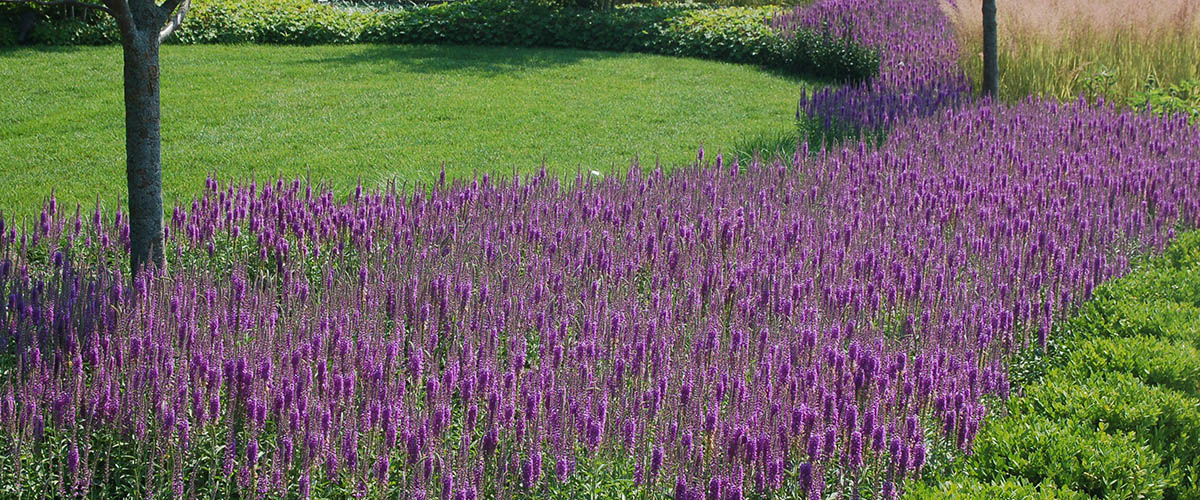
Evaluating Perennials for Chicagoland Gardens
Perennials in Focus is a plant evaluation program that examines new and underused plants for Chicagoland, the third largest metropolitan area in the country. A group of horticultural experts trials and evaluates plants at numerous locations across the region. Results help consumers, public gardens, growers, landscape designers, breeders, and other industry professionals make informed plant choices.
Testing perennial performance beside Chicago sidewalks
A narrow planting strip beside a Chicago sidewalk can be one of the harshest places to grow a perennial. Plants must cope with winter deicing salt, compacted soil, reflected heat, drought, snow storage, foot traffic, and irregular maintenance. A species that thrives in a sheltered garden bed may fail quickly when planted beside a busy road.
Salt tolerance is therefore more than a desirable trait. It is a practical measure of whether a perennial can maintain healthy foliage, produce flowers, and return reliably in an urban landscape. Careful regional trials can reveal which plants tolerate these combined pressures and which ones need a better site.
The work of Perennials in Focus offers a useful model for evaluating plants under Chicagoland conditions. By comparing selected and underused perennials across gardens and seasons, horticultural professionals can turn local observations into clearer guidance for gardeners, growers, designers, retailers, and public landscapes.
Why sidewalk sites create unusual stress
Deicing products reach planting beds in several ways. Brine can splash from passing vehicles, plowed snow can be piled directly over crowns, and meltwater can carry dissolved salts into the root zone. Wind may also deposit salt particles on leaves and stems. The result is a combination of foliar injury and increasing soil salinity.
Symptoms vary by plant and by timing. Brown leaf margins, scorched foliage, premature yellowing, weak flowering, and reduced spring emergence may indicate salt damage. Some perennials appear healthy during summer but decline after repeated exposure, especially when salts accumulate in poorly drained or compacted soil.
Urban microclimates intensify the problem. Pavement stores heat, buildings redirect wind, and limited soil volume restricts root growth. A perennial growing beside a sidewalk must handle salt while also recovering from drought and temperature fluctuations. Trial results are most useful when they record this full set of conditions rather than treating salt as an isolated variable.
Building a useful regional trial
A strong evaluation begins with comparable planting locations. Trial beds should include sites near sidewalks or roads with known winter maintenance patterns, along with less exposed reference beds. Recording soil texture, drainage, sun exposure, irrigation, snow storage, and the type of deicing material used helps explain differences between locations.
Plants should be evaluated over several seasons. One winter may produce little salt injury, while another may bring frequent freeze-thaw cycles and heavy applications of deicer. Multi-year observation also shows whether a plant can recover after damage, maintain a stable clump, and flower consistently as it matures.
Measurements can be simple and repeatable. Evaluators may record winter survival, spring emergence, foliage quality, bloom duration, height, spread, and the percentage of damaged stems or leaves. Notes on disease, pest pressure, lodging, and weed competition add context. A perennial with moderate salt injury but excellent recovery may be more useful than one that looks flawless in a mild year and fails after a severe winter.
Reading salt response in the planting bed
Salt tolerance is best understood as a range rather than a yes-or-no label. A tolerant perennial may show some browning yet continue growing and flowering. Another may avoid visible leaf damage but suffer root injury that appears later as poor vigor. Evaluators should distinguish temporary cosmetic damage from long-term decline.
Plant form also matters. Dense, low-growing perennials may be protected beneath snow or suffer less wind exposure. Upright plants can catch more salt spray, while fine-textured foliage may show injury quickly. Plants with deep or extensive root systems may recover better once spring rains dilute salts, provided the soil drains well.
The following comparison framework can help organize observations during a Chicagoland trial:
| Trait to record | What it reveals | Why it matters beside sidewalks |
|---|---|---|
| Winter survival | Whether crowns and roots withstand exposure | Indicates dependable return after salted winters |
| Spring emergence | Speed and completeness of regrowth | Shows recovery after snow, ice, and salt contact |
| Foliage injury | Browning, scorch, yellowing, or leaf drop | Separates visual damage from healthy appearance |
| Flowering performance | Bud formation, bloom length, and flower display | Confirms whether stress reduces ornamental value |
| Clump strength | Density, spread, and stem stability | Helps predict weed suppression and long-term coverage |
| Recovery after damage | New growth during spring and summer | Identifies plants that remain useful after injury |
These records can be paired with photographs taken at consistent points in the season. Images make it easier to compare plant habit and leaf quality across years, while written notes capture details that a single photograph cannot show.
Choosing plants for exposure, not labels
A perennial described as “salt tolerant” still needs the right placement. Salt levels can vary greatly within a few feet, with the most exposed edge receiving splash and plowed snow while the back of the bed remains relatively protected. Grouping plants by exposure creates a more reliable design than applying one species across the entire strip.
Plant diversity reduces the risk of losing an entire planting to a single stress. A mix of flowering perennials, grasses, and ground-covering forms can provide seasonal interest while distributing exposure among different growth habits. Strong candidates should offer several useful qualities at once: winter hardiness, drought tolerance, compact growth, attractive foliage, and the ability to recover from pruning or salt injury.
Regional trial notes are especially valuable when they include performance details rather than broad claims. The plant snapshots provide an example of the kind of concise, plant-specific information that can support decisions about bloom time, mature size, and landscape behavior.
Improving the test without changing the site
The goal of a sidewalk trial is to observe realistic conditions, not create an artificial laboratory environment. Still, basic site preparation can make results easier to interpret. Removing construction debris, correcting severe drainage problems, and establishing plants before winter gives each perennial a fair chance to develop roots.
Maintenance should be documented and kept consistent. Irrigation, spring cleanup, division, mulching, and fertilization can all influence salt response. A deep layer of organic mulch may reduce splash and conserve moisture, but it should not be placed directly against crowns. In exposed locations, occasional spring irrigation can help move accumulated salts below the main root zone, especially after dry winters.
Evaluators should also record deicing practices when possible. Sodium chloride, calcium chloride, magnesium chloride, and blended products differ in how they behave under cold conditions and how they affect plants and soil. The amount applied, the frequency of applications, and where snow is stored may have as much influence as the plant’s genetic tolerance.
Turning observations into practical recommendations
Results become most useful when they are translated into decisions that people can apply. A retailer may want a short list of reliable plants for curbside sales. A landscape professional may need plants for a municipal median or condominium walk. A homeowner may simply want a perennial that will survive beside the front path without constant replacement.
Recommendations should identify both strengths and limits. For example, a plant might be suitable for a moderately exposed sidewalk bed but a poor choice where snow is piled every winter. Clear distinctions help prevent promising trial results from being treated as universal guarantees.
- Match plant selection to exposure, including splash, snow storage, sun, and drainage.
- Track performance for multiple winters before calling a perennial dependable.
- Record cosmetic injury separately from survival, flowering, and long-term vigor.
- Use mixed plantings to spread risk across different forms and seasonal responses.
- Share location-specific observations with growers, designers, and gardeners.
Bringing trial knowledge into Chicago landscapes
Testing the salt tolerance of perennials along Chicago sidewalks can produce more than a list of tough plants. It can show how soil, maintenance, plant form, winter weather, and deicing practices interact in real landscapes. That knowledge supports better planting designs and reduces the cycle of replacing plants that were never suited to the site.
For the findings to remain useful, observations should be added to regional plant evaluations and revisited as plants mature. Gardeners, professionals, and public gardens can contribute by documenting what survives, what recovers, and what continues to provide flowers and foliage after difficult winters. Explore the program’s regional evaluations, compare plants suited to your conditions, and use the evidence to create more durable Chicagoland plantings.
In the Garden
Evaluator gardens are located across the Chicagoland area, representing a range of growing conditions. Visit our retail and wholesale partners to find trialled perennials for your own garden.
Retail & Wholesale: Hinsdale Nurseries (Willowbrook, IL), Mariani Nurseries (Kenosha, WI & Garden Prairie, IL), Northwind Perennials (Burlington, WI), The Growing Place (Aurora, IL).
Wholesale Only: Hinsdale Nurseries (Plano, IL), Intrinsic Perennial Gardens (Hebron, IL).
Our Evaluation Program
The 2017–2020 evaluation cycle included Agastache 'Blue Boa', Allium senescens 'Blue Eddy', Amsonia ciliata var. filifolia 'Georgia Pancake', Astilbe 'Chocolate Shogun', Boltonia astroides 'James Crocket', Brunnera 'Alexander's Great', and Geranium cinereum 'Jolly Jewel Purple'. Completed evaluations include Amsonia 'Blue Ice' (2004–07).
On April 10, 2020, the program published snapshot profiles for Vernonia lettermanii 'Iron Butterfly', Stokesia laevis 'Elf', Stachys officinalis 'Pink Cotton Candy', Lobelia 'Monet Moment', Helleborus 'Winter Thrillers', Geum 'Mai Tai', Geranium soboliferum 'Butterfly Kisses', Gentiana x intermedia 'True Blue', Eurybia divaricata, Asparagus 'Purple Passion', and Agastache 'Bolero'.
Browse the full collection of snapshots organized alphabetically — from A–D, E–H, I–Q, and R–Z — to find detailed performance data on perennials trialled across Chicagoland.