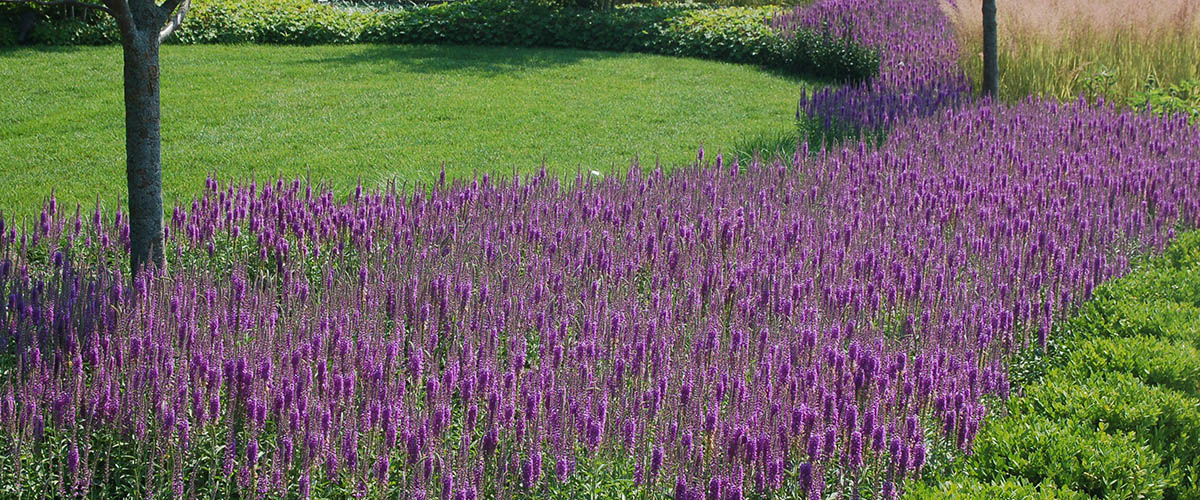
Evaluating Perennials for Chicagoland Gardens
Perennials in Focus is a plant evaluation program that examines new and underused plants for Chicagoland, the third largest metropolitan area in the country. A group of horticultural experts trials and evaluates plants at numerous locations across the region. Results help consumers, public gardens, growers, landscape designers, breeders, and other industry professionals make informed plant choices.
Finding Perennials That Can Grow Near Black Walnut
Black walnut trees are valuable landscape plants, offering shade, wildlife habitat, attractive foliage, and a strong vertical presence. They can also create a difficult planting environment beneath and around their canopy. Dense roots compete for water and nutrients, shade limits photosynthesis, and compounds released from walnut tissues may inhibit the growth of some neighboring plants.
For gardeners in the Chicagoland region, choosing suitable perennials requires more than checking a hardiness zone or reading a nursery label. Local soil, seasonal rainfall, winter conditions, mature tree size, and the age of the walnut all influence plant performance. A perennial that survives in a moist woodland elsewhere may struggle in compacted urban soil beneath a mature tree.
A regional evaluation can reveal which plants merely tolerate walnut-adjacent conditions and which maintain attractive foliage, dependable flowering, and adequate spread over several seasons. That distinction is especially useful when selecting plants for residential gardens, public landscapes, retail recommendations, and commercial planting plans.
Why black walnut sites are difficult
Black walnut (Juglans nigra) produces juglone, a naturally occurring compound associated with allelopathy. Juglone is present in roots, leaves, bark, and nut hulls, and it can enter the surrounding soil as plant material decomposes or living roots release compounds. Sensitive species may show poor growth, leaf yellowing, wilting, or premature decline.
Juglone is only part of the issue. Walnut roots often occupy a broad area beyond the trunk, where they compete directly with herbaceous plants for moisture and nutrients. The canopy can create dry shade, while fallen leaves and nuts may form a thick surface layer. In compacted or poorly drained soil, these pressures overlap and make establishment particularly difficult.
Plant response is not uniform. Published lists of “walnut-safe” plants should be treated as starting points rather than guarantees, because results can vary with tree age, soil texture, irrigation, exposure, and the distance between the perennial and major roots. Field trials are valuable because they measure performance under real planting conditions rather than relying only on isolated greenhouse observations.
Designing a useful regional trial
A meaningful Chicagoland evaluation should include several gardens or trial sites instead of a single planting bed. Multiple locations help separate plant genetics from site effects. A perennial that performs well in a loamy suburban garden but fails in a dry, heavily rooted parkway bed may still be useful, provided the conditions are clearly documented.
Each planting should record the walnut’s approximate age and canopy size, distance from the trunk, light exposure, soil drainage, irrigation practices, and presence of visible surface roots. Plants should be installed at a consistent size and spacing, with comparable soil preparation. Adding a small amount of compost may be appropriate, but heavily amending one site can make comparisons less reliable.
Evaluation should continue through establishment and at least two full growing seasons. Early survival is important, but long-term vigor matters more. Trial observers can document spring emergence, plant width, flower count, bloom duration, foliage quality, disease or pest symptoms, winter injury, and the amount of supplemental water required.
What to measure beyond survival
A plant that stays alive but remains stunted may not be a practical landscape choice. Trial notes should distinguish survival from usable performance. Height and spread indicate whether a perennial can fill its intended space, while stem strength and foliage density show whether it contributes structure throughout the season.
Flowering deserves separate attention. Record the first bloom date, peak bloom period, flower color, and whether flowering declines as the plant matures under root competition. Some perennials may produce healthy foliage but few flowers in dry shade, while others may flower briefly and then provide useful texture for the rest of the season.
The evaluation can also include maintenance observations. Note how often plants require irrigation, whether mulch remains in place, and whether roots become exposed as soil dries and erodes. A plant with moderate flowering but dependable foliage and low maintenance may be more valuable than a showy perennial that needs frequent watering to remain presentable.
The program’s regional trial snapshots can provide a useful model for presenting observations in a concise, accessible format. Clear records help gardeners compare traits without reducing performance to a simple yes-or-no judgment about walnut tolerance.
| Performance factor | What to record near walnut trees | Why it matters |
|---|---|---|
| Establishment | Spring emergence, initial survival, transplant recovery | Shows whether the plant can overcome early root and moisture competition |
| Vigor | Height, spread, stem count, foliage density | Indicates whether the perennial fills its intended landscape role |
| Flowering | Start date, peak bloom, duration, flower abundance | Separates ornamental value from basic survival |
| Water needs | Irrigation frequency and drought symptoms | Reveals how practical the plant is in dry shade |
| Seasonal durability | Winter injury, late-season decline, pest or disease symptoms | Helps predict performance over multiple years |
| Site response | Differences among soil types, light levels, and distances from the trunk | Prevents broad claims based on one location |
Comparing distance and root pressure
Distance from the trunk should be treated as a trial variable. The soil directly beneath the canopy may contain dense woody roots and receive little rain because foliage intercepts precipitation. A planting bed near the outer edge of the canopy may have more available moisture and fewer large roots, even though it remains influenced by the tree.
Researchers can create planting zones, such as near-trunk, mid-canopy, and canopy-edge locations. The goal is not to produce a universal distance rule, since mature trees differ substantially. Instead, the comparison shows how each perennial responds as root density, shade, and moisture availability change.
Root competition can also be influenced by the depth of planting. Shallow-rooted perennials may encounter intense competition close to the soil surface, while deep cultivation can damage walnut roots and create additional stress. Planting should avoid cutting major roots whenever possible. A small plant installed in a root-free pocket is often a better choice than a larger specimen forced into a crowded space.
Interpreting failures fairly
When a perennial declines, the cause should be investigated rather than automatically attributed to juglone. Drought, vole damage, poor drainage, crown rot, transplant shock, and winter injury can produce similar symptoms. Comparing the plant with the same cultivar in a nearby non-walnut control bed can help identify whether the tree environment is responsible.
Control plantings are especially important for underused perennials and newly introduced selections. If a plant performs poorly both beneath walnut and in an open garden, its problem may be general adaptability rather than walnut sensitivity. If it thrives in the control but declines near the tree, root competition or allelopathic effects become more plausible explanations.
Replicated observations strengthen the findings. A single failed plant should not eliminate an entire species, while one vigorous specimen should not establish a recommendation by itself. Looking for patterns across locations and seasons produces guidance that is more useful to homeowners, growers, landscape professionals, and public gardens.
Choosing and establishing promising plants
The strongest candidates will usually combine tolerance for dry shade with steady growth in ordinary garden soil. Plants with fibrous root systems, durable foliage, and flexible moisture requirements may have an advantage, although no trait guarantees success beside every black walnut. Regional testing can reveal which characteristics matter most under local conditions.
Establishment practices can improve the odds for nearly any perennial. Water new plants deeply and consistently during the first growing season, apply a moderate organic mulch layer without covering crowns, and avoid repeated shallow watering that encourages roots to remain near the surface. Remove excessive fallen walnut debris if it forms a dense mat, while preserving enough mulch to reduce evaporation.
Practical recommendations from a trial should be specific about placement and care rather than offering a blanket approval. A plant might be recommended for the canopy edge with irrigation, considered marginal beneath mature roots, or useful only where afternoon shade is combined with reliable soil moisture.
Practical recommendations for planting trials
- Include non-walnut control beds so poor growth can be compared with general plant performance.
- Record soil moisture, light exposure, canopy position, and irrigation instead of attributing every symptom to juglone.
- Test several plants of each perennial across more than one garden or landscape setting.
- Evaluate flowering, foliage, spread, and maintenance needs over multiple seasons.
- Install young plants carefully, protect them from drying, and avoid cutting major walnut roots.
Turning trial data into better plant choices
Results become most useful when they are written in language that reflects real landscape decisions. Instead of labeling a perennial simply “tolerant” or “intolerant,” describe its observed behavior: “maintained foliage at the canopy edge with supplemental water” or “survived beneath the tree but produced limited flowers.” Such wording gives gardeners a clearer expectation of what success may require.
The same information can guide different audiences in different ways. Home gardeners may need a short list of dependable plants and watering advice. Retailers can use performance notes to match plants with difficult sites. Breeders may identify traits worth selecting, while public gardens can assess whether a perennial provides reliable seasonal value under low-maintenance conditions.
Testing root competition near black walnut trees is therefore a continuing process rather than a one-time verdict. As more Chicagoland gardens contribute observations, the resulting evidence can sharpen planting recommendations and reveal perennials that deserve wider use. Explore the available regional evaluations, apply their findings to site-specific conditions, and document your own plants so future recommendations rest on stronger local experience.
In the Garden
Evaluator gardens are located across the Chicagoland area, representing a range of growing conditions. Visit our retail and wholesale partners to find trialled perennials for your own garden.
Retail & Wholesale: Hinsdale Nurseries (Willowbrook, IL), Mariani Nurseries (Kenosha, WI & Garden Prairie, IL), Northwind Perennials (Burlington, WI), The Growing Place (Aurora, IL).
Wholesale Only: Hinsdale Nurseries (Plano, IL), Intrinsic Perennial Gardens (Hebron, IL).
Our Evaluation Program
The 2017–2020 evaluation cycle included Agastache 'Blue Boa', Allium senescens 'Blue Eddy', Amsonia ciliata var. filifolia 'Georgia Pancake', Astilbe 'Chocolate Shogun', Boltonia astroides 'James Crocket', Brunnera 'Alexander's Great', and Geranium cinereum 'Jolly Jewel Purple'. Completed evaluations include Amsonia 'Blue Ice' (2004–07).
On April 10, 2020, the program published snapshot profiles for Vernonia lettermanii 'Iron Butterfly', Stokesia laevis 'Elf', Stachys officinalis 'Pink Cotton Candy', Lobelia 'Monet Moment', Helleborus 'Winter Thrillers', Geum 'Mai Tai', Geranium soboliferum 'Butterfly Kisses', Gentiana x intermedia 'True Blue', Eurybia divaricata, Asparagus 'Purple Passion', and Agastache 'Bolero'.
Browse the full collection of snapshots organized alphabetically — from A–D, E–H, I–Q, and R–Z — to find detailed performance data on perennials trialled across Chicagoland.