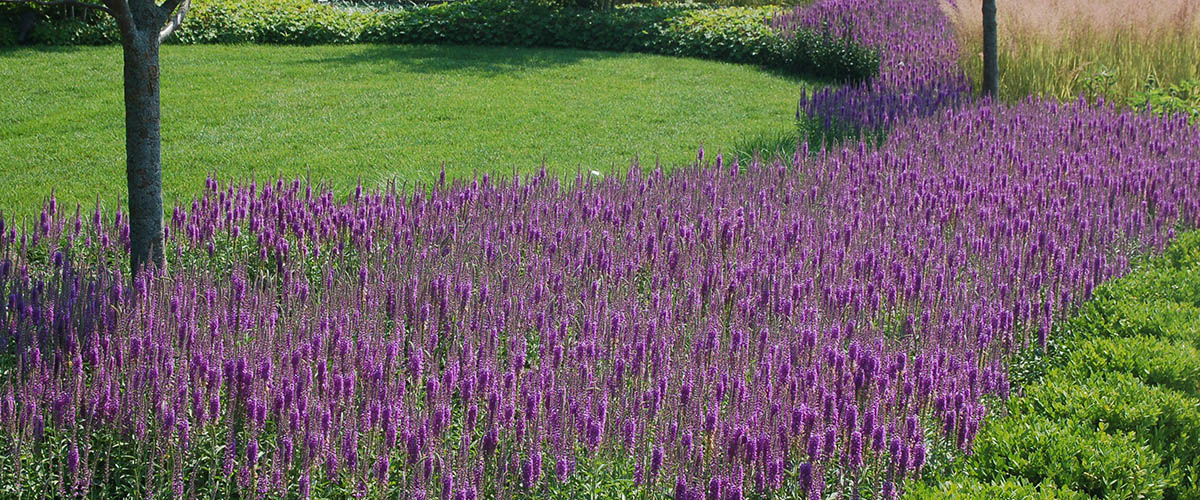
Evaluating Perennials for Chicagoland Gardens
Perennials in Focus is a plant evaluation program that examines new and underused plants for Chicagoland, the third largest metropolitan area in the country. A group of horticultural experts trials and evaluates plants at numerous locations across the region. Results help consumers, public gardens, growers, landscape designers, breeders, and other industry professionals make informed plant choices.
Trialling mealycup sage cultivars through Chicago winters
Perennials in Focus set out its inquiry about whether salvia cultivars often grown as annuals in colder zones might actually persist as perennials in the upper Midwest. Mealycup sage and the parish-type cultivars are widely sold in garden centres across the United States and Australia for their long flowering season, but their winter survival north of zone 7 is rarely documented. Chicago's zone 5b to 6a climate, fluctuating winter temperatures, and heavy clay soils make it a rigorous proving ground for plants marketed as "tender perennials." The trial asked a deceptively simple question: do these salvias come back, and if they do, how well do they perform?
The relevance reaches beyond the American Midwest. Gardeners in cooler parts of Australia — the Southern Tablelands around Canberra, the hill suburbs of Hobart, frost-prone pockets around Ballarat — face a parallel question when they read an Illinois plant tag for a salvia. Growers in Melbourne's outer suburbs and country gardeners in Tasmania regularly ask whether a salvia that survives a Chicago winter will survive their own cold snap. That shared curiosity is exactly the kind of question a multi-site perennial trial is built to answer.
Why Chicago winters challenge tender salvias
Chicago sits at the edge of USDA hardiness zones 5b and 6a, where winter low temperatures regularly drop below minus twenty-three degrees Celsius. The meteorological character of a Chicago winter is more damaging than the absolute minimum alone. Lake-effect snow, repeated freeze-thaw cycles, and desiccating winds pull moisture from evergreen and semi-evergreen foliage while soils heave and tear shallow roots. Salvias with a tropical or subtropical ancestry, including most forms of Salvia farinacea, are typically rated for zones 7 through 9, so even a mild Chicago winter exposes them to conditions well outside their published comfort range.
Australian cold-climate sites share several of these stresses without the deep snowpack. A Canberra gardener dealing with minus seven degrees and radiational cold on a still July night sees damage patterns similar to what a Chicago gardener sees after a polar vortex event. Both climates punish plants that sit wet and cold at the crown, which is the classic failure mode for mealycup sage in marginal zones.
Cultivars under evaluation
| Cultivar | Species | Flower colour | Mature height | Listed hardiness |
|---|---|---|---|---|
| 'Victoria Blue' | Salvia farinacea | Deep violet-blue | 45–60 cm | Zones 7–10 |
| 'Evolution' | Salvia farinacea | Pale violet | 40–55 cm | Zones 7–10 |
| 'Parish Pink' | Salvia × sylvestris | Soft mauve-pink | 50–70 cm | Zones 5–8 |
| 'May Night' (reference) | Salvia × sylvestris | Dark indigo | 45–60 cm | Zones 4–8 |
The parish-type selections are not as delicate as their common name implies. 'May Night', included as a reference plant, is a known hardy salvia that reliably overwinters in zone 4. The mealycup and parish-type cultivars, by contrast, carry genetics tied to warmer parents and are usually treated as annuals in Chicago. Each plant was grown from the same liner source and planted in matched conditions so that observed differences reflect the cultivar rather than the site.
Trial sites and recording methods
Trial sites are spread across the Chicago metropolitan area to capture the city's climatic variability. Sites include the Chicago Botanic Garden in Glencoe, the Morton Arboretum near Lisle, community college display beds in the city proper, and several private gardens in Evanston and Oak Park. Soil at every site was tested for texture and drainage, and planting holes were amended identically. Plants were labelled with permanent tags and photographed at four key moments each year: autumn senescence, midwinter crown check, early spring emergence, and peak summer bloom.
Recording followed the standardised Perennials in Focus protocol. Each evaluator logged crown condition on a five-point scale, counted living stems in spring, and noted first flower date, peak bloom window, and any signs of disease or pest pressure. The intent was to document what a home gardener would actually see when walking the bed in March or July, not to over-record through novelty.
Survival and regrowth after the first winter
Some hardiness signals showed up before any plant pushed new growth. In the first trial winter, more than half of the mealycup-type plants failed to break dormancy at all, while the parish-type selections emerged from a protective crown of basal foliage that had been invisible during the growing season. The pattern repeated across all four sites, suggesting it is a trait of the plant rather than a quirk of one microclimate. Mulch depth mattered less than crown drainage, with raised plantings outperforming in-ground plantings by a clear margin.
Regrowth patterns from surviving plants also diverged. Parish-type cultivars sent up vigorous new shoots from the base, while mealycup survivors regrew from short lateral stems close to soil level. A Chicago gardener assessing plants in April could confuse this basal regrowth with seedling weeds if unfamiliar with the growth habit, an observation worth flagging for any Australian gardener trialling these salvias in a similar cool climate. Comparable basal regrowth has been noted in cooler gardens from Ballarat to Hobart when grown in well-drained soil.
Bloom performance in the year after overwintering
Beyond simple survival, bloom performance in the year following a Chicago winter tells a more nuanced story. Parish-type cultivars that survived bloomed within seven to ten days of their first-year schedule, producing stems of comparable height and flower density. Mealycup survivors, when they appeared, bloomed later and on shorter stems, often with reduced floret count per spike. A gardener hoping for the full catalogue display should treat overwintered mealycup plants as a bonus rather than a reliable feature of the bed.
Evaluators also noted that surviving plants developed deeper root systems in their second year, suggesting that a mealycup sage that makes it through one season may have a better chance of making it through a second. This observation aligns with grower experience in warmer parts of Australia, where Salvia farinacea in its second season at properties around the Mornington Peninsula or in coastal Sydney gardens outperforms first-year stock. The lesson carries across hemispheres: establishment year is the risky year, especially at the cold edge of a plant's range.
Companion plants for winter structure
A salvia trial bed looks sparse in February, which is one reason structure plants matter when designing with these cultivars. The trial garden at one site paired overwintering salvias with perovskia, whose silver stems and persistent seed heads hold visual interest when the salvias are cut to the ground. Designers accustomed to working with strong winter form, including those working in cooler Australian gardens near Macedon or in the Adelaide Hills, can borrow this approach and treat the salvia as a seasonal layer above a year-round silver backbone.
For gardeners thinking about winter interest more broadly, the the winter interest of perovskia atriplicifolia seed heads after snowfall checklist offers a practical reference list. Pairing the checklist with salvia observations from the Chicago trial gives a designer two compatible data sets for planning a four-season border in a cold climate.
Cross-referencing with broader evaluation work
Multi-site trials only matter if their data can be compared with data from elsewhere. The Chicago findings sit within a wider network of perennial evaluation work, including projects that test salvia, perovskia, and other borderline-hardy genera across multiple hardiness zones. Readers wanting to compare regional results can consult the RECAP project resources, which aggregate findings from cooperating institutions and allow a Chicago observation to be checked against trials in colder or warmer regions.
Australian readers can use the same comparison logic. A salvia survival note from Glencoe is more directly transferable to a Canberra garden than to a Brisbane one, and a planting calendar for zone 6 in Illinois needs adjustment before it becomes a calendar for a Ballarat garden. The value of cross-referenced data is exactly this kind of calibration. Where two regions share a winter minimum and a similar freeze-thaw pattern, the plants that survive in one are likely candidates in the other, with site-specific adjustments for soil and exposure.
Perennials in Focus welcomes reports from home gardeners, public gardens, and landscape professionals who trial these cultivars in their own beds. If you have grown a parish-type or mealycup sage through a winter outside its published hardiness range, your observations strengthen the evidence base for everyone considering these plants at the cold edge of their adaptability.
In the Garden
Evaluator gardens are located across the Chicagoland area, representing a range of growing conditions. Visit our retail and wholesale partners to find trialled perennials for your own garden.
Retail & Wholesale: Hinsdale Nurseries (Willowbrook, IL), Mariani Nurseries (Kenosha, WI & Garden Prairie, IL), Northwind Perennials (Burlington, WI), The Growing Place (Aurora, IL).
Wholesale Only: Hinsdale Nurseries (Plano, IL), Intrinsic Perennial Gardens (Hebron, IL).
Our Evaluation Program
The 2017–2020 evaluation cycle included Agastache 'Blue Boa', Allium senescens 'Blue Eddy', Amsonia ciliata var. filifolia 'Georgia Pancake', Astilbe 'Chocolate Shogun', Boltonia astroides 'James Crocket', Brunnera 'Alexander's Great', and Geranium cinereum 'Jolly Jewel Purple'. Completed evaluations include Amsonia 'Blue Ice' (2004–07).
On April 10, 2020, the program published snapshot profiles for Vernonia lettermanii 'Iron Butterfly', Stokesia laevis 'Elf', Stachys officinalis 'Pink Cotton Candy', Lobelia 'Monet Moment', Helleborus 'Winter Thrillers', Geum 'Mai Tai', Geranium soboliferum 'Butterfly Kisses', Gentiana x intermedia 'True Blue', Eurybia divaricata, Asparagus 'Purple Passion', and Agastache 'Bolero'.
Browse the full collection of snapshots organized alphabetically — from A–D, E–H, I–Q, and R–Z — to find detailed performance data on perennials trialled across Chicagoland.