Evaluating Perennials for Chicagoland Gardens
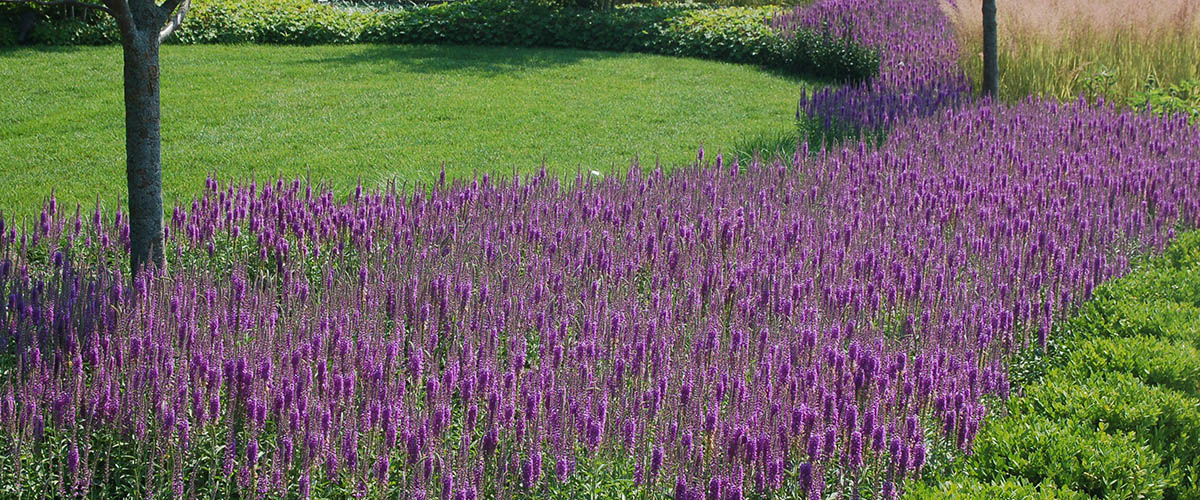
Perennials in Focus is a plant evaluation program that examines new and underused plants for Chicagoland, the third largest metropolitan area in the country. A group of horticultural experts trials and evaluates plants at numerous locations across the region. Results help consumers, public gardens, growers, landscape designers, breeders, and other industry professionals make informed plant choices.
Mycorrhizal Inoculation And Liatris Establishment In Sand
Liatris spicata, commonly called blazing star or dense blazing star, is valued for its upright flower spikes, late-summer colour and ability to support pollinators. Its corm-like underground storage organ helps the plant persist through seasonal stress, yet establishment can be uneven when plants are placed in very free-draining sand. Early root development, moisture retention and nutrient access become especially important during the first growing season.
Testing the impact of mycorrhizal inoculation on Liatris spicata establishment in sand offers a practical way to separate useful biology from attractive product claims. Arbuscular mycorrhizal fungi can form associations with plant roots, potentially extending the effective absorbing area of the root system. In low-organic-matter soil, that relationship may improve access to phosphorus and water, although the result depends on fungal compatibility, inoculum quality and site conditions.
The Perennials in Focus approach is well suited to this question because it values repeated observations across gardens and seasons rather than a single nursery result. A trial designed in the Chicagoland region can also provide useful principles for Australian growers and gardeners, provided the differences in climate, soil chemistry and irrigation are kept visible.
Why Sand Changes Establishment
Sand drains rapidly, contains little organic matter and generally holds fewer nutrients than loam or clay. These characteristics can benefit Liatris spicata once its root system is established, since the species dislikes persistent winter wetness. They can also create a difficult establishment window: a newly planted division or container-grown plant may dry out before roots have explored the surrounding soil.
Mycorrhizal fungi may help by producing fine hyphae that reach pores and nutrient pockets beyond the immediate root surface. This does not turn sand into fertile soil, and it cannot compensate for severe drought, poor planting depth or unsuitable irrigation. The most likely benefit would be seen in early root spread, steadier shoot growth or improved flowering after the plant has survived its first stress period.
The research question should therefore be broader than whether inoculated plants grow taller. A useful trial asks whether inoculation improves survival, root establishment, flowering reliability and resilience after irrigation is reduced. This distinction matters in Australian settings such as Perth, where deep, acidic sands and hot summers can expose weakly rooted perennials very quickly.
How To Set Up A Reliable Trial
A sound comparison needs at least two treatments: Liatris plants grown in the same sand without added inoculum, and matching plants receiving a measured mycorrhizal treatment. Replication across several beds or containers is preferable to placing one plant in each treatment. Plants should be similar in size, cultivar, container history and planting date, with randomised positions to reduce the influence of shade, wind and local drainage.
The sand should be characterised before planting. Record texture, pH, electrical conductivity, organic matter and available phosphorus, then use one consistent substrate throughout the experiment. Excess phosphorus is particularly important because high fertility can reduce a plant’s incentive to form mycorrhizal partnerships. Compost, controlled-release fertiliser and wetting agents should either be excluded or applied uniformly to all treatments.
Inoculum should be applied according to its label rather than scattered broadly over the soil surface. Direct contact with the root zone gives the fungi a better opportunity to colonise roots. Researchers should also record whether the product contains viable arbuscular mycorrhizal species, its carrier material and storage conditions. A failed result may reflect unsuitable or inactive inoculum rather than an absence of biological potential.
What To Measure Through The Seasons
Establishment begins before flowering. Record survival at two-week intervals during the first several months, along with the number of new shoots, plant height, basal width and visible signs of water stress. A simple canopy score can complement measurements, particularly when plants differ in leaf angle or growth habit. Soil moisture readings at consistent depths will help explain whether a treatment effect is linked to improved water use or merely uneven irrigation.
Flowering data should include the date of first visible buds, first open florets, peak display and the end of flowering. Count flowering stems and measure their height and spread. These observations fit the type of regional performance information that Perennials in Focus publishes, including bloom period, flower colour, mature height and garden spread.
The trial should continue beyond one summer. Liatris spicata is a perennial, so a treatment that produces larger first-year foliage may offer little value if plants fail to overwinter or become crowded and floppy later. Harvesting a small sample of roots at the end of the season can provide evidence of colonisation through staining and microscopy, while final corm weight or crown size can indicate whether the plant has built useful reserves.
Interpreting Climate And Site Effects
Results from Chicagoland should be interpreted alongside heat, rainfall and urban exposure. Pavement, reflected heat and warmer night temperatures can alter perennial bloom timing even when the planting bed appears well watered; the program’s observations on urban heat effects provide helpful context for separating inoculation effects from local microclimate.
Australian readers should make similar distinctions. A trial in Melbourne may encounter cool, wet winters and dry summers, while Adelaide can combine alkaline soils with hot, drying winds. In Brisbane, summer rainfall and humidity may favour different root and fungal dynamics than those found in a dry Perth garden. The same inoculated plant can therefore produce different results in a raised sand bed, a sandy loam border or a container exposed to radiant heat.
Site history is another source of variation. Fungicides, previous crops and existing native fungal communities may affect colonisation. Liatris grown after repeated fertiliser applications may respond differently from plants in nutrient-poor sand. Inoculation should be judged against the actual management system, including watering frequency and fertiliser rate, rather than presented as an isolated additive that works under every condition.
Applying Findings To Australian Gardens
If inoculation improves survival or flowering consistently, the most sensible use may be targeted application at planting rather than blanket treatment of every perennial bed. Gardeners can combine it with deep but measured watering, a thin organic mulch that does not bury the crown, and a low-phosphorus fertiliser strategy. In sandy gardens, regular moisture during establishment is still essential; fungal hyphae cannot replace water in a heatwave.
Australian nurseries and garden retailers already sell microbial soil conditioners, root dips and granular products, but labels vary widely in organism identity, concentration and storage advice. A credible result should identify the product and application rate clearly, allowing growers to compare cost with measurable outcomes. For public gardens and landscape contractors, reduced plant replacement may be a more meaningful benefit than a small increase in flower height.
Liatris spicata is available through parts of the Australian ornamental plant market, although supply can be less consistent than for mainstream cottage-garden perennials. Its vertical form suits pollinator borders, cut-flower plantings and naturalistic schemes, but it should be trialled for local performance rather than assumed to behave like a proven Australian native. In areas where black walnut is present, root competition and juglone concerns also deserve attention; regional black walnut guidance illustrates why neighbouring trees and soil conditions belong in planting decisions.
| Trial feature | Recommended approach | Why it matters |
|---|---|---|
| Control | Identical plants without added inoculum | Shows whether the treatment produces a measurable difference |
| Inoculated treatment | Label-rate arbuscular mycorrhizal product placed at the root zone | Gives fungi direct access to developing roots |
| Replication | Several plants across multiple positions or beds | Reduces the effect of local shade, moisture and soil variation |
| Early measurements | Survival, shoot count, height and moisture stress | Captures establishment before flowering |
| Seasonal measurements | Flowering dates, stem number, height and spread | Connects root establishment with ornamental performance |
| Root assessment | Colonisation check and end-of-season crown or corm size | Tests whether visible growth is associated with fungal partnership |
| Australian interpretation | Repeat under local sand, irrigation and climate conditions | Prevents direct transfer of results between very different regions |
A carefully run study can show whether mycorrhizal inoculation is a dependable aid for Liatris spicata or simply one factor among many. For home gardeners, the practical message is to prioritise sound planting and water management, then use inoculation where trial evidence supports the extra cost. For growers and landscape professionals, consistent records can turn an uncertain amendment into a defensible production decision.
Use the Perennials in Focus findings as a model for your own site trials: compare treated and untreated plants, record performance through more than one season, and share observations that help Australian gardens choose resilient perennials with greater confidence.
In the Garden
Evaluator gardens are located across the Chicagoland area, representing a range of growing conditions. Visit our retail and wholesale partners to find trialled perennials for your own garden.
Retail & Wholesale: Hinsdale Nurseries (Willowbrook, IL), Mariani Nurseries (Kenosha, WI & Garden Prairie, IL), Northwind Perennials (Burlington, WI), The Growing Place (Aurora, IL).
Wholesale Only: Hinsdale Nurseries (Plano, IL), Intrinsic Perennial Gardens (Hebron, IL).
Our Evaluation Program
The 2017–2020 evaluation cycle included Agastache 'Blue Boa', Allium senescens 'Blue Eddy', Amsonia ciliata var. filifolia 'Georgia Pancake', Astilbe 'Chocolate Shogun', Boltonia astroides 'James Crocket', Brunnera 'Alexander's Great', and Geranium cinereum 'Jolly Jewel Purple'. Completed evaluations include Amsonia 'Blue Ice' (2004–07).
On April 10, 2020, the program published snapshot profiles for Vernonia lettermanii 'Iron Butterfly', Stokesia laevis 'Elf', Stachys officinalis 'Pink Cotton Candy', Lobelia 'Monet Moment', Helleborus 'Winter Thrillers', Geum 'Mai Tai', Geranium soboliferum 'Butterfly Kisses', Gentiana x intermedia 'True Blue', Eurybia divaricata, Asparagus 'Purple Passion', and Agastache 'Bolero'.
Browse the full collection of snapshots organized alphabetically — from A–D, E–H, I–Q, and R–Z — to find detailed performance data on perennials trialled across Chicagoland.