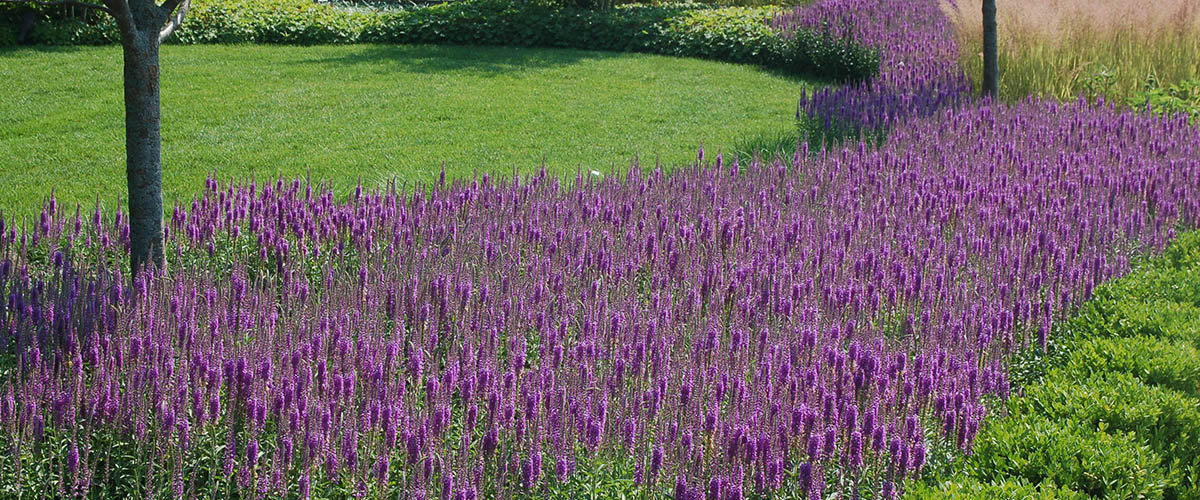
Evaluating Perennials for Chicagoland Gardens
Perennials in Focus is a plant evaluation program that examines new and underused plants for Chicagoland, the third largest metropolitan area in the country. A group of horticultural experts trials and evaluates plants at numerous locations across the region. Results help consumers, public gardens, growers, landscape designers, breeders, and other industry professionals make informed plant choices.
Mulch Trials for Thalictrum in Australian Gardens
Testing the impact of mulch type on soil moisture for Thalictrum aquilegifolium is a straightforward comparison, but useful conclusions depend on controlling the soil, watering and application rate. This Eurasian perennial, commonly called meadow rue, produces airy flower clusters in spring and summer and grows best in moisture-retentive but well-drained soil.
Australian results may differ from those recorded around Chicago because rainfall, humidity, soil type and seasonal temperatures vary considerably. A sound trial must separate the influence of mulch from irrigation, plant maturity and ordinary soil variation before recommending a treatment for home gardens.
Why Mulch Changes the Moisture Balance
Mulch reduces evaporation by shading the soil, slows rainwater runoff and can moderate temperature around the roots. These effects matter for Thalictrum aquilegifolium, whose spring growth and flowering depend on a steady supply of water. A dry surface can restrict new shoots even when deeper soil remains damp.
Mulch does not automatically improve moisture conditions. Coarse bark and woodchip leave larger spaces for rain to penetrate, while fine compost or leaf mould can form a dense layer that sheds water. Sugarcane mulch often holds substantial moisture, although a dry mat may become difficult for rainfall to pass through.
Mulch also affects soil biology and decomposition. As organic material breaks down, it changes soil structure and nutrient availability. Mulch should therefore be compared over a full growing cycle rather than judged after a single watering event or short dry spell.
Designing a Replicated Australian Trial
A practical design would use randomised blocks, with each block containing an untreated control and several mulch treatments. A gardener could apply 50 millimetres of coarse bark, composted pine bark, composted garden waste or sugarcane mulch to equivalent areas, using at least six plants per treatment.
Soil moisture should be measured with calibrated sensors at two depths, while containers or weighable beds can provide an independent check on water loss. Rainfall, irrigation, soil temperature, plant height, spread and flowering dates should be recorded on the same schedule. Readings every two or three days would reveal how quickly each treatment dries.
Trials beginning in autumn can cover winter establishment, spring flowering and the transition into summer. The mulch layer should be checked for compaction, erosion, fungal growth and movement, since these changes alter its original depth and function. Unequal quantities should be recorded by both volume and mass because bulk densities differ considerably.
Choosing Mulch Available in Australia
Australian nurseries and garden suppliers commonly offer bark, pine bark, woodchip, pea straw, sugarcane mulch and composted green waste. Packaged products are often sold by the litre or cubic metre, while council depots and landscape yards may supply bulk loads. Labels should identify the source, particle size, composted status and any added lawn or chemical treatment.
Local conditions influence which properties are most useful. Melbourne’s variable spring and dry summer reward mulch that conserves moisture without creating a wet root zone. Sydney’s humid weather and intense downpours call for a layer permeable enough to accept heavy rain, while Brisbane’s wet summers can favour treatments that resist compaction.
Adelaide gardens often depend on irrigation during hot, dry weather, making evaporation control especially valuable. Before starting, compare products under Australian conditions rather than assuming that a mulch successful in northern Illinois will behave identically. A trial that uses locally available materials will produce findings that gardeners can apply directly.
Interpreting Moisture and Plant Performance
Moisture retention should be judged by the consistency of the difference between mulched and untreated soil, not by one very wet reading after rain. Useful evidence includes slower drying, fewer irrigation events and steadier moisture through flowering. Recorded rainfall is essential because an unusually wet month can conceal the usual benefit of mulch.
Plant performance provides a separate layer of evidence. Stronger shoots, additional flowering stems and healthy foliage may indicate better water availability, although stake height, disease and sunlight can affect these measures. A plant that wilts in a heatwave but recovers quickly may be responding to root-zone temperature rather than simple moisture shortage.
The best treatment is therefore the one that supports healthy growth across repeated cycles. Compost may improve soil as it decomposes, bark may remain effective for longer, and sugarcane may need careful watering before it becomes fully wetted. These distinctions are more valuable than declaring one universal winner.
Keeping Regional Findings in Context
The regional lens is especially clear in Perennials in Focus’s review of Northern Illinois plant candidates. Observations from that area can guide further testing, but they cannot substitute for local data because rainfall patterns, soil composition and seasonal heat differ across Australia.
Northern Illinois has cold winters and a pronounced freeze-and-thaw cycle, whereas many Australian gardens experience milder winters, dry heat or summer humidity. Even within Australia, a trial in coastal Sydney cannot be applied uncritically to inland Adelaide or Brisbane. Documenting local soil type, rainfall totals and irrigation restrictions allows readers to judge how transferable the findings are.
Source quality also deserves attention. A search result that invites readers to play pokies at home belongs to entertainment rather than horticultural evidence, yet the source-checking lesson is similar: a persuasive page is not a substitute for recorded data. Gardeners should prioritise trial methods and observable results over unsupported product claims.
Turning the Trial Into Better Plant Choices
Begin with a clearly defined question, such as whether a 50-millimetre mulch layer reduces irrigation demand during flowering. Keep the planting site, spacing, watering regime and amount of compost identical across treatments. Include an uncovered control so the contribution of the mulch can be measured rather than assumed.
Publish the dates, weather records, application rates and moisture readings alongside photographs of the plants. Separate treatment effects from unrelated problems, including drought stress before mulching, root disturbance, shade changes and disease. Repeat the comparison in a second season if possible, since settling and decomposition can change performance substantially.
Choose the treatment that maintains suitable moisture while preserving airflow, healthy growth and reliable flowering in the local setting. Share the findings through local garden groups, nursery trials and community horticulture networks, where the measurements can guide planting decisions and help build a clearer regional evidence base for Thalictrum aquilegifolium.
In the Garden
Evaluator gardens are located across the Chicagoland area, representing a range of growing conditions. Visit our retail and wholesale partners to find trialled perennials for your own garden.
Retail & Wholesale: Hinsdale Nurseries (Willowbrook, IL), Mariani Nurseries (Kenosha, WI & Garden Prairie, IL), Northwind Perennials (Burlington, WI), The Growing Place (Aurora, IL).
Wholesale Only: Hinsdale Nurseries (Plano, IL), Intrinsic Perennial Gardens (Hebron, IL).
Our Evaluation Program
The 2017–2020 evaluation cycle included Agastache 'Blue Boa', Allium senescens 'Blue Eddy', Amsonia ciliata var. filifolia 'Georgia Pancake', Astilbe 'Chocolate Shogun', Boltonia astroides 'James Crocket', Brunnera 'Alexander's Great', and Geranium cinereum 'Jolly Jewel Purple'. Completed evaluations include Amsonia 'Blue Ice' (2004–07).
On April 10, 2020, the program published snapshot profiles for Vernonia lettermanii 'Iron Butterfly', Stokesia laevis 'Elf', Stachys officinalis 'Pink Cotton Candy', Lobelia 'Monet Moment', Helleborus 'Winter Thrillers', Geum 'Mai Tai', Geranium soboliferum 'Butterfly Kisses', Gentiana x intermedia 'True Blue', Eurybia divaricata, Asparagus 'Purple Passion', and Agastache 'Bolero'.
Browse the full collection of snapshots organized alphabetically — from A–D, E–H, I–Q, and R–Z — to find detailed performance data on perennials trialled across Chicagoland.