Evaluating Perennials for Chicagoland Gardens
Perennials in Focus is a plant evaluation program that examines new and underused plants for Chicagoland, the third largest metropolitan area in the country. A group of horticultural experts trials and evaluates plants at numerous locations across the region. Results help consumers, public gardens, growers, landscape designers, breeders, and other industry professionals make informed plant choices.
What late autumn pruning changes in New England asters
New England aster is a dependable late-season performer in the Chicago region, yet its value in a mixed border depends on height, spread and how long the flower colour remains effective. Perennials in Focus evaluates plants across several Chicagoland gardens, recording bloom period, colour, dimensions and seasonal behaviour. That regional approach is more useful than a general description because the same perennial can perform differently in a windy public garden, a home plot and a moist nursery.
The plant is widely sold as Aster novae-angliae and may also appear under the current name Symphyotrichum novae-angliae. In the northern hemisphere, it flowers from late summer into autumn and normally encounters frost before winter. Australia reverses that calendar: flowering may run from summer into autumn, while southern and northern gardens experience very different frost, rainfall and humidity. Melbourne and Canberra can be cool enough for dormancy, whereas Sydney, Perth and Brisbane offer less predictable winter rests.
The Chicagoland work asks a focused question: testing the impact of late fall pruning on flowering of Aster novae-angliae. Because the cut occurs after the main display, its effect should be judged in the following spring and summer. The central concern is whether removal of the old framework encourages useful basal growth or reduces the crown’s capacity to replace strong flowering stems.
Designing a fair pruning comparison
A useful trial starts with established, comparable plants rather than newly divided specimens. Similar-sized plants are assigned to an unpruned control, a half-height cut after senescence, and a cutback close to the crown. Researchers note bud and shoot development, then record flowering date, flower count, mature height and spread in the next season. Replicates across several sites help separate pruning effects from soil, exposure and disease.
| Autumn treatment | Winter appearance | Likely next-cycle effect | Best fit |
|---|---|---|---|
| Leave stems intact | Informal, with seed heads | Usually the tallest and most flower-rich, but loose | Wildlife value and natural planting |
| Cut stems to about half their length | Partly tidied | Moderate regrowth and a smaller floral display | Balanced borders |
| Cut all stems near the crown | Very neat | Greatest risk of weak or delayed flowering | Highly managed beds |
The comparison is not a vote on style; it shows what each treatment changes. Records from another long-bloom perennial, the programme’s extended-bloom Tiarella findings, reinforce the value of measuring a complete season instead of judging a plant on one flowering date. Cuts should also be dated after frost injury, since an early cut into green growth creates a different trial.
Reading the flowering response
In the following season, the clearest distinction is between tidy appearance and floral performance. Plants left standing generally carry more replacement stems and produce the tallest display. Half-height pruning can reduce bulk without removing all dormant material, while cutting to the crown may produce shorter, softer growth. Delayed opening is common where autumn injury or water stress has weakened the crown.
These are directional effects rather than fixed numbers. A sheltered plot may regenerate strongly after a severe cut, while an exposed one may not. Disease also matters: dense growth can encourage powdery mildew, whereas improved air movement may reduce it. Height and spread should be recorded alongside bloom period and colour so a successful result is not mistaken for a poor one simply because a compact plant carried fewer flowers.
Balancing flowers with useful structure
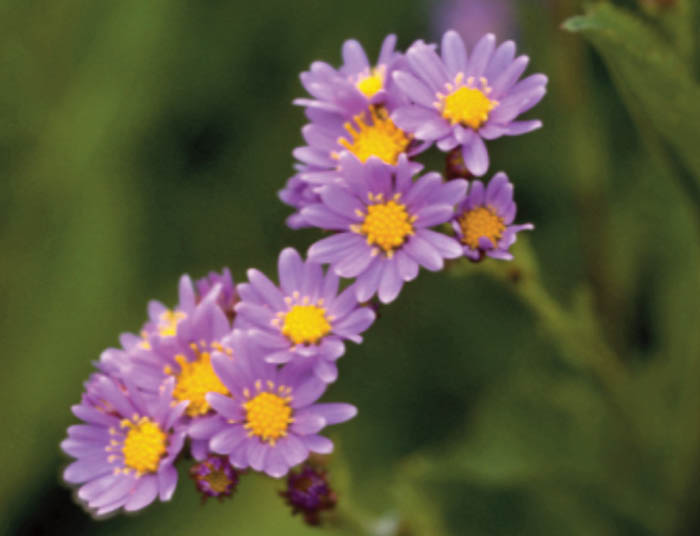
For a mixed border, flowering is only one part of the plant’s value. New England aster’s upright framework gives vertical structure after its purple, pink or mauve flowers fade, and the seed heads can remain attractive well into winter. Leaving stems is therefore a reasonable choice where visual structure and late-season habitat matter more than a sharply edged bed.
A gardener who values a clean autumn cut-back can compromise by removing collapsed material while retaining some healthy stems. The cut should not be treated as fertiliser. Keep the root crown uninjured, avoid cutting into soft basal growth and remove diseased material from the site. Where stems have already collapsed, light tidying is less stressful than forcing every plant into the same low silhouette.
Adapting Chicagoland evidence for Australia
Australian gardeners should translate the treatment, not copy the calendar. March to May is the usual autumn window, but the right time follows flowering, senescence and local growth habit. In cooler southern districts, a dormant crown can tolerate firmer pruning; in warmer subtropical gardens, cutting may trigger fresh leaves instead of dormancy and can encourage regrowth when the plant is already stressed.
Local conditions alter the result as much as the pruning method. Melbourne’s variable humidity can favour mildew, Canberra’s frost can damage shallow crowns, Perth’s dry summer increases water stress, and Sydney’s mild winter can extend soft growth. A tidy-up that works in one district may fail in another. Australian labels and local advice should therefore name the region and season rather than say simply “prune in autumn.”
The market adds another layer. Independent nurseries, garden centres, mail-order growers and breeders may stock different selections under the same common name, while local societies and public gardens often test them before they become retail favourites. Check mature size and regional behaviour on the label, buy from a source that can explain where the plant has been grown, and consult local weed and biosecurity registers before moving or composting flowering material.
Turning measurements into practical choices
Results are most valuable when translated into specific choices. Home gardeners can keep tall stems for a natural winter composition, use half-height cutting where neatness matters, and reserve close cutbacks for reliable, moist but well-drained sites. Growers and retailers can add expected height and spread to labels, reducing disappointment when a vigorous selection crowds a small border.
Public gardens can repeat the trial with plants already established on site and publish dates rather than a single-season score. Breeders can compare flower colour, branching, disease resistance and post-cutback vigour together. When planting is used to frame an outdoor room, a spatial planning reference may help with sightlines and balance, but local trial observations should guide every plant and pruning date.
Run a small pruning trial
Choose three established asters of similar size and mark one to remain untouched, one for half-height cutting, and one for cutting near the crown. Record the date of the final flowers, the first new shoots and the first blooms. Note height, spread, colour, disease and any winter damage, then repeat the same measurements next season.
Start the log before the autumn tidy-up, share the findings with a local nursery, plant society or public garden, and compare notes with other climates. Keeping flowering stems, leaving a low-cut plant, or simply recording what a severe winter does all produce useful evidence. Send the observations to Perennials in Focus and let the next regional trial begin with better evidence.
In the Garden
Evaluator gardens are located across the Chicagoland area, representing a range of growing conditions. Visit our retail and wholesale partners to find trialled perennials for your own garden.
Retail & Wholesale: Hinsdale Nurseries (Willowbrook, IL), Mariani Nurseries (Kenosha, WI & Garden Prairie, IL), Northwind Perennials (Burlington, WI), The Growing Place (Aurora, IL).
Wholesale Only: Hinsdale Nurseries (Plano, IL), Intrinsic Perennial Gardens (Hebron, IL).
Our Evaluation Program
The 2017–2020 evaluation cycle included Agastache 'Blue Boa', Allium senescens 'Blue Eddy', Amsonia ciliata var. filifolia 'Georgia Pancake', Astilbe 'Chocolate Shogun', Boltonia astroides 'James Crocket', Brunnera 'Alexander's Great', and Geranium cinereum 'Jolly Jewel Purple'. Completed evaluations include Amsonia 'Blue Ice' (2004–07).
On April 10, 2020, the program published snapshot profiles for Vernonia lettermanii 'Iron Butterfly', Stokesia laevis 'Elf', Stachys officinalis 'Pink Cotton Candy', Lobelia 'Monet Moment', Helleborus 'Winter Thrillers', Geum 'Mai Tai', Geranium soboliferum 'Butterfly Kisses', Gentiana x intermedia 'True Blue', Eurybia divaricata, Asparagus 'Purple Passion', and Agastache 'Bolero'.
Browse the full collection of snapshots organized alphabetically — from A–D, E–H, I–Q, and R–Z — to find detailed performance data on perennials trialled across Chicagoland.