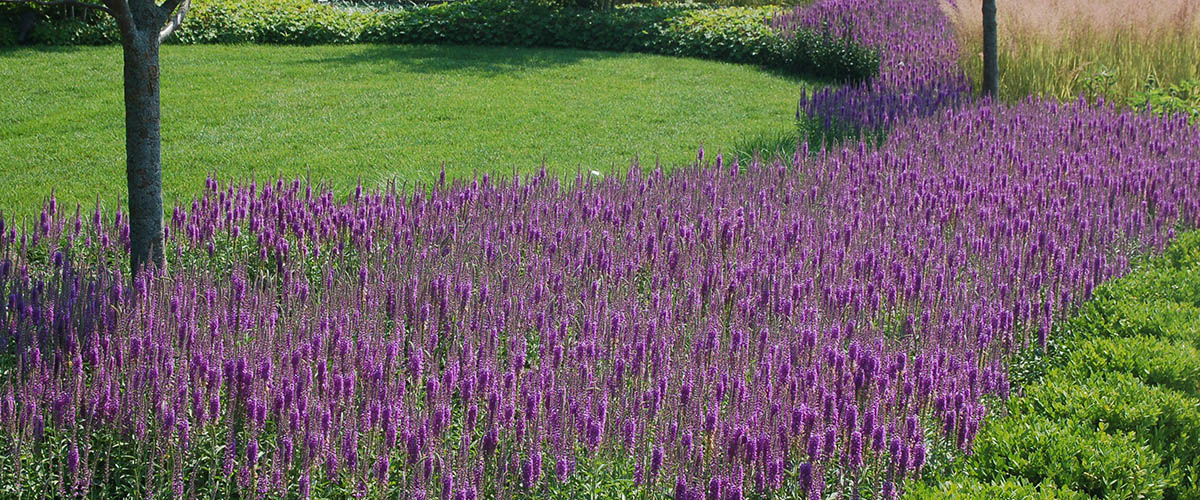
Evaluating Perennials for Chicagoland Gardens
Perennials in Focus is a plant evaluation program that examines new and underused plants for Chicagoland, the third largest metropolitan area in the country. A group of horticultural experts trials and evaluates plants at numerous locations across the region. Results help consumers, public gardens, growers, landscape designers, breeders, and other industry professionals make informed plant choices.
Testing Slow-Release Fertiliser For Container Perennials
Container-grown perennials are asked to perform under tighter conditions than plants in open ground. Their roots share a limited volume of potting mix, moisture can disappear quickly, and nutrients may be washed out through drainage holes. A slow-release fertiliser can create a steadier supply, but its value depends on the plant, the container, the climate and the growing medium.
Perennials in Focus evaluates plants through repeated, region-specific observation rather than relying on a single season or an attractive catalogue description. That approach is useful for Australian gardeners and growers too, provided trial results are interpreted alongside local conditions such as intense summer heat, variable rainfall and the warmer release rates common in many parts of Australia.
Why Container Trials Matter
A perennial that thrives in a garden bed may behave quite differently in a pot. Restricted roots can lead to faster drying, salt accumulation and sharp nutrient fluctuations. These stresses may reduce flowering, shorten the season or produce soft, leafy growth that is less resilient during hot weather.
Container trials make those effects visible. Plants can be grown in matching pots with the same potting mix, irrigation schedule and light exposure, while the fertiliser becomes the main variable. Measurements might include plant height, spread, flower count, foliage colour, pest damage and the time taken to recover after drying.
Heat tolerance is especially relevant when containers sit on paved courtyards or exposed balconies. The coreopsis heat trials show why performance during summer peaks deserves separate attention from general garden vigour. A fertiliser programme should support flowering without pushing growth that wilts easily.
What Slow-Release Fertiliser Actually Changes
Slow-release fertilisers contain nutrients that become available gradually. Some products use resin-coated granules, while others rely on less-soluble nutrient forms or microbial activity. The label may describe the expected feeding period as several months, but that estimate is usually based on particular temperature and moisture conditions.
Release is rarely perfectly even. Warm, consistently moist potting mix can speed up nutrient availability, while cool or very dry conditions may slow it. In Australia, a product rated for six months in a mild production environment may behave differently during a hot Perth summer or in a shaded Melbourne courtyard.
The aim is a stable supply rather than maximum feeding. Excess nitrogen can produce lush foliage at the expense of flowers, increase water demand and make some perennials more vulnerable to pests. A useful comparison therefore measures flowering and plant quality, not simply leaf size.
Designing A Fair Trial
A reliable test starts with uniform plant material. Use divisions, plugs or young plants of similar size, and place each treatment in identical containers. Record the pot diameter, potting mix brand or recipe, drainage characteristics, planting date and fertiliser analysis, including the nitrogen, phosphorus and potassium values.
Replication matters. One plant per treatment may produce an interesting observation, but several plants allow unusual individuals to be recognised as exceptions. Randomly position containers, then rotate them periodically so that a plant does not receive better light or shelter throughout the trial.
Keep irrigation consistent, but do not treat water use as irrelevant. A slow-release treatment that performs well only when the plant remains constantly moist may be unsuitable for a busy household. Record wilting, drainage, rainfall exposure and any top-up watering. In commercial production, note whether the fertiliser fits the existing fertigation or hand-watering routine.
Reading The Results
A simple scorecard can reveal patterns that casual observation misses. Record results at regular intervals, such as planting, first flowering, peak flowering, midsummer and the end of the season. Include a short note about weather conditions, especially heatwaves or prolonged rain.
| Measure | What To Record | Why It Matters |
|---|---|---|
| Flowering | First bloom, flower count and duration | Shows whether nutrition supports useful display |
| Growth | Height, spread and density | Identifies balanced growth rather than excessive foliage |
| Foliage | Colour, scorch and leaf retention | Helps separate nutrition issues from heat stress |
| Water use | Wilting and watering frequency | Indicates practical performance in a container |
| Root-zone condition | Salt crust, odour and drainage | Flags fertiliser accumulation or poor aeration |
| Recovery | Response after heat or drying | Measures resilience, not just peak appearance |
Statistical analysis can be modest but still valuable. Calculate average scores for each treatment and compare the range between plants. If one fertiliser produces excellent results in one pot but poor results in another, inconsistent moisture or uneven release may be part of the explanation.
Photographs taken from the same angle also help. A monthly image can show whether an apparent improvement is genuine or simply the result of a larger plant being viewed from a different distance.
Adapting Findings For Australian Gardens
Australian conditions require careful interpretation of overseas trials. In Brisbane and coastal New South Wales, warm temperatures and humid weather may accelerate release and encourage fungal problems in dense foliage. In Adelaide and Perth, dry air, hot winds and rapidly heating containers can increase water stress. Melbourne gardeners may experience cooler winters but sudden summer heat, while Canberra combines cold winters with strong sun and dry air.
Container material changes the result as well. Black plastic pots can heat quickly on a north- or west-facing surface, whereas thick ceramic pots may buffer temperature swings but remain heavy. Raising pots off concrete improves drainage, and grouping them can reduce moisture loss, although crowding may limit airflow.
The Australian market also affects product choice. Home gardeners often buy controlled-release granules from large hardware chains, garden centres or specialist nurseries, while wholesale growers may use professional formulations in bulk. Product cost, application labour, label clarity and availability through local suppliers belong in the final assessment. A slightly less productive treatment may be preferable if it is easier to source and apply accurately.
Matching Fertiliser To The Perennial
Different perennials have different nutritional expectations. Fast-growing flowering plants may benefit from a stronger initial supply, while drought-adapted species often prefer leaner conditions. Native or Mediterranean-style perennials can suffer when a rich feeding regime produces soft growth, particularly in small containers exposed to heat.
The potting mix deserves equal attention. A mix with compost, coir, bark or controlled-release wetting agents may already provide nutrients or alter water retention. Comparing fertilisers without recording the base mix can lead to misleading results. The same granule rate may behave differently in a free-draining mix than in a moisture-retentive one.
Soil preference also influences plant performance. The comparison of asclepias soil preferences demonstrates why a plant’s response cannot be separated from its growing medium. In a container, drainage, aeration and moisture retention often matter as much as the fertiliser itself.
Turning Trial Data Into Better Choices
The strongest outcome is a practical recommendation, such as a fertiliser rate, application timing and suitable container size for a defined growing situation. Avoid broad claims that a product is universally superior. State whether it worked for a particular perennial under particular light, watering and temperature conditions.
For Australian home gardeners, begin with a small side-by-side trial rather than changing every pot at once. Label containers, follow the product rate carefully and watch for leaf-edge scorch, sudden soft growth or a white crust on the mix. Do not add extra liquid feed simply because flowering has not started; check light, root crowding, watering and the plant’s natural bloom period first.
Growers and retailers can use the findings to improve crop scheduling and customer advice. A controlled-release treatment that supports compact growth, predictable flowering and lower labour may have greater market value than one that produces the largest plant. Public gardens and landscape teams can assess whether container displays remain attractive between maintenance visits.
Use the trial approach to compare products, potting mixes and perennial varieties in your own climate. Record clear observations across a full growing season, share useful results with local gardening networks and choose fertiliser programmes that deliver reliable plants rather than short-lived bursts of growth.
In the Garden
Evaluator gardens are located across the Chicagoland area, representing a range of growing conditions. Visit our retail and wholesale partners to find trialled perennials for your own garden.
Retail & Wholesale: Hinsdale Nurseries (Willowbrook, IL), Mariani Nurseries (Kenosha, WI & Garden Prairie, IL), Northwind Perennials (Burlington, WI), The Growing Place (Aurora, IL).
Wholesale Only: Hinsdale Nurseries (Plano, IL), Intrinsic Perennial Gardens (Hebron, IL).
Our Evaluation Program
The 2017–2020 evaluation cycle included Agastache 'Blue Boa', Allium senescens 'Blue Eddy', Amsonia ciliata var. filifolia 'Georgia Pancake', Astilbe 'Chocolate Shogun', Boltonia astroides 'James Crocket', Brunnera 'Alexander's Great', and Geranium cinereum 'Jolly Jewel Purple'. Completed evaluations include Amsonia 'Blue Ice' (2004–07).
On April 10, 2020, the program published snapshot profiles for Vernonia lettermanii 'Iron Butterfly', Stokesia laevis 'Elf', Stachys officinalis 'Pink Cotton Candy', Lobelia 'Monet Moment', Helleborus 'Winter Thrillers', Geum 'Mai Tai', Geranium soboliferum 'Butterfly Kisses', Gentiana x intermedia 'True Blue', Eurybia divaricata, Asparagus 'Purple Passion', and Agastache 'Bolero'.
Browse the full collection of snapshots organized alphabetically — from A–D, E–H, I–Q, and R–Z — to find detailed performance data on perennials trialled across Chicagoland.