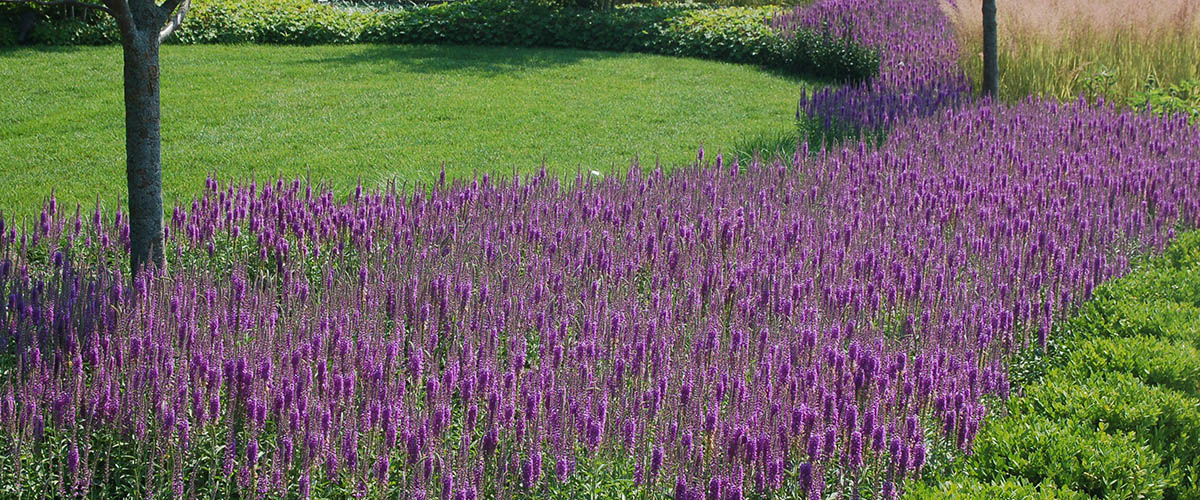
Evaluating Perennials for Chicagoland Gardens
Perennials in Focus is a plant evaluation program that examines new and underused plants for Chicagoland, the third largest metropolitan area in the country. A group of horticultural experts trials and evaluates plants at numerous locations across the region. Results help consumers, public gardens, growers, landscape designers, breeders, and other industry professionals make informed plant choices.
Nepeta and roses: a natural approach to aphid management
Rose growers across the country are always searching for sustainable ways to keep their plants healthy, and one method gaining traction involves pairing roses with Nepeta, often called catmint. This aromatic perennial, a relative of the herb catnip, produces soft blue-purple flower spikes that attract beneficial insects while confusing pests with its strong scent. A recent trial programme examined whether this companion planting strategy could meaningfully reduce aphid pressure on roses, and the findings offer useful guidance for gardeners from Hobart to Cairns.
The investigation was designed to mirror real garden conditions, testing both potted and garden-bed plantings across multiple sites. Researchers tracked aphid numbers, rose vigour, and pollinator activity over two growing seasons. The goal was to determine if Nepeta functions as a true functional companion, altering pest behaviour rather than simply masking it. Results indicate that the relationship between these two plants is more nuanced than folklore suggests, with measurable benefits that depend on planting density, rose variety, and local climate.
The science behind companion planting with Nepeta
Companion planting operates on several ecological principles. Aromatic plants like Nepeta release volatile compounds, including nepetalactones, which interfere with the ability of sap-sucking insects to locate host plants. When roses are surrounded by these scents, aphids may struggle to find suitable feeding sites during the critical early stages of colony establishment. Additionally, the small tubular flowers of Nepeta attract hoverflies, lacewings, and parasitic wasps, all of which prey on aphids or lay eggs inside them.
The Perennials in Focus team has long observed that perennial borders combining structural plants with flowering herbs tend to support more stable insect communities. In the rose trial, control plants grown without neighbours showed aphid colonies that expanded rapidly within two weeks of detection. By contrast, roses interplanted with Nepeta experienced slower colony growth, though they were not entirely immune to infestation. The difference became most pronounced during warm, dry spells when aphid reproduction accelerates.
Another factor involves soil moisture and root competition. Nepeta is drought tolerant once established, making it suitable for the water-wise gardens increasingly popular in Perth and Adelaide. Its root system remains relatively shallow, so it does not appear to compete aggressively with rose roots for deep moisture. Gardeners in Brisbane's humid subtropics should note, however, that Nepeta performs best with good drainage and may struggle in heavy clay during the wet season.
Designing a fair trial across varied conditions
To produce reliable results, researchers established trial plots in several locations representing different climatic zones. Coastal gardens in Sydney, inland sites near Melbourne, and cooler gardens in the Adelaide Hills each contributed data. Roses of the same cultivar were planted in identical soil preparations, with half receiving Nepeta 'Walker's Low' as a border plant and half left as controls. Aphid counts were taken weekly using a standardised leaf-sampling method.
The selection of Nepeta 'Walker's Low' was deliberate. This cultivar reaches roughly 60 to 70 centimetres in height, forming a dense mound that does not overshadow shorter rose varieties. It flowers from late spring through autumn in most parts of Australia, providing a continuous nectar source for beneficial insects. Its grey-green foliage also contrasts attractively with the deep green of rose leaves, offering visual interest beyond its functional role.
Researchers also documented secondary effects, including changes in rose flowering duration and the presence of other pests such as thrips and spider mites. Gardeners participating through public garden networks provided additional observational data from their own plantings. This citizen-science component strengthened the dataset and helped account for regional variation in pest pressure.
Observed results and seasonal patterns
Aphid populations followed predictable curves in both treatment and control groups, but the timing differed. In control plots, aphid colonies typically peaked four to six weeks after the first spring flush of rose growth. In plots with Nepeta, the same peak occurred one to two weeks later, and peak numbers were approximately 40 to 60 percent lower. By mid-summer, both groups showed declining aphid pressure, though treated roses maintained better overall vigour.
The data also revealed that rose variety matters. Modern shrub roses with glossy, disease-resistant foliage appeared less attractive to aphids overall, regardless of companion planting. Heirloom varieties, prized for their fragrance and petal form, were more susceptible and benefited most from the presence of Nepeta. Gardeners in cooler regions like Tasmania may find this particularly relevant, as many heritage roses thrive in the state's temperate conditions.
Pollinator activity increased markedly in treated plots. Hoverflies, in particular, were recorded at three to four times the rate seen in control areas. For gardeners interested in supporting broader biodiversity, the strategy aligns well with guidance on combining perennials for pollinators, where staggered bloom periods keep beneficial insects present throughout the growing season.
Implications for Australian rose growers
Australian conditions differ from those in many overseas trial locations, so local relevance matters. The Mediterranean climates of Adelaide and parts of Western Australia favour both roses and Nepeta, with hot dry summers and cool wet winters matching the plants' preferences. In subtropical Brisbane, summer humidity can stress Nepeta, but it often recovers well in autumn and continues flowering into winter. Gardeners in these regions may need to lift and divide clumps every two to three years to maintain plant health.
Water restrictions in many Australian councils have made drought-tolerant pairings increasingly attractive. Nepeta's low water needs once established make it a sensible choice for gardeners navigating South Australian water restrictions or similar guidelines in other states. Pairing it with roses on a drip irrigation system further reduces water use while keeping both plants productive.
Biosecurity is another consideration unique to Australia. Several states regulate the movement of plant material to prevent the spread of pests and diseases, and gardeners sourcing Nepeta or roses should purchase from reputable nurseries that comply with state quarantine rules. The Australian Government's biosecurity requirements, enforced by each state department, mean that bringing cuttings across state borders without certification can result in fines. Local growers and retail nurseries remain the safest source for healthy, region-appropriate plants.
Practical tips for home gardeners
For those ready to try this approach, spacing is important. Plant Nepeta roughly 30 to 40 centimetres from the base of rose bushes, allowing airflow between the two while ensuring the aromatic foliage is close enough to intercept pests. Cutting Nepeta back by one-third after the first flush of flowers encourages a second bloom and keeps the mound tidy.
Fertilising needs differ slightly between the two plants. Roses respond well to regular feeding with organic or controlled-release fertiliser, while Nepeta prefers leaner soil and may become floppy if overfed. Mulching around roses but keeping mulch away from the Nepeta crown helps prevent rot. Many weekend gardeners visiting Bunnings Warehouse for supplies will find both plants readily available in spring and autumn across most states.
| Companion strategy | Aphid reduction observed | Maintenance needs | Best suited regions |
|---|---|---|---|
| Roses with Nepeta 'Walker's Low' | 40 to 60 percent lower peak populations | Low; prune after flowering | Temperate and Mediterranean zones including Adelaide, Melbourne, Perth |
| Roses with garlic or chives | Moderate; strong scent may deter | Moderate; lift clumps annually | Cool regions like Tasmania and the Southern Highlands |
| Roses with marigolds | Variable; some benefit near root zone | Moderate; replace seasonally | Subtropical gardens in Brisbane and northern NSW |
| Roses alone (no companion) | Baseline; full pest pressure | High; regular monitoring needed | All regions, but labour intensive |
For gardeners seeking the broadest pollinator benefits, layering several perennials around roses creates a more resilient system than relying on a single species. Echinacea, Salvia, and Gaura extend the bloom season and support different groups of beneficial insects at various times of year.
If you are planning a rose bed renovation or establishing a new garden this season, consider including Nepeta as a structural and functional element. Browse the programme's trial findings and connect with regional evaluators through the Perennials in Focus committee to share your own observations. Your data and experience help build a clearer picture of what works across Australia's diverse growing conditions.
In the Garden
Evaluator gardens are located across the Chicagoland area, representing a range of growing conditions. Visit our retail and wholesale partners to find trialled perennials for your own garden.
Retail & Wholesale: Hinsdale Nurseries (Willowbrook, IL), Mariani Nurseries (Kenosha, WI & Garden Prairie, IL), Northwind Perennials (Burlington, WI), The Growing Place (Aurora, IL).
Wholesale Only: Hinsdale Nurseries (Plano, IL), Intrinsic Perennial Gardens (Hebron, IL).
Our Evaluation Program
The 2017–2020 evaluation cycle included Agastache 'Blue Boa', Allium senescens 'Blue Eddy', Amsonia ciliata var. filifolia 'Georgia Pancake', Astilbe 'Chocolate Shogun', Boltonia astroides 'James Crocket', Brunnera 'Alexander's Great', and Geranium cinereum 'Jolly Jewel Purple'. Completed evaluations include Amsonia 'Blue Ice' (2004–07).
On April 10, 2020, the program published snapshot profiles for Vernonia lettermanii 'Iron Butterfly', Stokesia laevis 'Elf', Stachys officinalis 'Pink Cotton Candy', Lobelia 'Monet Moment', Helleborus 'Winter Thrillers', Geum 'Mai Tai', Geranium soboliferum 'Butterfly Kisses', Gentiana x intermedia 'True Blue', Eurybia divaricata, Asparagus 'Purple Passion', and Agastache 'Bolero'.
Browse the full collection of snapshots organized alphabetically — from A–D, E–H, I–Q, and R–Z — to find detailed performance data on perennials trialled across Chicagoland.