Evaluating Perennials for Chicagoland Gardens
Perennials in Focus is a plant evaluation program that examines new and underused plants for Chicagoland, the third largest metropolitan area in the country. A group of horticultural experts trials and evaluates plants at numerous locations across the region. Results help consumers, public gardens, growers, landscape designers, breeders, and other industry professionals make informed plant choices.
Testing Deer Resistance in New Salvia Nemorosa Cultivars
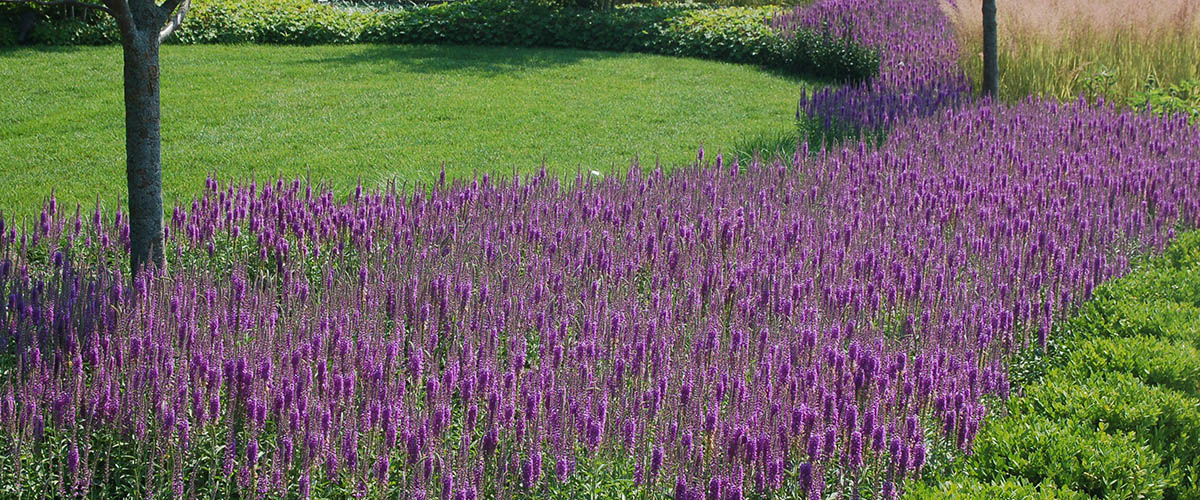
Gardeners across Chicagoland often want perennials that can survive both winter and browsing pressure. Salvia nemorosa, commonly called woodland sage, is valued for its upright flower spikes, long bloom season, and tolerance of sunny, relatively dry sites. Yet a cultivar that performs well in one garden may receive very different treatment in another when deer populations, food availability, and landscape conditions change.
Evaluating deer resistance requires more than observing whether a plant has flowers at the end of summer. Young shoots, flower stems, foliage, and late-season regrowth can all attract different levels of attention. A useful regional trial must record browsing throughout the growing season while also measuring the plant’s ornamental performance.
Perennials in Focus can help turn those observations into practical information for home gardeners, growers, landscape professionals, retailers, breeders, and public gardens. By comparing new and underused cultivars in several Chicagoland settings, the program can show which plants remain attractive and productive when deer are a regular part of the landscape.
Why salvia nemorosa deserves closer testing
Woodland sage is generally considered less appealing to deer than many soft-leaved perennials. Its aromatic foliage, textured leaves, and relatively firm stems may discourage casual feeding. However, “deer resistant” does not mean immune to damage. Hungry animals may browse plants they normally ignore, especially during spring growth, drought, or winter conditions when natural forage is limited.
New cultivars can also differ in meaningful ways. Compact forms may place foliage closer to the ground, while tall selections expose flower stems above surrounding vegetation. A cultivar with dense basal growth may recover quickly after browsing, whereas a sparsely branched plant may look damaged for the rest of the season.
Flower color and bloom timing could influence visibility, though these traits should not be treated as proof of resistance. Plant habit, neighboring vegetation, irrigation, soil fertility, and the presence of other preferred food sources all need to be considered when interpreting results.
Building a useful regional trial
A strong evaluation begins with several cultivars planted under comparable conditions. Each selection should be represented by multiple plants, with enough spacing to allow natural growth and enough repetition to reduce the influence of one unusually vigorous or weak specimen. Trial sites should include different levels of deer pressure, such as residential gardens, public landscapes, and more exposed suburban settings.
Observers can inspect plants at regular intervals from early spring through autumn. Notes should distinguish between light nipping, removal of entire stems, repeated browsing, and damage severe enough to alter flowering. Photographs taken from consistent angles make it easier to compare plant shape and recovery over time.
Other perennial trials benefit from the same disciplined approach. For example, the methods used when trialing heuchera cultivars can help evaluators separate true genetic differences from site-related variation. The goal is not simply to rank plants, but to document how reliably each cultivar performs across several environments.
What should be measured besides browsing
A deer-resistance score is most useful when paired with basic horticultural records. A plant that suffers occasional damage but quickly produces new foliage may be more practical than one that remains untouched but has weak stems, poor winter survival, or a short display period.
The following traits can be recorded alongside browsing intensity:
| Trait | What to record | Why it matters |
|---|---|---|
| Early-season foliage | Emergence date, density, and visible damage | Shows whether deer target new growth |
| Flower stems | Number, height, and browsing before bloom | Indicates impact on the main display |
| Bloom period | First flower, peak color, and repeat flowering | Reveals whether plants recover after damage |
| Plant spread | Basal width and overall habit | Helps assess replacement value and spacing |
| Recovery | New shoots and regrowth after browsing | Separates temporary damage from lasting injury |
| End-of-season condition | Foliage quality and seedhead persistence | Supports late-season landscape decisions |
Evaluators should also record irrigation, fertilization, nearby plants, and any fencing or repellent use. These details provide context for the final ratings. A cultivar exposed to deer without protection should not be directly compared with one growing behind a barrier unless the difference is clearly identified.
Reading damage across the growing season
Spring browsing often affects tender foliage and emerging stems. At this stage, even modest feeding can delay flowering, particularly in newly planted specimens with limited root systems. Repeated removal of the same shoots may create a low, uneven habit that differs from the cultivar’s expected form.
Summer observations should focus on flower buds and flowering stems. Deer may ignore aromatic foliage but sample the developing tips, reducing the number of visible spikes. In other cases, damage may be concentrated along pathways or at the outer edge of a planting, suggesting that location and accessibility are influencing the result.
Late-season browsing can reveal a cultivar’s resilience. Plants that produce fresh basal shoots after damage may still provide a useful display in the following season. Evaluators should avoid treating a single visit as definitive; a plant untouched in June may be heavily browsed in August when surrounding forage has declined.
Separating resistance from overall performance
Deer avoidance is only one part of a successful perennial recommendation. A cultivar must also survive Chicagoland winters, tolerate summer humidity, and maintain a pleasing shape without excessive staking. Soil drainage is especially important for salvia nemorosa, since wet winter conditions can weaken crowns and make plants less vigorous the following year.
Trial records should therefore combine browsing observations with winter survival, plant vigor, disease symptoms, and bloom quality. A plant with moderate browsing but strong recovery may be a better choice for a mixed border than a more resistant cultivar that flops or disappears after a wet winter.
Heat and moisture stress can also change how plants respond to feeding. Research approaches used in testing coreopsis heat tolerance offer a useful reminder that site conditions can shape plant performance as strongly as genetics. In an urban garden surrounded by pavement, drought-stressed salvia may be more vulnerable to damage and slower to recover than the same cultivar in an evenly watered border.
Turning observations into practical ratings
A simple rating system can make results easier to communicate, provided the scoring rules are defined in advance. For example, evaluators might rate visible browsing from zero, meaning no damage, to four, meaning severe and repeated removal of foliage or flowering stems. A separate recovery score can indicate whether the plant resumes growth within several weeks.
Ratings should be supported by written descriptions and photographs. “Good resistance” is more useful when it means that most plants showed only minor leaf damage and retained their flowering structure through the season. Likewise, “poor resistance” should identify whether the issue was early foliage loss, bud removal, or repeated feeding that altered the plant’s habit.
Results are best presented by site and season rather than as a single universal verdict. A cultivar that performs well in a fenced public garden may not behave the same way beside a wooded residential lot. Regional trial data should help gardeners estimate risk, not promise complete protection.
Choosing salvia for deer-prone gardens
Home gardeners can use trial findings to match cultivar traits with the conditions of a particular site. In areas with occasional browsing, a vigorous selection with strong basal growth and reliable rebloom may be sufficient. Where deer move through daily, even the most promising salvia should be combined with physical barriers, habitat planning, or other protective measures.
Useful selection priorities include:
- Dense, healthy foliage that emerges quickly in spring
- Strong flower stems that remain productive after light browsing
- Compact growth with enough basal shoots to recover
- Reliable winter survival in local trial conditions
- A bloom period that extends beyond the first flush
- Documented performance across more than one Chicagoland site
Growers and retailers can also use these findings to describe cultivars more accurately. Instead of making an absolute claim, plant labels and catalogs can explain whether a selection showed low, moderate, or variable browsing in regional evaluations.
The most valuable outcome is a clearer understanding of risk. Deer pressure varies from block to block, but consistent multi-site observations can identify cultivars that are more dependable starting points for sunny perennial borders, pollinator plantings, and low-input landscapes.
Follow the published Perennials in Focus evaluations as new salvia nemorosa cultivars move through regional trials. Use the data alongside local observations, plant several selections when possible, and record how each one performs in your own garden so that future recommendations become even more precise.
In the Garden
Evaluator gardens are located across the Chicagoland area, representing a range of growing conditions. Visit our retail and wholesale partners to find trialled perennials for your own garden.
Retail & Wholesale: Hinsdale Nurseries (Willowbrook, IL), Mariani Nurseries (Kenosha, WI & Garden Prairie, IL), Northwind Perennials (Burlington, WI), The Growing Place (Aurora, IL).
Wholesale Only: Hinsdale Nurseries (Plano, IL), Intrinsic Perennial Gardens (Hebron, IL).
Our Evaluation Program
The 2017–2020 evaluation cycle included Agastache 'Blue Boa', Allium senescens 'Blue Eddy', Amsonia ciliata var. filifolia 'Georgia Pancake', Astilbe 'Chocolate Shogun', Boltonia astroides 'James Crocket', Brunnera 'Alexander's Great', and Geranium cinereum 'Jolly Jewel Purple'. Completed evaluations include Amsonia 'Blue Ice' (2004–07).
On April 10, 2020, the program published snapshot profiles for Vernonia lettermanii 'Iron Butterfly', Stokesia laevis 'Elf', Stachys officinalis 'Pink Cotton Candy', Lobelia 'Monet Moment', Helleborus 'Winter Thrillers', Geum 'Mai Tai', Geranium soboliferum 'Butterfly Kisses', Gentiana x intermedia 'True Blue', Eurybia divaricata, Asparagus 'Purple Passion', and Agastache 'Bolero'.
Browse the full collection of snapshots organized alphabetically — from A–D, E–H, I–Q, and R–Z — to find detailed performance data on perennials trialled across Chicagoland.