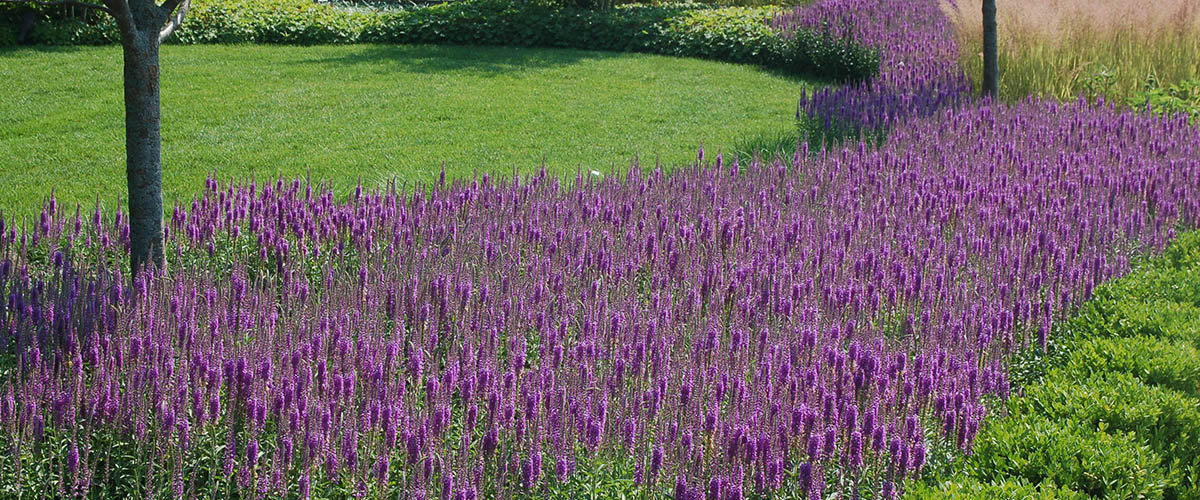
Evaluating Perennials for Chicagoland Gardens
Perennials in Focus is a plant evaluation program that examines new and underused plants for Chicagoland, the third largest metropolitan area in the country. A group of horticultural experts trials and evaluates plants at numerous locations across the region. Results help consumers, public gardens, growers, landscape designers, breeders, and other industry professionals make informed plant choices.
Deer Browsing Trials of Agastache in Open Lots
A perennial can look excellent in a sheltered courtyard and struggle in an exposed vacant lot. For Chicago-area growers, that difference matters because heat, winter wet, compacted soil and browsing can all affect the same plant. Perennials in Focus tests plants across multiple Chicagoland gardens so their performance is judged across real sites rather than a single idealised bed.
Deer adds a variable that moves between gardens and seasons. Testing the deer browsing resistance of Agastache urticifolia, commonly called anise hyssop, in open lots asks a practical question: how much damage occurs when animals have routine access, and can the plant recover and still flower? It also asks whether plants protected from browsing remain vigorous enough to make a fair comparison.
Resistance is relative, not absolute. A plant may lose a few leaves and still provide a healthy display, or appear untouched during a quiet summer before browsing intensifies. Australian gardeners can learn from the trial method, but they should not treat a Chicagoland finding as a guarantee for Melbourne, Canberra or a local wildlife corridor.
What an open-lot trial should measure
In the Chicago area, where white-tailed deer are common, the useful design pairs similar plants in protected and browsed positions. Where practical, narrow-mesh exclosures protect a comparison plant while leaving light and root conditions broadly unchanged; uncaged plants experience the normal movement of deer. Randomising plant positions and repeating the arrangement across gardens helps separate browsing effects from soil, irrigation and shade.
Each plant needs a baseline before the first browse. Record leaf loss, broken stems, the height of the visible browsing line, regrowth after damage, and the number and length of flower spikes. Keep living growth, flowering and spread distinct: a low plant can escape damage simply because it sits below the animals’ reach.
Seasonal repeat counts matter too. The programme’s trial snapshots are a reminder that observations across time are more informative than a single photograph. Cameras or dated browse notes can establish whether deer were present, while a wet spring or severe heat can explain damage that would otherwise be blamed on animals.
Why Agastache is a useful test plant
Agastache urticifolia is a clump-forming perennial from central North America, valued for aromatic leaves and upright spikes of lavender to purplish flowers. It brings clear structure to open sites, where tall grasses and compact shrubs can otherwise look loose. Exact dimensions vary with selection and growing conditions, so trial records should include bloom period, flower colour, height and spread rather than rely on catalogue figures.
Deer often browse softer foliage and tender shoots, but the response of this species cannot be assumed from scent alone. Animals learn which plants are rewarding, and their pressure changes with food supply and habituation. A repeatedly nibbled plant may send new stems from the crown; another may lose flowering stems and never rebuild them during the same season.
Those outcomes need separate scores. Leaf damage, stem loss, recovery time and bloom production tell different parts of the story. A named cultivar also needs its own assessment, since Australian nurseries may sell hybrids under broad agastache labels. A result for a compact selection should not be transferred automatically to the species.
Reading results without overclaiming
Trial data should be read against the plant’s overall performance. Strong establishment, dense flowering and steady spread can offset some browsing, while stressed plants may suffer more severe damage. The most useful summary combines a damage score with recovery, bloom count and final size. It should also state how often browsing was observed.
Cold and snow create a separate stress that must not be confused with deer damage. Companion Sedum snow-load trials show the value of isolating one pressure while recording the whole plant’s condition. Snow tolerance cannot prove browsing resistance, but both records help explain why a plant that survives winter may still lose its spring stems.
Resistance also needs a time limit. An untouched first season says little if a trial ends before animals return. Nor does browsing avoidance establish that a perennial suits every Australian garden: some selections can self-seed in mild conditions, while others are sterile. Check the named plant’s habit, not just the genus.
Australian conditions that change the answer
Melbourne’s outer eastern and peri-urban neighbourhoods can encounter sambar deer, particularly where gardens meet bushland. Local rainfall patterns also matter: mild, wet winters favour spring growth, while dry summers make open, sunny lots demanding unless irrigation is available. Those conditions can change both how much tender growth is produced and how attractive it is to browsing animals.
Canberra offers another useful comparison, with frosty suburban lots and red and fallow deer recorded in the ACT. Frost can shorten or collapse stems without any animal involvement, so local observers should separate weather injury from bite marks and missing foliage. A sheltered plant in a courtyard is not a valid stand-in for the exposed site used in an open-lot trial.
The local market and rules matter too. Australian garden centres sell agastache by trade name, and any imported liners must satisfy federal biosecurity requirements through the Department of Agriculture, Fisheries and Forestry and its BICON system. In Victoria, wildlife management is regulated under the Wildlife Act 1953, while councils may control boundary fencing and front-yard structures. Check the relevant local rules before trapping, netting or altering animal access.
Turning trial plots into garden decisions
Translating the results starts with matching the test to the garden. Record whether deer use a path, lawn edge or shrub line, and place plants where they can be observed without putting them behind a barrier that changes shade or airflow. Secure, fine mesh can protect a young plant, but loose netting creates risks for wildlife and is poor long-term garden practice.
Give each clump room to show its mature spread and allow space to measure regrowth. The practical lesson about matching dimensions to a setting is not confined to interiors: a pendant light scale guide explains why a dining-room light should suit the table rather than dominate it. A perennial likewise needs a visible role, not a cramped position between aggressive neighbours.
Use flowering as one part of the judgement, alongside foliage condition, stem integrity and persistence through the following season. A plant that is rarely browsed but provides little summer colour may serve a different purpose from one with softer new growth and fewer flowers. Let the garden’s priorities determine which trade-off is acceptable.
Make local observations count
Local observation can add the seasonal detail that an overseas trial cannot supply. Note the date of the first browse, the kind of damage, rainfall, irrigation and any change in animal traffic. Photographs of the whole plant and its base are often more useful than a close-up, since a missing crown or shortened stem changes the interpretation.
Gardeners can also ask their local nursery, council or regional plant society to record agastache performance alongside other perennials in exposed sites. Repeated observations from several gardens create a more dependable picture than a single household’s experience, especially where deer pressure varies between streets and seasons.
Choose a few plants, monitor them through a full growing cycle, and share the results with local growers and the trial programme. Start with selections that combine healthy establishment and useful flowering, then use local evidence to refine the choice. Plant with evidence, monitor through every season, and share what you learn.
In the Garden
Evaluator gardens are located across the Chicagoland area, representing a range of growing conditions. Visit our retail and wholesale partners to find trialled perennials for your own garden.
Retail & Wholesale: Hinsdale Nurseries (Willowbrook, IL), Mariani Nurseries (Kenosha, WI & Garden Prairie, IL), Northwind Perennials (Burlington, WI), The Growing Place (Aurora, IL).
Wholesale Only: Hinsdale Nurseries (Plano, IL), Intrinsic Perennial Gardens (Hebron, IL).
Our Evaluation Program
The 2017–2020 evaluation cycle included Agastache 'Blue Boa', Allium senescens 'Blue Eddy', Amsonia ciliata var. filifolia 'Georgia Pancake', Astilbe 'Chocolate Shogun', Boltonia astroides 'James Crocket', Brunnera 'Alexander's Great', and Geranium cinereum 'Jolly Jewel Purple'. Completed evaluations include Amsonia 'Blue Ice' (2004–07).
On April 10, 2020, the program published snapshot profiles for Vernonia lettermanii 'Iron Butterfly', Stokesia laevis 'Elf', Stachys officinalis 'Pink Cotton Candy', Lobelia 'Monet Moment', Helleborus 'Winter Thrillers', Geum 'Mai Tai', Geranium soboliferum 'Butterfly Kisses', Gentiana x intermedia 'True Blue', Eurybia divaricata, Asparagus 'Purple Passion', and Agastache 'Bolero'.
Browse the full collection of snapshots organized alphabetically — from A–D, E–H, I–Q, and R–Z — to find detailed performance data on perennials trialled across Chicagoland.