Evaluating Perennials for Chicagoland Gardens
Perennials in Focus is a plant evaluation program that examines new and underused plants for Chicagoland, the third largest metropolitan area in the country. A group of horticultural experts trials and evaluates plants at numerous locations across the region. Results help consumers, public gardens, growers, landscape designers, breeders, and other industry professionals make informed plant choices.
Choosing Perennials That Thrive in Chicago Rain Gardens
Rain gardens help slow stormwater, reduce runoff, and give excess water time to soak into the soil. In the Chicago region, these planted depressions must handle an unusual cycle: saturated soil after a heavy rain, followed by dry conditions during summer heat. The best plants are selected for that full range rather than for wet soil alone.
A successful planting also has to fit local winters, clay-heavy soils, changing light levels, and the scale of the garden. A species that performs beautifully in a constantly moist swale may fail on the higher, drier edge. Matching each perennial to its position is more important than choosing a single list of “water-loving” plants.
Regional trials offer useful guidance because performance can vary considerably between climates. Observations of bloom time, mature height, spread, flower color, foliage quality, and seasonal resilience help gardeners select plants that provide dependable interest instead of relying on a catalog description.
Read The Rain Garden From Wet To Dry
The lowest basin holds water longest and may remain saturated for several days after a storm. Plants placed here should tolerate temporary inundation and oxygen-poor soil. Swamp milkweed, cardinal flower, blue flag iris, and fox sedge are strong candidates when the basin has adequate moisture and receives enough sunlight.
The middle slope usually experiences alternating wet and moderate conditions. This is often the most versatile planting zone, suitable for mountain mint, sneezeweed, obedient plant, and Joe-Pye weed. Their roots can handle periodic moisture, while their structure remains attractive when the soil begins to dry.
The upper edge drains fastest and behaves much like an ordinary perennial border. Here, select plants that tolerate occasional runoff but do not require continuously wet roots. Little bluestem, wild geranium, prairie dropseed, and penstemon can help connect the rain garden to the surrounding landscape.
Match Plants To Light And Soil
Sun exposure changes throughout the day as nearby buildings, fences, and mature trees cast shadows. Full-sun rain gardens generally support the widest range of flowering perennials, especially species associated with wet prairies and open wetlands. At least six hours of direct light encourages sturdy stems and abundant blooms.
Part-shade sites call for a different palette. Golden ragwort, foamflower, great blue lobelia, and certain sedges can perform well where sunlight is filtered. Gardeners working beneath trees should also account for root competition, since established trees may remove moisture rapidly after the basin has drained.
Clay soil is common in the region and can compact under construction traffic. Incorporating compost into the planting area may improve structure, but excessive organic matter can create a soft, nutrient-rich bed that favors weak growth. Test drainage before planting, and use a soil mix designed for infiltration rather than treating the rain garden like a conventional raised bed.
Build A Palette With Seasonal Interest
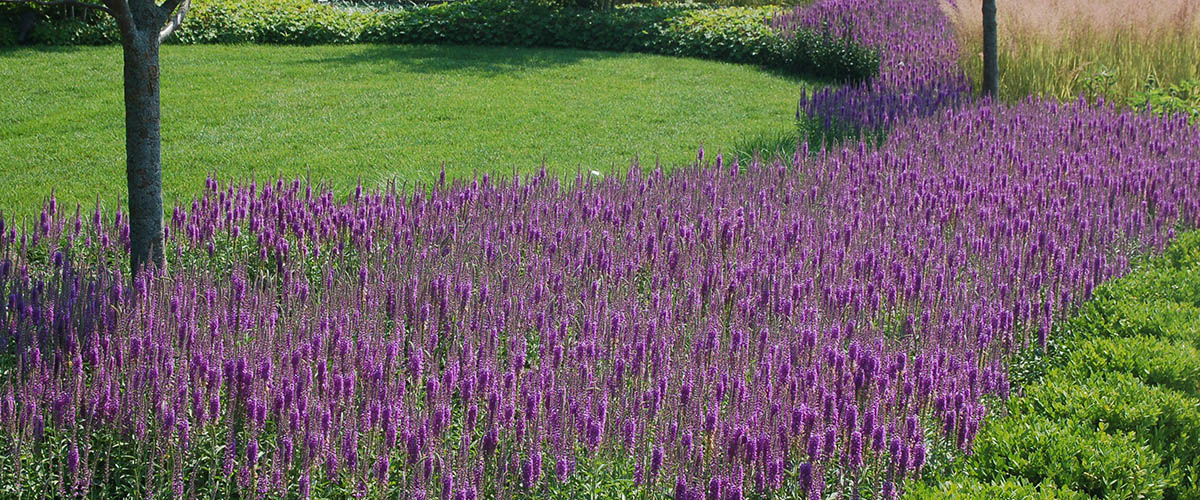
A rain garden should have a sequence of bloom periods so that its ecological value and visual appeal extend beyond a short spring display. Early flowers from golden ragwort or Virginia mountain mint can lead into summer blooms from swamp milkweed, cardinal flower, and mountain mint. Late-season color may come from sneezeweed, asters, and stiff goldenrod.
Flower form matters as much as flower color. Flat-topped blooms attract many small beneficial insects, while tubular flowers provide resources for hummingbirds and long-tongued bees. Seedheads and persistent stems can feed birds or add winter structure when they are left standing until late winter.
| Rain garden zone | Suitable perennial examples | Seasonal or design value |
|---|---|---|
| Lowest basin | Swamp milkweed, blue flag iris, fox sedge | Moisture tolerance, summer flowers, strong foliage |
| Middle slope | Cardinal flower, sneezeweed, mountain mint | Pollinator activity and long bloom succession |
| Upper edge | Little bluestem, wild geranium, penstemon | Drought tolerance and transition to lawn or border |
| Shaded basin edge | Golden ragwort, great blue lobelia, foamflower | Foliage coverage and color in filtered light |
Use groups of several plants rather than scattering individual specimens across the basin. Repeated drifts create a clearer design, make maintenance easier, and allow each species to occupy the conditions it prefers. Include a few structural plants with upright forms, then fill gaps with lower sedges or spreading perennials.
Use Native Plants With Proven Regional Performance
Native perennials are often a sensible starting point because many evolved with the region’s precipitation patterns, soils, and wildlife. They are not automatically successful in every rain garden, however. A wetland species may struggle if the basin dries completely, while a prairie plant may decline in a low pocket that stays saturated.
Trialed and underused plants deserve consideration alongside familiar favorites. Perennials in Focus evaluates plants across multiple gardens and seasons, recording practical characteristics such as height, spread, bloom period, and flower color. Those observations can help identify plants that maintain good form through Chicago-area weather rather than simply surviving in a nursery container.
Avoid filling the entire garden with aggressive spreaders unless their growth is appropriate for the site. Some vigorous species can overwhelm shorter plants or escape into adjacent beds. Check mature dimensions, propagation habits, and seed production before combining them in a small residential planting.
Make Shade A Deliberate Design Choice
A rain garden beneath mature trees presents a special combination of shade, root competition, and intermittent moisture. The lowest area may stay damp while the upper edge becomes dry because tree roots draw water from the soil. Use moisture-tolerant plants in the basin and more drought-resilient shade plants along the rim.
For broader ideas about plants suited to lower-light conditions, explore these shade-loving perennials. Then narrow the choices according to soil moisture, mature size, and the amount of direct sun the garden receives during the growing season.
Texture becomes especially valuable when flowers are limited. Broad leaves, fine sedges, and upright stems create contrast in shaded areas, while evergreen or semi-evergreen foliage can help the planting look intentional after frost. Keep taller plants toward the rear or center so they do not shade out shorter companions.
Plan For Establishment And Long-Term Care
The first growing season requires regular watering, even in a rain garden. Newly planted roots need consistent moisture while they establish, and a dry spell can stress plants before they develop enough depth to use stored soil water. Water slowly at the base, then reduce irrigation as plants become established.
Mulch helps suppress weeds and protect soil during establishment, but keep it away from crowns and avoid thick layers that float into storm drains. Organic mulch can be useful on the upper edge; in the lowest basin, plant coverage and a suitable soil mix are often preferable to heavy mulch.
Inspect the garden after major storms. Look for erosion, standing water that persists longer than expected, sediment deposits, or clogged overflow routes. Cut back dead stems in late winter rather than immediately after flowering when possible, allowing wildlife habitat and winter structure to remain.
- Place plants according to actual moisture zones, not just the garden’s overall soil type.
- Combine early, midseason, and late-blooming perennials for continuous interest.
- Confirm mature height and spread before planting vigorous species in groups.
- Include sedges and grasses to stabilize soil and soften hard drainage features.
- Observe the site through a full year and replace plants that consistently fail.
A well-planned rain garden should look like part of the landscape rather than a temporary drainage project. Select plants for wet-dry cycles, regional hardiness, and year-round structure, then use trial-based information to refine the palette. Browse regional perennial evaluations and apply those findings to your site so the finished garden can manage stormwater while supporting pollinators and providing dependable beauty.
In the Garden
Evaluator gardens are located across the Chicagoland area, representing a range of growing conditions. Visit our retail and wholesale partners to find trialled perennials for your own garden.
Retail & Wholesale: Hinsdale Nurseries (Willowbrook, IL), Mariani Nurseries (Kenosha, WI & Garden Prairie, IL), Northwind Perennials (Burlington, WI), The Growing Place (Aurora, IL).
Wholesale Only: Hinsdale Nurseries (Plano, IL), Intrinsic Perennial Gardens (Hebron, IL).
Our Evaluation Program
The 2017–2020 evaluation cycle included Agastache 'Blue Boa', Allium senescens 'Blue Eddy', Amsonia ciliata var. filifolia 'Georgia Pancake', Astilbe 'Chocolate Shogun', Boltonia astroides 'James Crocket', Brunnera 'Alexander's Great', and Geranium cinereum 'Jolly Jewel Purple'. Completed evaluations include Amsonia 'Blue Ice' (2004–07).
On April 10, 2020, the program published snapshot profiles for Vernonia lettermanii 'Iron Butterfly', Stokesia laevis 'Elf', Stachys officinalis 'Pink Cotton Candy', Lobelia 'Monet Moment', Helleborus 'Winter Thrillers', Geum 'Mai Tai', Geranium soboliferum 'Butterfly Kisses', Gentiana x intermedia 'True Blue', Eurybia divaricata, Asparagus 'Purple Passion', and Agastache 'Bolero'.
Browse the full collection of snapshots organized alphabetically — from A–D, E–H, I–Q, and R–Z — to find detailed performance data on perennials trialled across Chicagoland.