Evaluating Perennials for Chicagoland Gardens
Perennials in Focus is a plant evaluation program that examines new and underused plants for Chicagoland, the third largest metropolitan area in the country. A group of horticultural experts trials and evaluates plants at numerous locations across the region. Results help consumers, public gardens, growers, landscape designers, breeders, and other industry professionals make informed plant choices.
Perennials for Dry Shade Beneath Mature Oak Trees
Gardening beneath mature oak trees requires a different strategy from filling a sunny border. The canopy reduces available light, the extensive root system competes for water, and the soil may be crowded with fine roots close to the surface. In Chicagoland, summer heat and periodic drought can make these conditions even more demanding.
Still, a dry, shaded planting area can support a beautiful and durable community of foliage plants, spring ephemerals, sedges, ferns, and long-lived flowering perennials. Perennials that thrive in the dry shade under mature oak trees tend to share useful traits: they establish steadily, tolerate root competition, and maintain attractive leaves after their main bloom period.
Regional observation is especially valuable because a plant labeled “shade tolerant” may perform well in consistently moist woodland soil but struggle under an established oak. The Perennials in Focus program offers a useful model for evaluating plants across seasons and gardens rather than relying only on catalog descriptions.
Read The Site Before Choosing Plants
Begin by observing the planting area through the growing season. Note how many hours of filtered light reach the ground, where rain is intercepted by branches, and whether the soil becomes powdery by midsummer. Areas near the trunk are usually the driest and most root-filled, while the outer edge of the canopy may receive more rain and support a broader plant palette.
Do not assume that all shade beneath an oak is equally difficult. Morning sun, reflected light from paving, a gentle slope, or a downspout can create small microclimates. Test drainage after a heavy rain, then check moisture several days later. This simple observation can distinguish truly dry shade from soil that is merely dry at the surface.
Avoid deep digging around established trees. Cutting large roots can injure the oak, and turning the soil repeatedly creates more disturbance than most woodland perennials need. Instead, remove weeds carefully, loosen only the planting pocket, and place new plants between major roots whenever possible.
Plants With A Strong Track Record
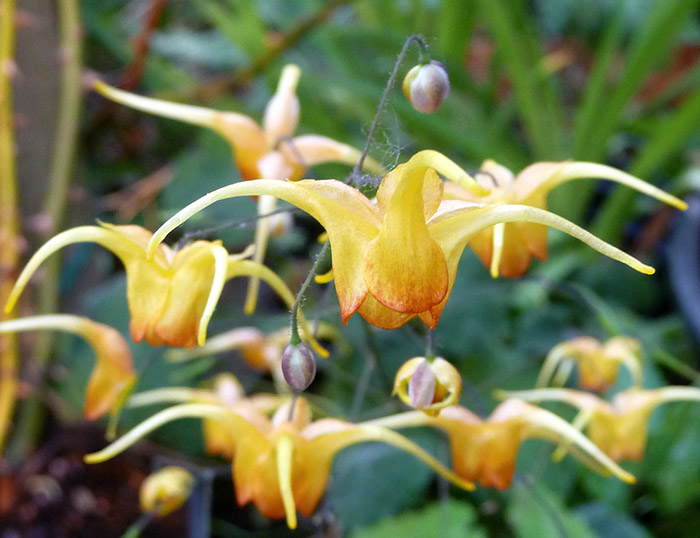
Epimedium, often called barrenwort, is one of the most dependable choices for dry woodland conditions. Its wiry stems, heart-shaped leaves, and small spring flowers provide interest without demanding rich soil. Many cultivars form a slowly expanding groundcover, although growth is faster when plants receive occasional water during their first two seasons.
Bigroot geranium, Geranium macrorrhizum, is another reliable candidate. It creates broad mounds of aromatic foliage, flowers in late spring, and often develops attractive red or bronze tones in autumn. Once established, it can handle dry soil better than many traditional shade perennials and is useful for stabilizing open spaces beneath trees.
Pennsylvania sedge, Carex pensylvanica, brings a fine-textured, grasslike appearance to oak shade. It is especially useful when the desired effect is a low meadow or a soft carpet rather than a collection of individual clumps. Christmas fern, Polystichum acrostichoides, adds evergreen structure, while coral bells and foamflower contribute colorful leaves and spring-to-early-summer flowers where conditions are not excessively parched.
Compare Plants By More Than Flower Color
Flowering is only one measure of success in a difficult planting site. A perennial that blooms for two weeks but collapses during August may be less valuable than one with restrained flowers and excellent foliage for six months. Record survival, plant density, weed resistance, seasonal appearance, and the amount of supplemental water needed.
Regional trials can also reveal differences among cultivars that are not obvious from a plant tag. For example, careful observation of Echinacea bloom timing shows why flowering windows and performance data matter when selecting plants for a particular climate. The same principle applies to shade plants: compare several forms under similar conditions rather than judging a whole species by one disappointing specimen.
The following snapshot can help organize choices for a Chicagoland oak-shade planting. Actual performance will vary with soil depth, canopy density, winter exposure, and establishment care.
| Plant | Main Contribution | Typical Height | Dry-Shade Notes |
|---|---|---|---|
| Epimedium | Spring flowers and durable foliage | 8–18 in. | Excellent once established; slow to fill |
| Bigroot geranium | Mounded foliage and late-spring flowers | 12–18 in. | Handles root competition well |
| Pennsylvania sedge | Fine-textured green carpet | 6–12 in. | Best for naturalistic, low-maintenance designs |
| Christmas fern | Evergreen structure | 18–24 in. | Needs reasonable soil depth to develop fully |
| Coral bells | Colored foliage and airy flowers | 12–24 in. | Performs best with occasional drought relief |
| Foamflower | Spring flowers and spreading leaves | 8–16 in. | Better in moderate, rather than extreme, dryness |
Establish Plants Without Harming The Oak
Planting time is important. Early spring and early fall generally provide the best conditions because temperatures are moderate and soil moisture is more dependable. Small plants are often easier to fit between roots, and they can establish with less digging than large container specimens.
Water deeply and consistently during the first growing season. A slow soak encourages roots to move downward and outward, while frequent shallow sprinkling keeps the root zone near the surface. During extended drought, prioritize new plantings and vulnerable ferns or coral bells rather than trying to irrigate every established perennial equally.
A thin layer of leaf mulch can moderate soil temperature and conserve moisture, but keep it away from the oak’s trunk and avoid piling it over perennial crowns. Shredded leaves or finely textured composted mulch are usually easier to manage than thick, fresh layers that mat together. Mulch should support the soil system, not bury the plants.
Build A Layered Woodland Composition
A successful planting combines different forms instead of repeating one groundcover everywhere. Use Pennsylvania sedge or epimedium as a broad matrix, then place clumps of bigroot geranium, coral bells, or foamflower where there is slightly more light. Add Christmas fern or another site-appropriate fern to create upright, evergreen or semi-evergreen accents.
Spring bulbs and short-lived woodland flowers can provide seasonal movement before the oak canopy becomes dense. Virginia bluebells, trout lily, and other spring ephemerals may perform well where the soil retains spring moisture, but they are less suitable for the driest sites. Match each plant to its microclimate rather than forcing a single theme across the entire area.
Color can come from leaves as much as flowers. Blue-green sedge, burgundy coral bells, silver-marked lungwort, and glossy evergreen fern fronds create contrast in periods when few plants are blooming. This approach also makes the space more resilient when a hot summer shortens the flowering period.
A Practical Selection Checklist
Use the following criteria when narrowing the plant list for a mature oak planting:
- Choose plants rated for dry or average moisture in shade, not merely for “part shade.”
- Favor durable foliage, spreading habits, or strong clumping over brief floral displays.
- Match mature size to the available space so plants do not require frequent division.
- Select several species with different bloom times and leaf textures.
- Trial a small group before installing a large quantity across the entire root zone.
Pay attention to winter behavior as well. Plants that hold attractive foliage, seedheads, or persistent structure can make the garden feel intentional through the dormant season. Remove only damaged or collapsed growth when necessary, leaving healthy organic material to support habitat and soil life.
Keep records of what survives with little intervention. A simple note about planting date, watering, bloom period, and midsummer appearance can be more useful than a generic hardiness label. Over several seasons, these observations will identify the plants best adapted to that particular oak, soil, and exposure.
Turn A Difficult Site Into A Regional Trial
The most successful oak-shade gardens develop gradually. Start with a few dependable species, protect them through establishment, and watch how they respond during both wet and dry years. Replacing weak performers early is easier than maintaining a large planting that depends on constant watering.
Use region-specific evaluation findings, nursery observations, and your own garden records to refine the palette. Select plants for sustained performance, healthy foliage, and compatibility with the tree’s root environment, then install them with care. With that measured approach, the dry ground beneath a mature oak can become a layered, low-maintenance planting that rewards observation season after season.
In the Garden
Evaluator gardens are located across the Chicagoland area, representing a range of growing conditions. Visit our retail and wholesale partners to find trialled perennials for your own garden.
Retail & Wholesale: Hinsdale Nurseries (Willowbrook, IL), Mariani Nurseries (Kenosha, WI & Garden Prairie, IL), Northwind Perennials (Burlington, WI), The Growing Place (Aurora, IL).
Wholesale Only: Hinsdale Nurseries (Plano, IL), Intrinsic Perennial Gardens (Hebron, IL).
Our Evaluation Program
The 2017–2020 evaluation cycle included Agastache 'Blue Boa', Allium senescens 'Blue Eddy', Amsonia ciliata var. filifolia 'Georgia Pancake', Astilbe 'Chocolate Shogun', Boltonia astroides 'James Crocket', Brunnera 'Alexander's Great', and Geranium cinereum 'Jolly Jewel Purple'. Completed evaluations include Amsonia 'Blue Ice' (2004–07).
On April 10, 2020, the program published snapshot profiles for Vernonia lettermanii 'Iron Butterfly', Stokesia laevis 'Elf', Stachys officinalis 'Pink Cotton Candy', Lobelia 'Monet Moment', Helleborus 'Winter Thrillers', Geum 'Mai Tai', Geranium soboliferum 'Butterfly Kisses', Gentiana x intermedia 'True Blue', Eurybia divaricata, Asparagus 'Purple Passion', and Agastache 'Bolero'.
Browse the full collection of snapshots organized alphabetically — from A–D, E–H, I–Q, and R–Z — to find detailed performance data on perennials trialled across Chicagoland.