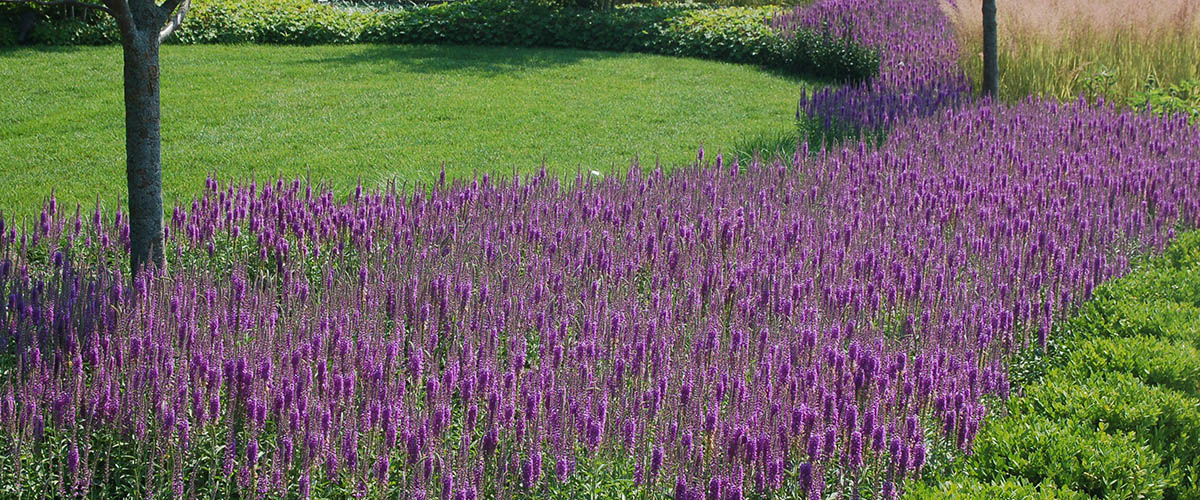
Evaluating Perennials for Chicagoland Gardens
Perennials in Focus is a plant evaluation program that examines new and underused plants for Chicagoland, the third largest metropolitan area in the country. A group of horticultural experts trials and evaluates plants at numerous locations across the region. Results help consumers, public gardens, growers, landscape designers, breeders, and other industry professionals make informed plant choices.
Perennials That Shelter Ground-Nesting Bees in Home Gardens
Ground-nesting bees need more than flowers. Solitary bees such as Andrena excavate individual burrows in bare or lightly covered soil, often choosing sunny slopes, compacted paths, sandy banks or open spaces between plants. Their nesting habitat can be easy to overlook because it does not resemble a hive or a conspicuous colony.
Perennials can support these bees by supplying nectar and pollen, moderating soil temperature and creating sheltered pockets beside suitable nesting ground. The best planting design combines flowering plants with small areas of undisturbed soil, rather than covering every space with mulch or dense groundcover.
Although the Perennials in Focus program evaluates plants in the Chicagoland region, its records on bloom period, habit, height and spread offer a useful way to compare garden performance. Australian gardeners can use the same approach while adjusting plant choices for local rainfall, heat, soil and seasonal bee activity.
What Ground-Nesting Bees Need
Andrena bees are generally solitary: each female makes her own nest, provisions cells with pollen and nectar, and lays eggs without maintaining a communal hive. Many related ground-nesting bees follow a similar pattern. They need soil that can be excavated, reliable flowers within flight range and protection from repeated disturbance.
“Nesting cover” should therefore mean shelter around the nest, not a thick blanket over it. Low stems, loose leaf litter and nearby perennial foliage can reduce wind exposure and extreme heat. However, a deep layer of wood mulch, landscape fabric or dense turf may prevent bees from reaching the soil.
A small bare patch beside a flowering border may be more valuable than a perfectly finished bed. South-facing or north-facing exposure will have different effects in Australia, so observe where the soil warms without becoming dangerously dry. In Brisbane, afternoon heat may call for partial shade, while a Melbourne garden may benefit from a sunny, winter-dry edge.
Plant Form Matters More Than Density
Plants with open crowns and upright stems allow bees to move through the border and leave patches of soil visible. Yarrow, catmint, coreopsis, salvias and many daisy-forming perennials offer flowers without creating an impenetrable mat. Their foliage can also break the force of wind near the ground.
A mixed-height planting is usually more useful than a single carpet. Taller species provide shelter from prevailing winds, medium perennials offer abundant blooms, and low plants soften the edge without sealing the soil. Leave inspection gaps between clumps so gardeners can monitor nesting activity and avoid stepping on active entrances.
Choose plants that flower in succession. Early spring flowers support bees emerging after cool weather, while summer and autumn blooms maintain food supplies for later generations. In Australian cities, flowering times may shift dramatically between Sydney, Adelaide, Perth and Hobart, so local nursery advice is more reliable than a calendar copied from North America.
Perennials Worth Considering
In temperate gardens, Penstemon, Salvia, Nepeta, Echinacea, Rudbeckia, Coreopsis, Aster and Sedum can provide a long sequence of pollen and nectar. Their value depends on the cultivar, climate and maintenance regime. A plant that flowers for six weeks in one garden may flower briefly or fail altogether in another.
Australian-friendly alternatives can include Brachyscome, Scaevola, Chrysocephalum, Olearia and selected Dianella, depending on the region and soil. Native plants are not automatically superior for every bee, but they are often better adapted to local rainfall and heat. Use a mix of flower shapes because different bees vary in tongue length, body size and foraging behaviour.
Look for sturdy perennials that retain some standing stems after flowering. These stems create winter structure and shelter small insects, even though ground-nesting bees use soil rather than hollow stems. The Perennials in Focus trials provide a helpful model for judging a plant by its real garden performance instead of relying only on catalogue photographs.
Soil, Mulch and Watering
Prepare a modest nesting zone by loosening compacted soil without turning it into fine, unstable dust. Sandy loam, light clay and gravelly ground can all be suitable if drainage is reasonable. Avoid placing a new planting bed over constantly wet soil, irrigation run-off or areas frequently flooded by downpipes.
Many Australian gardeners mulch heavily to conserve water, especially during hot summers. Keep mulch several centimetres away from selected nesting patches, and use a thin, loose organic layer around plants rather than covering every exposed surface. In sandy Perth soils, a little organic matter may improve plant growth, but the bee area itself should remain open and drain freely.
Water new perennials deeply while they establish, then reduce irrigation according to species and weather. Sprinklers that repeatedly soak the soil surface can collapse burrows or discourage nesting. Drip irrigation directed at plant roots is usually less disruptive, though even drip lines should not be placed across a concentrated nesting area.
Pesticides and Everyday Garden Care
Insecticides can harm bees through direct contact, contaminated flowers or residues brought back to nests. Avoid spraying open flowers, particularly during warm daylight hours when bees are active. Weed control, pest monitoring and pruning should begin with the least disruptive method available.
Australian products must be registered and used according to the label under the national agricultural chemical regulatory system administered by the Australian Pesticides and Veterinary Medicines Authority. State and territory rules can add restrictions, and local councils may impose requirements in public or leased landscapes. A product marketed as “natural” still requires careful handling.
The timing of everyday habits matters. Mowing a lawn less often can preserve low flowers, while sweeping every fallen leaf from a border removes useful shelter. In a Sydney courtyard or Melbourne suburban garden, simply leaving a quiet strip beside the path may provide more benefit than installing a decorative insect hotel in a shaded, damp corner.
Designing for Different Australian Climates
In Melbourne and Canberra, combine cold-tolerant perennials with sunny, well-drained nesting patches that receive winter light. In Sydney, choose plants that can handle humid summers and occasional heavy rain, while protecting soil from erosion. Brisbane gardeners may need heat-tolerant flowers and afternoon shelter, especially where paving reflects additional warmth.
Adelaide and Perth gardens often face dry summers, alkaline or sandy soils and water restrictions. Select drought-adapted plants after establishment, but do not assume that every bee-friendly perennial must be native. A well-performing introduced perennial can extend the flowering calendar when it is non-invasive and suited to the site.
Check local weed listings before buying vigorous groundcovers or self-seeding ornamentals. A bee-supporting plant becomes a poor choice if it escapes into bushland or requires constant chemical control. Local native nurseries, botanic gardens and council planting guides can help match flowers to regional conditions and legal requirements.
Measuring Performance Over Several Seasons
Record when each perennial begins flowering, how long it continues, its mature height and spread, and whether it survives the local summer. Also note which plants receive repeated bee visits. These observations reveal whether a plant genuinely supports pollinators or simply produces an attractive flush of flowers for a short period.
Do not remove a plant after one disappointing season. Perennials may spend their first year building roots, particularly in Melbourne’s dry summers or after a difficult transplant. At the same time, eliminate plants that repeatedly fail, become invasive or require irrigation and spraying beyond what the garden can reasonably provide.
Clump division is another consideration. Vigorous plants can crowd out open soil and require frequent disturbance. Choosing long-lived perennials that remain productive without regular splitting helps preserve stable nesting areas; the minimal-division guidance offers a useful starting point for evaluating this trait.
| Perennial or plant group | Useful garden role | Soil and structure notes | Australian considerations |
|---|---|---|---|
| Yarrow and coreopsis | Open flowers over a long season | Leave gaps between clumps | Suitable for many temperate, sunny sites |
| Salvias and catmint | Nectar-rich flowers and upright shelter | Avoid dense spreading mats | Choose species suited to local heat and rainfall |
| Echinacea and rudbeckia | Summer to autumn forage | Standing stems add structure | Better in cooler or temperate regions with drainage |
| Sedum | Late-season flowers and low shelter | Performs best in free-draining soil | Useful in dry gardens; protect from excessive humidity |
| Brachyscome and scaevola | Local-season flowers and low cover | Keep some soil visible nearby | Match species to region, frost and moisture |
| Olearia and chrysocephalum | Native forage and structural diversity | Avoid shading the whole nesting patch | Valuable options for Australian conditions when locally appropriate |
Create one small, pesticide-free flowering border and reserve a few square metres of sunny, lightly managed soil beside it. Track bloom times, bee visits and plant survival for two growing seasons. That simple record can guide better purchases, support local pollinators and turn an ordinary perennial bed into a safer landscape for ground-nesting bees.
In the Garden
Evaluator gardens are located across the Chicagoland area, representing a range of growing conditions. Visit our retail and wholesale partners to find trialled perennials for your own garden.
Retail & Wholesale: Hinsdale Nurseries (Willowbrook, IL), Mariani Nurseries (Kenosha, WI & Garden Prairie, IL), Northwind Perennials (Burlington, WI), The Growing Place (Aurora, IL).
Wholesale Only: Hinsdale Nurseries (Plano, IL), Intrinsic Perennial Gardens (Hebron, IL).
Our Evaluation Program
The 2017–2020 evaluation cycle included Agastache 'Blue Boa', Allium senescens 'Blue Eddy', Amsonia ciliata var. filifolia 'Georgia Pancake', Astilbe 'Chocolate Shogun', Boltonia astroides 'James Crocket', Brunnera 'Alexander's Great', and Geranium cinereum 'Jolly Jewel Purple'. Completed evaluations include Amsonia 'Blue Ice' (2004–07).
On April 10, 2020, the program published snapshot profiles for Vernonia lettermanii 'Iron Butterfly', Stokesia laevis 'Elf', Stachys officinalis 'Pink Cotton Candy', Lobelia 'Monet Moment', Helleborus 'Winter Thrillers', Geum 'Mai Tai', Geranium soboliferum 'Butterfly Kisses', Gentiana x intermedia 'True Blue', Eurybia divaricata, Asparagus 'Purple Passion', and Agastache 'Bolero'.
Browse the full collection of snapshots organized alphabetically — from A–D, E–H, I–Q, and R–Z — to find detailed performance data on perennials trialled across Chicagoland.