Evaluating Perennials for Chicagoland Gardens
Perennials in Focus is a plant evaluation program that examines new and underused plants for Chicagoland, the third largest metropolitan area in the country. A group of horticultural experts trials and evaluates plants at numerous locations across the region. Results help consumers, public gardens, growers, landscape designers, breeders, and other industry professionals make informed plant choices.
Blue-Blooming Perennials for Pollinators Through the Seasons
A garden with blue flowers can offer much more than a cool colour scheme. When different perennial species open in succession, they provide nectar and pollen for native bees, honey bees, hoverflies, butterflies and other beneficial insects across a long growing season. The most dependable planting combines early woodland flowers, summer bloomers and late-season daisy forms rather than relying on one standout plant.
The Chicagoland trials published by Perennials in Focus are especially useful for comparing height, spread, flowering time and garden performance. Australian gardeners should treat those findings as valuable evidence rather than a guarantee, since a plant that thrives through a Chicago winter may need afternoon shade, sharper drainage or seasonal watering in Melbourne, Adelaide or Sydney.
Build A Continuous Blue Flowering Sequence
Early spring can begin with Virginia bluebells, Mertensia virginica, and lungwort, Pulmonaria cultivars. Virginia bluebells produce pendulous, tubular flowers that attract early-emerging bees, then retreat into dormancy as temperatures rise. Lungwort is better suited to a shaded, moisture-retentive position and offers useful flowers before many summer perennials have started.
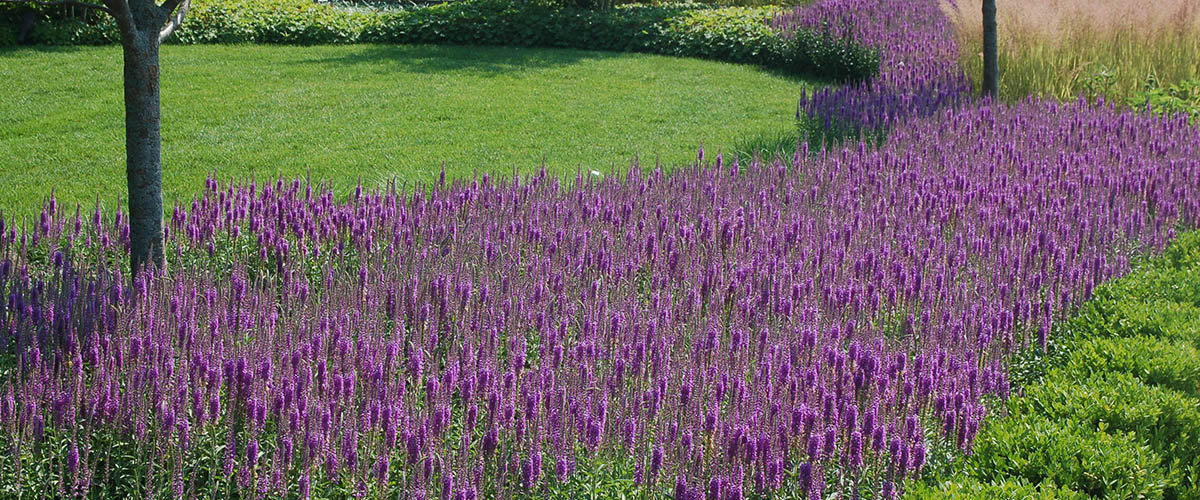
By late spring and early summer, catmint, Nepeta, woodland phlox and blue false indigo, Baptisia australis, extend the display. Catmint is particularly useful around paths and sunny borders because its aromatic foliage resists browsing and its flower spikes are visited repeatedly. The Baptisia trial findings can help gardeners compare selections for reliable flowering, plant shape and long-term garden value.
Summer planting can then move into globe thistle, Echinops, blue salvia, Salvia nemorosa, Salvia guaranitica and selected veronicas. These plants vary considerably in height and moisture needs, so grouping them by conditions produces a stronger display than placing every blue-flowered perennial in the same bed.
Choose Early Flowers For Active Pollinators
Spring pollinators often work close to the ground and favour accessible, tubular or bell-shaped blooms. Bluebells and lungwort provide flowers when food sources are still limited, especially in gardens where winter-flowering shrubs have finished and summer plants are only producing foliage. Their early contribution is valuable even when the flowering period lasts only a few weeks.
In cooler Australian districts, such as Canberra, the Dandenong Ranges or elevated parts of Victoria, these spring plants may perform well in a sheltered bed with compost-enriched soil. In warmer areas, including Brisbane and coastal New South Wales, they may need protection from intense afternoon heat and may not receive enough winter chill to behave as they do in North American trials.
Baptisia is a more substantial choice for a sunny perennial border. Its blue pea-shaped flowers appear on upright stems, while the blue-green foliage continues to provide structure after flowering. Allow room for the plant to mature, and avoid moving an established specimen because its deep root system dislikes disturbance.
Use Summer Plants To Feed A Wider Range Of Insects
Catmint and garden salvias are among the most practical summer choices for Australian home gardens. They suit the common habit of planting low-maintenance borders near patios, driveways and front paths, where their long flowering period can be enjoyed without demanding daily care. A light trim after the first flush often encourages fresh growth, provided the plant is not cut back during extreme heat.
Blue veronica, Veronica spicata, and Veronica longifolia provide narrow flower spikes above compact foliage. They work well beside yellow coreopsis, white yarrow or soft pink gaura, creating colour contrast while maintaining a steady supply of nectar. Globe thistle offers a different flower shape and is useful for larger spaces, though its mature size and prickly foliage should be considered near play areas.
Not every pollinator plant needs blue flowers. The performance of Pycnanthemum in trials demonstrates why a mixed palette matters. Mountain mint may have pale flowers rather than intense blue blooms, yet its dense clusters and aromatic foliage can attract abundant native bees, adding ecological value between blue-flowered peaks.
Extend Colour Into Late Summer And Autumn
Late-season colour is often the missing part of a pollinator border. Caryopteris, sometimes called bluebeard, flowers from late summer into autumn and provides a woody, compact form that suits sunny, well-drained positions. It is useful in Melbourne, Adelaide and inland New South Wales, where dry summers reward plants that dislike constantly wet soil.
Blue-flowered asters, including selected Symphyotrichum cultivars, can carry the display into autumn. In their best conditions, they support late bees and butterflies when many early perennials have set seed. They prefer good air movement and soil that retains some moisture without becoming waterlogged, especially during hot weather.
In frost-prone gardens, leaving a small amount of spent growth standing through winter can provide shelter and seed for wildlife. Cut stems back in late winter rather than immediately after flowering, unless disease or access requires earlier maintenance. This approach also gives the bed more texture during the dormant season.
Adapt Chicagoland Findings To Australian Conditions
Trial data from the United States can reveal useful traits such as disease resistance, sturdy stems, flowering duration and mature spread. It cannot replace local observation. Perth’s sandy soils, Adelaide’s dry summers, Sydney’s humid conditions and Melbourne’s changing rainfall patterns create very different tests for the same perennial.
Watering deeply during establishment is usually more effective than frequent shallow watering. Once rooted, many sun-loving blue bloomers benefit from mulch, but keep organic mulch away from crowns to reduce rot. In areas with water restrictions, choose drought-tolerant plants such as catmint, caryopteris and suitable salvias, while reserving higher-moisture spaces for lungwort or moisture-loving veronicas.
Check the label and your state or territory’s weed regulations before buying unfamiliar species. Australia’s biosecurity framework controls the movement and importation of plant material, while state and local authorities may restrict the sale or cultivation of particular plants. A plant that is well behaved in a Chicagoland trial should still be assessed for seed spread, suckering and persistence in the local climate. For broader nomenclature and perennial references, European plant resources can provide useful comparison points, but local nursery advice remains essential.
Match Flowering Plants To A Living Garden
Pollinator value depends on more than bloom colour. Select flowers with different shapes, include plants at several heights, and avoid treating every insect visit as a pest problem. A small patch of bare soil, a shallow water source and undisturbed stems can make a blue border more useful to insects than a larger bed managed as a spotless ornamental display.
Avoid routine insecticide applications when flowers are open, particularly during the warm part of the day when bees are active. In Australian gardens, hand removal, pruning, improved airflow and targeted treatment are often better first steps. Buying from reputable local nurseries also helps reduce the risk of introducing poorly identified or invasive plants.
| Flowering period | Blue-flowered perennial | Useful conditions | Pollinator and design value |
|---|---|---|---|
| Early spring | Virginia bluebells | Part shade, moist soil | Early nectar; naturalises in suitable cool gardens |
| Spring to early summer | Lungwort | Shade, reliable moisture | Early bee forage and patterned foliage |
| Late spring to summer | Baptisia australis | Full sun, deep well-drained soil | Upright structure and pea-shaped flowers |
| Summer | Nepeta | Full sun, moderate drainage | Long flowering, aromatic foliage, edging plant |
| Summer | Salvia nemorosa | Full sun, free-draining soil | Repeated visits from bees and compact habit |
| Summer to autumn | Caryopteris | Full sun, dry to moderate soil | Late nectar and woody structure |
| Autumn | Blue asters | Sun, fertile but free-draining soil | Extends forage when many plants have faded |
Use these plants as a framework, then record what actually flowers and attracts insects in your own garden. Grow a small trial group, note flowering dates, observe which blooms receive visits and expand the strongest performers. Explore region-specific perennial evaluations and build a blue-flowered succession that supports pollinators from spring to autumn.
In the Garden
Evaluator gardens are located across the Chicagoland area, representing a range of growing conditions. Visit our retail and wholesale partners to find trialled perennials for your own garden.
Retail & Wholesale: Hinsdale Nurseries (Willowbrook, IL), Mariani Nurseries (Kenosha, WI & Garden Prairie, IL), Northwind Perennials (Burlington, WI), The Growing Place (Aurora, IL).
Wholesale Only: Hinsdale Nurseries (Plano, IL), Intrinsic Perennial Gardens (Hebron, IL).
Our Evaluation Program
The 2017–2020 evaluation cycle included Agastache 'Blue Boa', Allium senescens 'Blue Eddy', Amsonia ciliata var. filifolia 'Georgia Pancake', Astilbe 'Chocolate Shogun', Boltonia astroides 'James Crocket', Brunnera 'Alexander's Great', and Geranium cinereum 'Jolly Jewel Purple'. Completed evaluations include Amsonia 'Blue Ice' (2004–07).
On April 10, 2020, the program published snapshot profiles for Vernonia lettermanii 'Iron Butterfly', Stokesia laevis 'Elf', Stachys officinalis 'Pink Cotton Candy', Lobelia 'Monet Moment', Helleborus 'Winter Thrillers', Geum 'Mai Tai', Geranium soboliferum 'Butterfly Kisses', Gentiana x intermedia 'True Blue', Eurybia divaricata, Asparagus 'Purple Passion', and Agastache 'Bolero'.
Browse the full collection of snapshots organized alphabetically — from A–D, E–H, I–Q, and R–Z — to find detailed performance data on perennials trialled across Chicagoland.