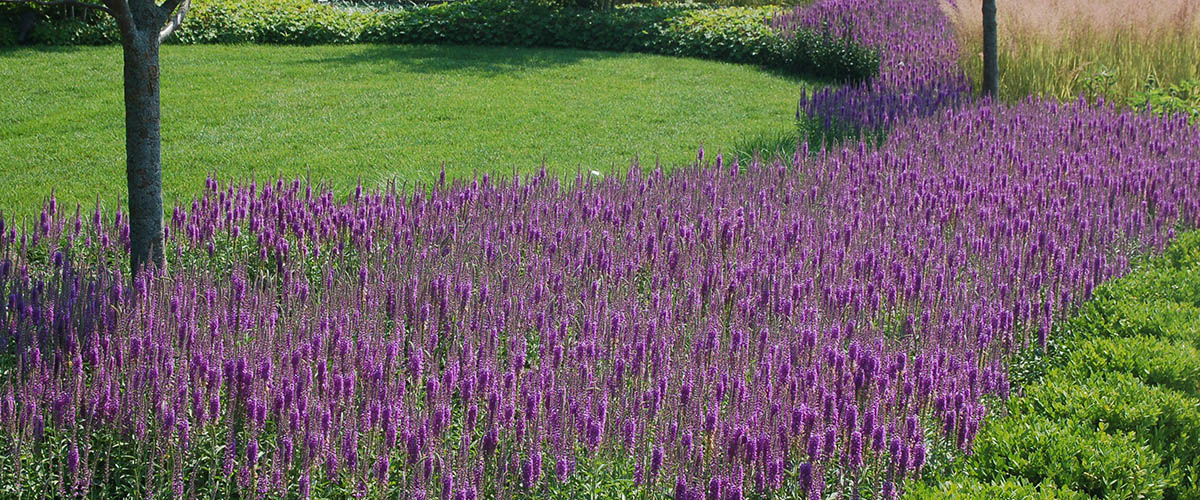
Evaluating Perennials for Chicagoland Gardens
Perennials in Focus is a plant evaluation program that examines new and underused plants for Chicagoland, the third largest metropolitan area in the country. A group of horticultural experts trials and evaluates plants at numerous locations across the region. Results help consumers, public gardens, growers, landscape designers, breeders, and other industry professionals make informed plant choices.
Perennials For Reliable Fall Color In Sandy Lakeside Soils
Autumn performance is often judged by flower colour, yet a planting can remain visually strong after summer blooms fade through foliage, seed heads, stems and changing textures. This is especially valuable in sandy ground near Lake Michigan, where wind, rapid drainage and low organic matter can expose weak plants quickly.
The Chicagoland climate adds another test: hot summers, sudden rainfall, humid periods and hard winter freezes. A perennial that looks excellent in a rich display bed may become sparse on an exposed dune edge. The strongest candidates combine dependable establishment with an autumn feature that lasts for several weeks.
For Australian gardeners, the research is useful as a guide to plant behaviour rather than a ready-made shopping list. The same species may respond differently in Melbourne’s sandy coastal suburbs, Perth’s dry summers, Adelaide’s alkaline soils or Sydney’s milder winters. Check local hardiness, water needs and weed status before planting.
The following selections focus on autumn foliage, late flowers and persistent structure. They suit lean, free-draining soils when planted at the right time and watered carefully during establishment, while also offering ideas for Australian growers, landscape designers and garden retailers comparing plants for difficult sites.
Why Sandy Lakeside Sites Need Careful Selection
Sandy soil warms quickly in spring and drains rapidly after rain. Near Lake Michigan, exposed beds may also receive strong winds and occasional salt spray, while dunes and old beach deposits can contain very little nitrogen or organic matter. Plants need deep or fibrous root systems, and young specimens need consistent moisture before they become self-sufficient.
A soil test is a practical first step. It can reveal whether the bed is acidic, neutral or calcareous, and whether nutrients are genuinely low. Incorporating modest amounts of compost improves water-holding capacity, but heavily enriching a native-style or low-input bed can encourage floppy growth and weeds.
For Australian conditions, the same principle applies to coastal sand around Perth, sandy rises near Adelaide and free-draining sites in Melbourne. Mulch is useful, but keep it clear of crowns. In water-restricted areas, choose a coarse organic mulch or mineral surface dressing that slows evaporation without creating a permanently damp collar.
Plants That Carry Autumn Interest
Amsonia hubrichtii is one of the clearest choices for luminous yellow autumn foliage. Its narrow leaves create a soft, willow-like texture through summer, then turn gold after cooler nights. It prefers full sun and tolerates lean, sandy soil once established, though it needs reliable irrigation during its first growing seasons.
Little bluestem, Schizachyrium scoparium, brings copper, bronze and reddish tones to open plantings. Its upright stems remain useful into winter, making it a strong option where flower colour is brief. Several cultivars differ in height and habit, so growers should trial them rather than assuming every selection performs equally in wind.
Switchgrass, Panicum virgatum, is another dependable structural perennial. Cultivars range from compact forms to tall screens, with foliage that may turn yellow, orange or red-brown. It handles drought after establishment and supports seed heads that catch low autumn light, although excessive fertility can produce weak, sprawling growth.
Late Flowers For Lean Ground
Goldenrod, especially well-behaved garden selections of Solidago, provides a late-season supply of yellow flowers for pollinators. It is suited to sunny, well-drained ground, but plant form matters: some species spread aggressively, while named cultivars are generally more restrained and better suited to residential borders.
Helenium autumnale and its hybrids bring warm yellow, copper and red daisy flowers from late summer into autumn. They perform best with regular moisture, so they are better for a sandy bed improved with compost than for the driest dune crest. Cutting back weak stems in early summer can encourage a fuller plant.
Sedum, now commonly placed in the genus Hylotelephium, offers fleshy foliage, late flower clusters and sturdy seed heads. ‘Autumn Joy’ and related forms are familiar, but newer cultivars vary in height and colour. Good drainage is essential through winter; wet crowns can fail even when the surrounding soil is sandy.
A Practical Comparison For Planting Design
| Perennial | Autumn feature | Sandy-soil suitability | Main consideration |
|---|---|---|---|
| Amsonia hubrichtii | Clear yellow foliage | High after establishment | Needs early-season moisture |
| Schizachyrium scoparium | Copper-red foliage and stems | High | Select a stable cultivar |
| Panicum virgatum | Coloured foliage and seed heads | High | Avoid high nitrogen |
| Solidago cultivar | Late yellow flower clusters | High | Check spreading habit |
| Helenium hybrid | Red, gold or copper flowers | Moderate | Needs more consistent moisture |
| Hylotelephium cultivar | Late flowers and persistent heads | High | Protect crowns from winter wet |
A successful border usually combines at least three types of interest: a plant with changing foliage, a late flowering species and a grass or perennial with persistent stems. Repeating groups of the same plant creates stronger colour blocks than scattering single specimens through the bed.
For designers and retailers, performance records should include height, spread, bloom timing and the date when foliage changes. The Perennials in Focus programme is valuable because multi-site observations reveal whether an attractive plant is consistently useful or merely impressive in one sheltered garden.
Structure After The Flowers Fade
Seed heads are particularly important in exposed sites because they provide shape after frost. Upright grasses, coneflowers, sedums and some asters can hold their form through winter, giving birds feeding opportunities and keeping a sandy border from looking bare. The seed-head notes offer a useful way to assess this late-season character.
Leave stems standing until late winter where local conditions allow. In Chicagoland, delayed cutting protects overwintering insects and preserves texture against snow. In Australia, timing may be adjusted for fire-risk rules, local council requirements or the species’ tendency to harbour pests. Always follow site-specific vegetation-management guidance.
This approach also suits Australian gardens that rely on weekend maintenance rather than constant grooming. A carefully chosen mix can look intentional through autumn and winter without requiring every brown stem to be removed as soon as flowering ends.
Watering And Establishment
Even drought-tolerant perennials need regular watering while roots expand. Deep, infrequent irrigation is generally more effective than a light daily sprinkle, especially in sand where surface moisture disappears quickly. Drip irrigation or a soaker line can reduce evaporation and keep water near the root zone.
In Melbourne and Adelaide, summer watering may be limited by state or local restrictions, while Perth gardeners often work around prescribed watering days. Sydney’s rainfall can be more generous, but sandy coastal beds may still dry rapidly between storms. Group plants with similar water requirements so irrigation is efficient.
Avoid pushing growth with high-nitrogen fertiliser. Slow-release fertiliser, a thin compost layer and occasional replenishment of mulch are usually safer. Overfed grasses and tall perennials can become lush but unstable, losing the upright form that makes them valuable in autumn.
Adapting Regional Findings For Australia
A plant that survives a Chicagoland winter may have no difficulty with Australian cold, but it may struggle with a long, dry summer, mild winter dormancy or humid coastal conditions. Conversely, a perennial that performs in Perth may not experience enough winter chill to produce the same seasonal rhythm as it does near Lake Michigan.
Australian nurseries and garden centres, including large chains such as Bunnings and specialist native-plant retailers, often label water needs and mature dimensions, but availability changes by state. Ask for the cultivar name rather than relying on a broad common name, particularly with grasses, sedums and goldenrods.
Biosecurity rules under Australia’s Biosecurity Act 2015 regulate the movement and importation of plant material, and each state or territory may maintain additional weed restrictions. Before importing seed or ordering unusual plants, consult the Department of Agriculture, Fisheries and Forestry and the relevant state authority. A plant suitable for a North American trial may be restricted or invasive in Australia.
Designing A Season-Long Sandy Border
Place the most reliable foliage plants where they can be seen from a path, kitchen window or outdoor seating area. Amsonia can form a low-to-medium drift, while little bluestem and switchgrass add vertical punctuation behind it. Sedums and compact asters can fill the front without competing for excessive moisture.
Use repetition to connect separate areas, then vary texture rather than adding many unrelated colours. Gold foliage beside blue-green grass is effective in autumn, while copper stems work well with late yellow flowers. Leave enough space for mature spread so airflow remains good and plants do not need frequent division.
For Australian landscapes, pair these trial candidates with locally adapted companions only after checking compatibility and legal status. Native grasses, dianellas or other regional perennials may provide similar structure with better heat tolerance. The aim is a resilient seasonal composition, not a direct copy of a Midwestern planting.
Choose plants with documented performance, prepare the sand carefully and record what changes through the season. Gardeners, growers and landscape professionals can use those observations to refine future plantings, while retailers can recommend autumn performers with greater confidence. Begin with a small trial bed, monitor it through summer and winter, and let proven plants earn a larger place in the landscape.
In the Garden
Evaluator gardens are located across the Chicagoland area, representing a range of growing conditions. Visit our retail and wholesale partners to find trialled perennials for your own garden.
Retail & Wholesale: Hinsdale Nurseries (Willowbrook, IL), Mariani Nurseries (Kenosha, WI & Garden Prairie, IL), Northwind Perennials (Burlington, WI), The Growing Place (Aurora, IL).
Wholesale Only: Hinsdale Nurseries (Plano, IL), Intrinsic Perennial Gardens (Hebron, IL).
Our Evaluation Program
The 2017–2020 evaluation cycle included Agastache 'Blue Boa', Allium senescens 'Blue Eddy', Amsonia ciliata var. filifolia 'Georgia Pancake', Astilbe 'Chocolate Shogun', Boltonia astroides 'James Crocket', Brunnera 'Alexander's Great', and Geranium cinereum 'Jolly Jewel Purple'. Completed evaluations include Amsonia 'Blue Ice' (2004–07).
On April 10, 2020, the program published snapshot profiles for Vernonia lettermanii 'Iron Butterfly', Stokesia laevis 'Elf', Stachys officinalis 'Pink Cotton Candy', Lobelia 'Monet Moment', Helleborus 'Winter Thrillers', Geum 'Mai Tai', Geranium soboliferum 'Butterfly Kisses', Gentiana x intermedia 'True Blue', Eurybia divaricata, Asparagus 'Purple Passion', and Agastache 'Bolero'.
Browse the full collection of snapshots organized alphabetically — from A–D, E–H, I–Q, and R–Z — to find detailed performance data on perennials trialled across Chicagoland.