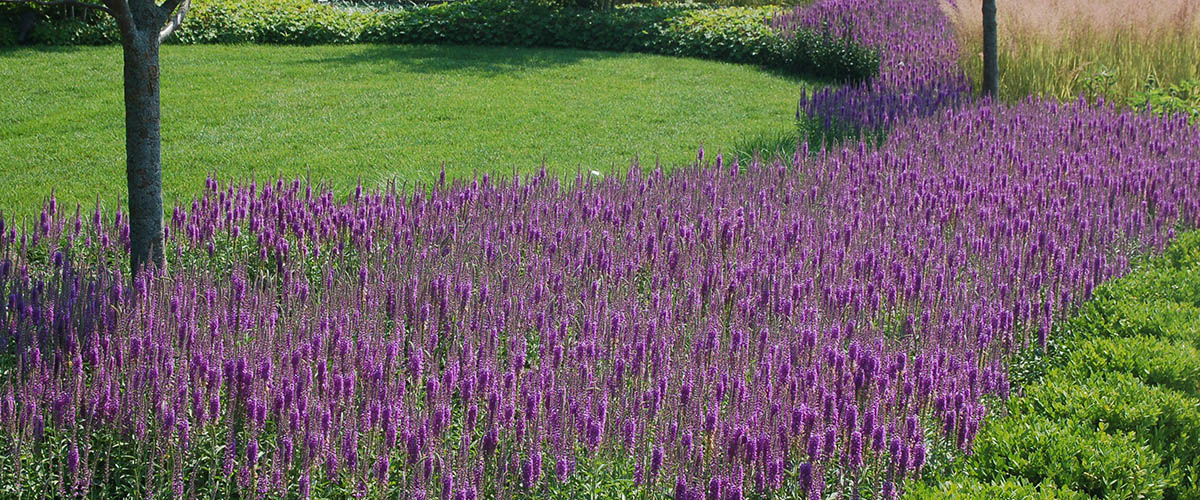
Evaluating Perennials for Chicagoland Gardens
Perennials in Focus is a plant evaluation program that examines new and underused plants for Chicagoland, the third largest metropolitan area in the country. A group of horticultural experts trials and evaluates plants at numerous locations across the region. Results help consumers, public gardens, growers, landscape designers, breeders, and other industry professionals make informed plant choices.
Perennials With Season-Long Foliage for Zones 5-6
A flower bed can lose much of its visual appeal between bloom cycles, but foliage keeps the garden composed from the first spring shoots through autumn’s final frost. In Zones 5-6, including the Chicagoland region, carefully selected perennials provide dependable color, texture, height, and contrast across a long growing season.
The strongest planting combinations use plants with different leaf shapes and habits rather than relying on flowers alone. Broad hosta leaves, finely divided fern fronds, upright ornamental grass blades, and silver or burgundy foliage can create a layered display even when few plants are in bloom.
Performance also depends on placement. Soil moisture, exposure, winter drainage, and the amount of afternoon sun all influence how well foliage holds its color and form. Regional trials and observations are especially valuable because a perennial that performs well in a mild garden may struggle with the freeze-thaw cycles common around Chicago.
What Creates Lasting Foliage Interest
Season-long foliage begins with a mix of emergence times. Some perennials appear early, such as brunnera, lungwort, and certain coral bells. Others reach their best size in summer, including hostas, Siberian bugloss, and many ornamental grasses. Late-season performers, such as sedum and amsonia, carry structure and color into October.
Leaf color should be considered alongside texture. Chartreuse foliage catches low spring and autumn light, blue-green leaves add cool contrast, and deep purple or bronze tones anchor a planting. Variegated plants brighten shaded areas, while finely cut leaves soften the strong lines of paths, walls, and foundation beds.
Evergreen or semi-evergreen perennials can extend the display even further. Heuchera, hellebores, epimedium, and some evergreen sedges may retain leaves through much of winter when protected from harsh wind. Their spring condition varies by site, so damaged foliage can be trimmed as new growth emerges.
Spring Foliage That Starts the Display
Early-season foliage is often as important as the first flowers. Hellebores offer leathery, dark green leaves soon after winter, while brunnera produces heart-shaped leaves that form a luminous groundcover in partial shade. Pulmonaria adds spotted foliage and stays useful after its spring flowers fade.
Coral bells provide a wide range of leaf colors, from caramel and copper to near-black purple and silver. In Zones 5-6, they perform best in well-drained soil with regular moisture. Winter heaving and wet crowns can cause losses, so avoid planting them in low spots where water collects.
Ferns contribute a different kind of spring interest. Japanese painted fern emerges with silver, burgundy, and green fronds, while native Christmas fern offers a dependable evergreen presence. Their arching forms work well beneath trees, beside paths, or at the front of a shaded border.
Summer Foliage For Structure And Contrast
Hostas remain among the most useful foliage plants for shade, with sizes ranging from compact clumps to broad specimens several feet across. Blue-leaved types generally hold their color best with morning sun or bright shade. Gold and chartreuse selections can tolerate more light if the soil remains evenly moist.
For sunny locations, consider catmint, yarrow, Russian sage, and ornamental grasses. Their narrow leaves and upright stems contrast with rounded perennials. Sedum develops thick, water-storing leaves that remain attractive during dry periods, and its sturdy form continues into winter if seedheads are left standing.
Amsonia is another strong multi-season plant. Its narrow leaves create a soft, willow-like texture in summer, then turn clear gold in fall. Baptisia forms a substantial mound after flowering, with blue-green foliage that stays handsome through drought and heat. These plants are useful in larger borders where their mature size has room to develop.
| Perennial | Best Light | Foliage Character | Strongest Seasonal Contribution |
|---|---|---|---|
| Hosta | Part shade to shade | Broad, ribbed leaves in green, blue, gold, or variegated tones | Summer volume and texture |
| Brunnera | Part shade | Heart-shaped silver or green leaves | Early spring emergence and shade brightness |
| Coral bells | Part shade to part sun | Colorful rounded leaves on compact mounds | Spring through fall color |
| Japanese painted fern | Shade to part shade | Finely divided silver, green, and burgundy fronds | Spring texture and woodland layering |
| Amsonia | Full sun to part sun | Narrow green leaves that turn gold | Summer structure and fall color |
| Sedum | Full sun | Thick green, blue, or burgundy leaves | Drought tolerance and late-season form |
| Ornamental grass | Full sun | Upright or arching blades | Movement, height, and winter structure |
Foliage That Carries Into Autumn
Autumn interest is strongest when foliage changes gradually rather than disappearing after the first cold night. Amsonia turns a warm yellow, some coral bells deepen in tone, and many ornamental grasses shift from green to tan, copper, or russet. These colors can bridge the gap between fading perennials and fallen leaves.
Sedum keeps its fleshy leaves until frost and develops flower heads that age from pink to copper. Peonies may turn burgundy or bronze before their leaves collapse, offering a final display after months of dark green structure. Certain geraniums also produce attractive red or orange tones in cool weather.
Leave sturdy stems and seedheads in place when possible. They add winter form, protect crowns from fluctuating temperatures, and provide food or shelter for wildlife. Cut back only plants that become diseased, collapse badly, or create a safety concern. A selective cleanup is often better for the garden than removing every stem in autumn.
For regional inspiration, gardeners can review seasonal garden observations that show how plants perform beyond a single flowering moment. This kind of information helps place autumn color within the larger rhythm of the garden.
Matching Plants To Site Conditions
Shade does not mean the same thing in every garden. Dry shade beneath mature trees is considerably more demanding than moist shade beside a downspout. Epimedium, barrenwort, Christmas fern, and some hellebores handle root competition better than moisture-loving hostas, while sedges can bridge the gap between woodland and open border conditions.
Sun-loving foliage plants still need the right soil. Lavender, catmint, and sedum prefer sharp drainage, while many grasses and moisture-tolerant perennials grow more vigorously in deeper soil. Amending compacted beds with organic matter can improve root growth, but drainage must be corrected rather than masked with compost alone.
Spacing is equally important. Plants installed too close together may look full in the first year but become crowded, prone to foliar disease, and difficult to maintain. Check mature width before planting, and use repeated groupings of three or more plants to create continuity without making the border appear monotonous.
A Practical Planting Checklist
A foliage-focused border is easier to manage when each plant has a clear role. Combine a dependable framework plant, a seasonal color accent, a textural contrast, and a low-growing filler. Repeat key colors or leaf shapes at intervals so the planting feels intentional from spring through fall.
Use the following recommendations when selecting perennials for a Zone 5-6 garden:
- Place blue, silver, and gold foliage where morning or filtered light can preserve its color without causing scorch.
- Pair broad leaves with fine textures, such as hosta with fern, sedum with ornamental grass, or brunnera with hakonechloa.
- Choose at least one early-emerging, one summer-dominant, and one late-season perennial for each major planting area.
- Match moisture needs carefully, especially in beds beneath trees or beside paved surfaces.
- Observe mature height and spread before combining plants, then leave room for gradual expansion.
Keep notes on bloom timing, foliage color, winter survival, and maintenance demands. A plant that looks promising in a catalog may behave differently in a local microclimate, while an underused perennial may become a dependable favorite after several seasons of observation.
Building A Cohesive Four-Season Border
The most successful foliage combinations use repetition and progression. A line of coral bells can connect separate sections of a bed, while repeated clumps of amsonia or grass create rhythm through summer and autumn. Taller plants should generally sit toward the back or center, with mounding and low-growing forms layered around them.
Think about views from windows, patios, and walkways. A shade border may need bright leaves near a dark foundation, while a sunny island bed can benefit from cool blue foliage to temper hot flower colors. In each location, select plants that remain attractive after their flowers have passed.
Regional evaluation programs help turn these design principles into practical choices by recording how perennials grow across multiple gardens and seasons. Those observations can guide plant selection for residential landscapes, public gardens, retail displays, and larger professional projects.
Start with one bed and map its light, soil moisture, and mature planting space. Add a small group of dependable foliage perennials, then track how the combination changes from the first spring leaves to the final autumn color. Over time, those observations will create a resilient, visually layered garden suited to the conditions of Zones 5-6.
In the Garden
Evaluator gardens are located across the Chicagoland area, representing a range of growing conditions. Visit our retail and wholesale partners to find trialled perennials for your own garden.
Retail & Wholesale: Hinsdale Nurseries (Willowbrook, IL), Mariani Nurseries (Kenosha, WI & Garden Prairie, IL), Northwind Perennials (Burlington, WI), The Growing Place (Aurora, IL).
Wholesale Only: Hinsdale Nurseries (Plano, IL), Intrinsic Perennial Gardens (Hebron, IL).
Our Evaluation Program
The 2017–2020 evaluation cycle included Agastache 'Blue Boa', Allium senescens 'Blue Eddy', Amsonia ciliata var. filifolia 'Georgia Pancake', Astilbe 'Chocolate Shogun', Boltonia astroides 'James Crocket', Brunnera 'Alexander's Great', and Geranium cinereum 'Jolly Jewel Purple'. Completed evaluations include Amsonia 'Blue Ice' (2004–07).
On April 10, 2020, the program published snapshot profiles for Vernonia lettermanii 'Iron Butterfly', Stokesia laevis 'Elf', Stachys officinalis 'Pink Cotton Candy', Lobelia 'Monet Moment', Helleborus 'Winter Thrillers', Geum 'Mai Tai', Geranium soboliferum 'Butterfly Kisses', Gentiana x intermedia 'True Blue', Eurybia divaricata, Asparagus 'Purple Passion', and Agastache 'Bolero'.
Browse the full collection of snapshots organized alphabetically — from A–D, E–H, I–Q, and R–Z — to find detailed performance data on perennials trialled across Chicagoland.