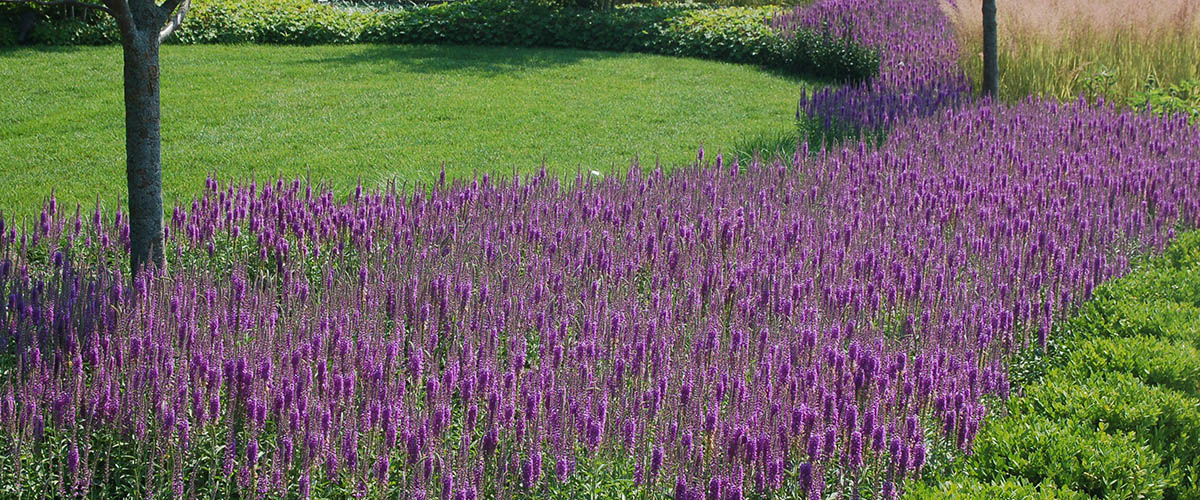
Evaluating Perennials for Chicagoland Gardens
Perennials in Focus is a plant evaluation program that examines new and underused plants for Chicagoland, the third largest metropolitan area in the country. A group of horticultural experts trials and evaluates plants at numerous locations across the region. Results help consumers, public gardens, growers, landscape designers, breeders, and other industry professionals make informed plant choices.
Perennials That Hold Up Along Busy Pathway Edges
Pathway borders experience a special kind of wear. Shoes clip the planting bed while people pass, guests step aside to let others through, and winter maintenance can push snow, salt, and grit into the soil. A perennial planted at the edge must tolerate occasional contact without looking flattened for the rest of the season.
In the Chicagoland region, successful choices also need to manage cold winters, humid summers, clay-heavy soils, spring moisture, and periods of drought. No plant is truly indestructible, and even the toughest ground cover performs poorly when it receives constant footfall. The goal is to select low-growing plants that recover quickly and make accidental steps less damaging.
Plant trials can help gardeners distinguish between a plant that merely survives and one that remains attractive across several seasons. Region-specific observations, including bloom time, spread, height, and habit, are especially useful when choosing perennials for paths, stepping-stone walks, and informal garden routes.
What makes a pathway-edge perennial durable
The most reliable plants stay close to the ground, spread densely, and have flexible stems or resilient foliage. A mat-forming habit distributes pressure across many growing points instead of concentrating damage on a few upright stems. Small leaves also tend to spring back more effectively than broad, brittle foliage.
Rooting ability matters just as much. Ground covers that root along stems can repair small gaps and gradually knit together around pavers. Plants with shallow but extensive roots are useful in narrow borders, where soil volume is limited and competition from lawn or tree roots can be intense.
Durability does not mean that a plant welcomes regular walking. These selections are best for occasional missteps, pathway shoulders, and spaces between widely placed stones. Where people walk every day, use hard paving for the main tread and reserve living plants for the margins.
Traits that matter in Chicagoland gardens
Winter survival is the first filter. A plant may tolerate occasional contact yet fail after repeated freeze-thaw cycles, saturated spring soil, or exposure to deicing salts. Hardy perennials with a compact crown and good drainage generally have a stronger chance of returning evenly in the Chicago area.
Summer performance deserves equal attention. Path edges can become hot and dry beside concrete or stone, while shaded walks may remain damp and cool. Match the plant to the site rather than relying on a general label such as “tough ground cover.” Sun exposure, soil texture, irrigation, and drainage all influence recovery from foot traffic.
Flowering season can shape the appearance of the entire route. Thyme offers summer color and fragrance, while some foliage-focused ground covers provide a quieter, consistent carpet. Review plant snapshots for useful comparisons of growth habit and seasonal interest when narrowing down candidates.
Strong candidates for occasional steps
Creeping thyme, especially low woolly or culinary thyme selections, is a classic choice for sunny, sharply drained edges. It forms a fragrant mat, stays short, and produces flowers that attract pollinators. Thyme dislikes wet winter soil and heavy shade, so place it between stones or along a raised, gritty border rather than in a low muddy strip.
Mazus reptans is better suited to evenly moist soil and partial shade. Its small leaves create a dense carpet, and spring flowers add color before many summer perennials reach their peak. It can handle an occasional step once established, although winter wet and aggressive spreading should be monitored.
Blue star creeper, commonly sold as Isotoma fluviatilis, can fill gaps between stepping stones in locations with consistent moisture. It is attractive and low-growing, but hardiness and performance can vary by selection and exposure. Treat it as a trial-worthy option rather than a guaranteed solution for every Chicagoland garden.
Creeping sedums are useful where the path edge is sunny, dry, and lean. Their succulent foliage stores moisture, and their low profile reduces breakage. They are less appropriate for damp, compacted soil. Irish moss and brass buttons may also work in protected microclimates, but their winter survival can be less predictable than that of proven hardy ground covers.
| Perennial | Best setting | Seasonal interest | Foot-traffic tolerance | Main caution |
|---|---|---|---|---|
| Creeping thyme | Full sun, dry, well-drained soil | Summer flowers, fragrance | Occasional steps | Poor performance in wet soil |
| Mazus reptans | Partial shade, evenly moist soil | Spring flowers, green carpet | Light to occasional steps | Can spread beyond the intended edge |
| Creeping sedum | Full sun, lean and dry soil | Foliage and summer flowers | Light steps after establishment | Rot in saturated ground |
| Blue star creeper | Sun to partial shade, consistent moisture | Small flowers through the growing season | Occasional steps | Hardiness may vary by site |
| Pennsylvania sedge | Part shade, woodland or lawn-edge conditions | Fine foliage, subtle seasonal change | Limited incidental contact | Better for brushing contact than direct walking |
Designing a path that shares space with plants
A successful planting begins with path geometry. Keep the main walking line wide enough that visitors do not need to step into the border when passing. A generous edge, low retaining lip, or line of flat stones can protect living ground covers while still creating a soft transition from paving to garden.
Install plants slightly back from the most heavily used tread. Even a few inches can prevent repeated heel strikes. At stepping-stone paths, place durable ground covers around the stones but leave enough exposed surface for a stable foot placement. Avoid creating a route that appears walkable if the plants cannot withstand regular use.
Soil preparation has a direct effect on recovery. Remove perennial weeds, loosen compacted soil, and amend according to the plant’s needs rather than adding rich compost indiscriminately. Thyme and sedum need fast drainage, while mazus benefits from more consistent moisture. Water new plants regularly during the first season so they can root before facing winter.
How to judge performance beyond the first season
A newly planted edge may look open and vulnerable, while a mature planting can become dense enough to absorb occasional contact. Evaluate establishment speed, winter dieback, weed resistance, and the plant’s ability to close small gaps. A perennial that spreads steadily without swallowing the path is often more useful than one that grows rapidly and requires frequent trimming.
Observe the plant after rain, heat, and periods of heavy use. Does foliage remain attractive after a shoe brushes across it? Do stems recover overnight? Does the crown rot where water collects? These practical details are more valuable than a catalog description when the planting will sit beside a busy walk.
Collaborative trials add another layer of confidence because performance is observed across multiple gardens and seasons. The evaluation team brings horticultural experience to questions that matter in real landscapes, including height, spread, bloom period, and regional adaptability.
Practical planting recommendations
Use the following principles when planning a resilient pathway border:
- Reserve direct, repeated foot traffic for paving, gravel, or stepping stones rather than living plants.
- Match the perennial to moisture and light before considering its ability to tolerate an occasional step.
- Combine one dependable ground cover with a small number of trial plants to compare winter survival and spread.
- Keep aggressive spreaders contained with edging and inspect the path twice each growing season.
- Replace damaged or declining plants promptly so weeds do not occupy open gaps.
Mulch can protect young plants, but thick mulch at a path edge may spill onto paving and become slippery. A thin layer of fine material, gravel between stones, or a clean soil surface is often easier to maintain. Trim runners before they cover the walking surface, and remove salt-laden debris after winter whenever possible.
Choose a pathway-edge planting that fits the way the route is actually used, then give it the right soil, spacing, and establishment time. Explore regional trial observations, compare suitable ground covers, and build a border that softens the path without sacrificing safety or durability.
In the Garden
Evaluator gardens are located across the Chicagoland area, representing a range of growing conditions. Visit our retail and wholesale partners to find trialled perennials for your own garden.
Retail & Wholesale: Hinsdale Nurseries (Willowbrook, IL), Mariani Nurseries (Kenosha, WI & Garden Prairie, IL), Northwind Perennials (Burlington, WI), The Growing Place (Aurora, IL).
Wholesale Only: Hinsdale Nurseries (Plano, IL), Intrinsic Perennial Gardens (Hebron, IL).
Our Evaluation Program
The 2017–2020 evaluation cycle included Agastache 'Blue Boa', Allium senescens 'Blue Eddy', Amsonia ciliata var. filifolia 'Georgia Pancake', Astilbe 'Chocolate Shogun', Boltonia astroides 'James Crocket', Brunnera 'Alexander's Great', and Geranium cinereum 'Jolly Jewel Purple'. Completed evaluations include Amsonia 'Blue Ice' (2004–07).
On April 10, 2020, the program published snapshot profiles for Vernonia lettermanii 'Iron Butterfly', Stokesia laevis 'Elf', Stachys officinalis 'Pink Cotton Candy', Lobelia 'Monet Moment', Helleborus 'Winter Thrillers', Geum 'Mai Tai', Geranium soboliferum 'Butterfly Kisses', Gentiana x intermedia 'True Blue', Eurybia divaricata, Asparagus 'Purple Passion', and Agastache 'Bolero'.
Browse the full collection of snapshots organized alphabetically — from A–D, E–H, I–Q, and R–Z — to find detailed performance data on perennials trialled across Chicagoland.