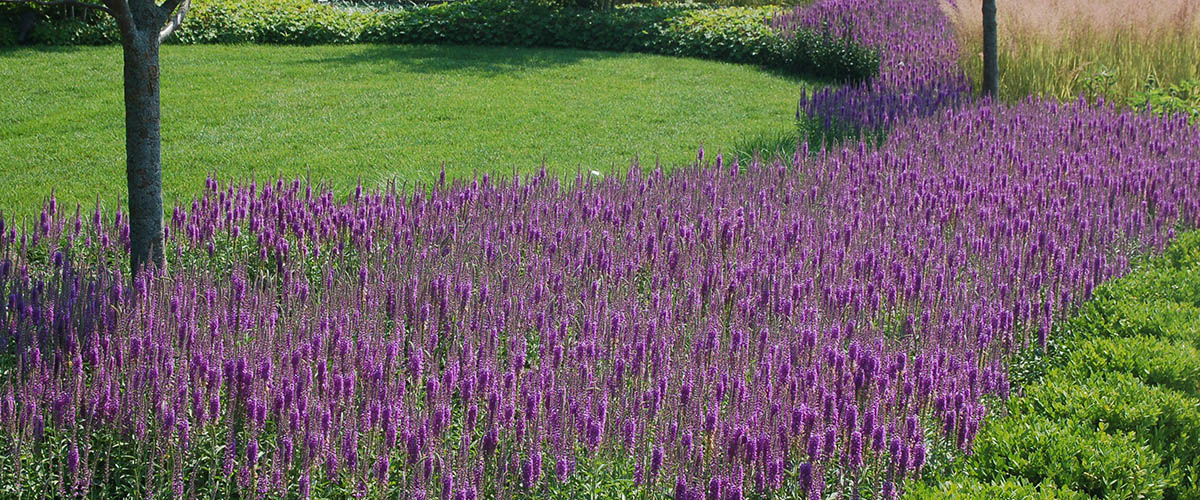
Evaluating Perennials for Chicagoland Gardens
Perennials in Focus is a plant evaluation program that examines new and underused plants for Chicagoland, the third largest metropolitan area in the country. A group of horticultural experts trials and evaluates plants at numerous locations across the region. Results help consumers, public gardens, growers, landscape designers, breeders, and other industry professionals make informed plant choices.
Perennials for Pollinators in the Chicagoland Region
A productive pollinator garden in Chicagoland must do more than produce a few attractive flowers in midsummer. Plants need to handle cold winters, humid summers, clay or compacted soil, fluctuating moisture, and the competition created by urban landscapes. The strongest choices also provide a dependable sequence of nectar, pollen, shelter, and—in some cases—host foliage.
Perennials in Focus evaluates plants across multiple gardens and seasons, making regional performance central to the selection process. That approach is especially valuable for pollinator plantings, where winter survival, flowering duration, stem strength, disease resistance, and manageable spread all influence whether a planting remains useful over time.
This Chicagoland plant evaluation report considers how well established and underused perennials support pollinators while fitting real residential, commercial, and public-garden conditions. The goal is not to identify a single “best” plant, but to assemble resilient combinations that feed insects from spring through fall.
What pollinators need from a perennial planting
Pollinator value begins with flower structure and accessibility. Open, shallow flowers generally provide easy access for small bees, syrphid flies, and other short-tongued insects, while tubular blooms may serve bumble bees, butterflies, and moths with longer mouthparts. Composite flowers such as asters and goldenrods offer many small florets in a compact display, creating efficient foraging areas.
Timing is equally important. A garden dominated by June bloom can become a food desert in August and September. Early plants such as native phlox, penstemon, and baptisia can bridge the spring-to-summer transition, while mountain mint, coneflower, anise hyssop, blazing star, and aromatic aster extend the season.
Flowering perennials also support insects after the petals fade. Standing stems provide overwintering sites for solitary bees and beneficial insects, and seedheads offer food for birds. Leaving selected stems in place until late winter can therefore increase the ecological value of a planting without adding maintenance.
Regional performance matters in Chicagoland
The Chicago area includes a wide range of growing conditions. A sunny suburban border may have rich amended soil, while a city streetscape may expose plants to reflected heat, road salt, drought, and root competition. Low areas can stay wet in spring, whereas raised beds and sandy soils may dry rapidly by midsummer.
Plants that perform consistently across several sites are especially useful. Strong candidates tend to establish without prolonged pampering, tolerate ordinary garden soils, and maintain an attractive habit after heavy rain or wind. Disease resistance is also important for bee balm, phlox, and other plants that can struggle in humid weather.
A perennial’s spread should be evaluated alongside its ecological benefits. Vigorous plants can fill a difficult site quickly, yet aggressive self-seeding or underground expansion may overwhelm slower companions. Clump-forming species and well-behaved cultivars often provide a better fit for mixed borders, while spreading natives can be reserved for larger naturalistic areas.
Strong performers for a long pollinator season
Baptisia, often called false indigo, is an excellent early-summer anchor. Its pea-like flowers attract bumble bees and other visitors, while its substantial blue-green foliage remains useful after bloom. Once established, it develops a deep root system and can withstand periods of dryness. Its long lifespan and low maintenance explain why Baptisia suits public gardens as well as home landscapes.
For late spring and summer, consider catmint, penstemon, mountain mint, yarrow, and bee balm. Catmint offers a long flowering period and a tidy mounded habit when sheared after its first flush. Mountain mint is particularly valuable for a broad range of native bees and beneficial flies, although its spreading habit requires room.
Coneflowers and blazing star bring height, color, and strong insect activity to sunny borders. Echinacea supports bees during summer and supplies seed later in the season. Liatris provides upright flower spikes that are highly visible to butterflies and bees. In average soil, both can contribute structure without demanding frequent irrigation once established.
Late-season bloomers are essential in the Midwest. Goldenrod, asters, sneezeweed, and sedum help sustain insects before winter. Goldenrod pollen is often misunderstood: it is heavy and insect-borne, unlike the airborne pollen associated with seasonal allergies. Asters and goldenrods planted together create a particularly valuable autumn resource.
Comparing useful perennial candidates
The following comparison emphasizes landscape role, pollinator value, and practical considerations for regional planting. Performance can vary by cultivar, soil, exposure, and maintenance, so trial observations remain more useful than a catalog description alone.
| Perennial | Main bloom period | Typical site | Pollinator value | Chicagoland considerations |
|---|---|---|---|---|
| Baptisia | Late spring to early summer | Full sun, average to dry soil | Bumble bees and other bees | Deep-rooted, long-lived, slow to establish |
| Monarda | Mid to late summer | Sun to part shade, evenly moist soil | Bumble bees, butterflies, hummingbird moths | Select mildew-resistant forms and allow airflow |
| Pycnanthemum | Summer | Full sun, average soil | Native bees, wasps, hoverflies | Spreads steadily; aromatic foliage discourages browsing |
| Echinacea | Summer into early fall | Full sun, well-drained soil | Bees and butterflies; seeds for birds | Avoid consistently wet winter soil |
| Liatris | Mid to late summer | Full sun, well-drained soil | Bees and butterflies | Upright habit; excellent vertical accent |
| Solidago | Late summer to fall | Sun, average to dry soil | Large numbers of bees and flies | Choose a clumping selection for smaller gardens |
| Symphyotrichum | Late summer to fall | Sun to part shade, adaptable soil | Late-season bees and butterflies | Pinch early for shorter, fuller plants |
This list works best as a planting sequence rather than a shopping list. Pair an early anchor such as baptisia with summer bloomers such as mountain mint and coneflower, then repeat late-season asters and goldenrods through the border. Repetition makes a planting easier to read visually and creates larger, more useful foraging patches.
Designing for more than honey bees
Honey bees are familiar visitors, but a resilient pollinator garden should serve native solitary bees, bumble bees, butterflies, moths, flower flies, and beetles as well. Flower size, bloom density, scent, and plant height all influence which insects can use a particular area. A layered design with low, medium, and tall perennials increases access for different species.
Host plants add another dimension. Nectar plants feed adult butterflies, while host plants support caterpillars and complete the life cycle. Native grasses, violets, goldenrods, and certain trees and shrubs can be as important as showy flowers, even when their appearance is less dramatic.
Avoid treating every insect as a pest. Some caterpillars will chew foliage, and leaf damage is often evidence that a planting is supporting wildlife. Limit broad-spectrum pesticides, avoid spraying open flowers, and use targeted controls only when a genuine plant-health problem warrants intervention.
Practical recommendations for planting and care
Successful pollinator plantings are managed for continuity, habitat, and seasonal appearance. Dense groupings of three or more plants are easier for insects to locate than isolated specimens scattered across a lawn. Repeated drifts also simplify watering, weeding, and observation.
Use these recommendations when developing or refining a Chicagoland perennial border:
- Combine early-, mid-, and late-season bloomers so flowers remain available from spring through fall.
- Match plants to drainage and sunlight instead of trying to correct every site with intensive amendments.
- Repeat dependable species in groups, using taller plants toward the back and shorter clump-formers near paths.
- Leave some stems and seedheads standing through winter, then cut them back in late winter or early spring.
- Watch for disease, lodging, and unwanted spread during several seasons before expanding a planting.
Regional trials are especially helpful when a plant looks promising in photographs but its mature habit, bloom length, or winter survival is uncertain. Records of flowering dates can reveal gaps that are easy to miss during a single garden visit. For additional ideas on sustained seasonal color, this resource on long-blooming Midwest perennials provides a useful planning perspective.
Turning evaluation results into resilient landscapes
The most effective pollinator garden is rarely a collection of isolated specialty plants. It is a functioning plant community in which dependable bloom periods overlap, root systems occupy different layers, and maintenance decisions protect insect habitat. A modest border can make a meaningful contribution when it offers flowers repeatedly and avoids unnecessary disturbance.
For homeowners, the next step may be replacing a small section of lawn with three or four well-matched perennials. Designers and growers can use regional observations to refine plant palettes, compare cultivars, and set realistic expectations for mature size. Public gardens and retailers can highlight plants that combine ecological value with reliable performance, helping more Chicagoland gardeners make informed choices.
Review local trial findings, observe bloom and insect activity through the seasons, and build your next planting around proven performers rather than isolated novelty. With thoughtful plant selection and patient care, a Chicagoland garden can provide a steady source of nourishment and shelter for pollinators from the first spring flowers to the final autumn asters.
In the Garden
Evaluator gardens are located across the Chicagoland area, representing a range of growing conditions. Visit our retail and wholesale partners to find trialled perennials for your own garden.
Retail & Wholesale: Hinsdale Nurseries (Willowbrook, IL), Mariani Nurseries (Kenosha, WI & Garden Prairie, IL), Northwind Perennials (Burlington, WI), The Growing Place (Aurora, IL).
Wholesale Only: Hinsdale Nurseries (Plano, IL), Intrinsic Perennial Gardens (Hebron, IL).
Our Evaluation Program
The 2017–2020 evaluation cycle included Agastache 'Blue Boa', Allium senescens 'Blue Eddy', Amsonia ciliata var. filifolia 'Georgia Pancake', Astilbe 'Chocolate Shogun', Boltonia astroides 'James Crocket', Brunnera 'Alexander's Great', and Geranium cinereum 'Jolly Jewel Purple'. Completed evaluations include Amsonia 'Blue Ice' (2004–07).
On April 10, 2020, the program published snapshot profiles for Vernonia lettermanii 'Iron Butterfly', Stokesia laevis 'Elf', Stachys officinalis 'Pink Cotton Candy', Lobelia 'Monet Moment', Helleborus 'Winter Thrillers', Geum 'Mai Tai', Geranium soboliferum 'Butterfly Kisses', Gentiana x intermedia 'True Blue', Eurybia divaricata, Asparagus 'Purple Passion', and Agastache 'Bolero'.
Browse the full collection of snapshots organized alphabetically — from A–D, E–H, I–Q, and R–Z — to find detailed performance data on perennials trialled across Chicagoland.