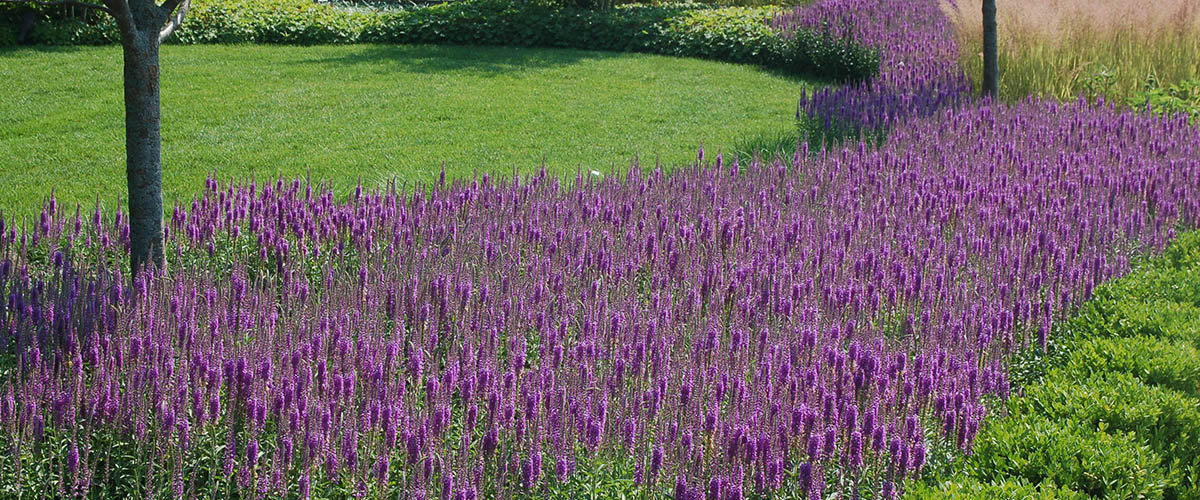
Evaluating Perennials for Chicagoland Gardens
Perennials in Focus is a plant evaluation program that examines new and underused plants for Chicagoland, the third largest metropolitan area in the country. A group of horticultural experts trials and evaluates plants at numerous locations across the region. Results help consumers, public gardens, growers, landscape designers, breeders, and other industry professionals make informed plant choices.
Native perennials for residential firebreaks in Australia
Fire risk around Australian homes is shaped by ember attack, wind, dry vegetation and the way gardens meet buildings. A planted strip can slow hot embers and keep flames low, but it complements rather than replaces a compliant firebreak, defendable-space zone and the rest of the property’s emergency preparation.
Learning how to use perennials as a firebreak in residential landscapes with native plants starts with site assessment. The aim is a continuous, low-growing, well-maintained band that fits local climate, soil and council rules, supported by paths, clearings and appropriate plant placement near walls and timber fences.
No plant is fireproof, and a native label does not guarantee low fuel. Fire behaviour changes as plants mature or dry, so choose vigorous local species, reduce dead material and test the planting across seasons before relying on it around occupied buildings.
Separate a garden layer from a legal firebreak
In Australian fire-safety terminology, a firebreak is often a cleared or managed strip with a defined purpose under state legislation. A low perennial border is usually a horticultural layer within the wider asset zone, not an accredited firebreak. Melbourne gardeners should check CFA and council guidance; Sydney and Newcastle residents should consult the RFS and local council; Adelaide properties fall under CFS and council requirements.
Get the formal requirements in writing before designing. Nearest-building vegetation zones, maximum plant height, clear access to doors and gates, and permissible surface materials vary by address, state and hazard assessment. A compliant mineral strip, paved path or irrigated low-growing area can sit beside the perennial planting without creating a path for flame to climb.
Match the planting to fire-season conditions
Australia has no single fire season. In much of Victoria and South Australia, the highest concern can arrive with hot northerly winds after a dry spring; in NSW, ember attack during the Bush Fire Danger Period may matter even when the immediate garden looks green. Record the site’s wind direction, slope, reflected heat and when vegetation becomes bone dry.
Perennials work best where they stay leafy through the period that matters. Coastal Sydney gardens may face salt, wind and a wet winter followed by rapid drying, while inland and western Australian sites often combine heat with water restrictions. Match plants to the local rainfall pattern, not merely the average climate, and avoid creating a lawn or border that becomes a source of cured summer fuel.
Select compact species with manageable dry-season fuel
Look for vigorous rhizomatous or mat-forming plants that recover from trimming and have relatively low, flexible stems. The comparison below groups several Australian natives by planting role; local ecotypes can differ, so confirm mature size and provenance with the nursery.
| Plant | Best role | Conditions | Firebreak caution |
|---|---|---|---|
| Dianella caerulea or D. revoluta | Low edging, 20–50 cm | Sun or part shade; adaptable soil | Remove dry seedheads and prevent dense thatch |
| Ajuga australis | Shaded groundcover, 10–25 cm | Moist woodland soil | Keep watered during dry periods and trim runners |
| Oplismenus aemulus | Soft path-side cover, 15–30 cm | Shade and reliable moisture | Avoid drought stress and accumulated dead foliage |
| Viola hederacea | Cool, sheltered pockets, 5–15 cm | Moist soil and light shade | Control spreading and remove dried growth |
| Lomandra multiflora | Wider transition zone, 60–90 cm | Sun or part shade; adaptable soil | Space from buildings because old foliage can burn |
Perennials in Focus, a collaborative Chicagoland trial program, publishes guidance on sedum clay-soil trials. Sedums are not Australian natives, but the recording method is transferable: a local trial should track summer moisture, cured foliage and survival after cutting back. Flowering stems also change the fuel profile, so deadhead plants before summer and avoid dense patches beneath windows.
Use layers that keep flame and ember paths low
A useful layout has three distinct layers: a clear or low-fuel zone nearest the building, a continuous band of suitable perennials beyond it, and taller shrubs or trees set well back according to local advice. This prevents a dry flower border from touching eaves, fences or other combustible material and preserves open paths for residents and emergency crews.
Australian suburban design often combines rendered brick, Colorbond roofing, timber fences, pergolas, pools and barbecue areas. Keep those elements in mind rather than treating the whole garden as one planting zone. Leave gates and escape routes usable, remove combustible stored items, and use paths, gravel or regularly cleared ground to interrupt lateral flame spread.
Read labels for provenance, size and water needs
The Australian nursery market offers useful native plants, from Dianella and Lomandra to local sedges and groundcovers, but descriptions may focus on ornamental value rather than fire performance. Ask whether a plant is indigenous to the region, whether it is a selected cultivar, and how large it becomes under local conditions. Provenance is particularly important when choosing a woodland, grassland or coastal community analogue.
Water restrictions make drought-tolerant claims attractive, yet low water use can mean the plant dies back or cures during a dangerous spell. Group plants with similar moisture needs, avoid combustible wood mulch close to structures, and keep irrigation in service where approved. A living groundcover that dies from drought is not delivering the intended protection.
Test the planting and document real performance
Install in modest blocks and observe them through at least one full growing cycle. Record establishment, flowering, flower colour, height, spread, summer appearance and recovery after cutting. A group that stays low and dense under local heat is more useful than a spectacular but tall specimen, while observations from a windy slope or coastal courtyard may contradict results from a sheltered garden.
Shared records can prevent repeated mistakes among nurseries, councils and garden groups. For groups considering resilient ways to publish local findings, the wider discussion of decentralised domain names can inform their long-term hosting choices. Plant records should still include suburb, soil, watering and date, because an entry without site conditions has little predictive value.
Create a practical garden-scale firebreak plan
Begin by marking the required asset zones, then choose two or three locally proven perennials for the lower layer. Plant them in broad, continuous groups rather than isolated islands, edge paths and fences with non-combustible surfaces, and set back taller vegetation according to current state and council advice. Schedule cutting or deadheading before the local grass-curing period, not after winds begin.
Take action now by arranging a site walk with a council fire-safety officer or qualified local nursery, then trial the selected natives through one full season. Record results, adjust spacing and irrigation, and keep formal firebreak and defendable-space obligations intact. That combination of compliant preparation, low-fuel planting and ongoing maintenance gives perennials a meaningful role in reducing residential fire risk without overstating their performance.
In the Garden
Evaluator gardens are located across the Chicagoland area, representing a range of growing conditions. Visit our retail and wholesale partners to find trialled perennials for your own garden.
Retail & Wholesale: Hinsdale Nurseries (Willowbrook, IL), Mariani Nurseries (Kenosha, WI & Garden Prairie, IL), Northwind Perennials (Burlington, WI), The Growing Place (Aurora, IL).
Wholesale Only: Hinsdale Nurseries (Plano, IL), Intrinsic Perennial Gardens (Hebron, IL).
Our Evaluation Program
The 2017–2020 evaluation cycle included Agastache 'Blue Boa', Allium senescens 'Blue Eddy', Amsonia ciliata var. filifolia 'Georgia Pancake', Astilbe 'Chocolate Shogun', Boltonia astroides 'James Crocket', Brunnera 'Alexander's Great', and Geranium cinereum 'Jolly Jewel Purple'. Completed evaluations include Amsonia 'Blue Ice' (2004–07).
On April 10, 2020, the program published snapshot profiles for Vernonia lettermanii 'Iron Butterfly', Stokesia laevis 'Elf', Stachys officinalis 'Pink Cotton Candy', Lobelia 'Monet Moment', Helleborus 'Winter Thrillers', Geum 'Mai Tai', Geranium soboliferum 'Butterfly Kisses', Gentiana x intermedia 'True Blue', Eurybia divaricata, Asparagus 'Purple Passion', and Agastache 'Bolero'.
Browse the full collection of snapshots organized alphabetically — from A–D, E–H, I–Q, and R–Z — to find detailed performance data on perennials trialled across Chicagoland.