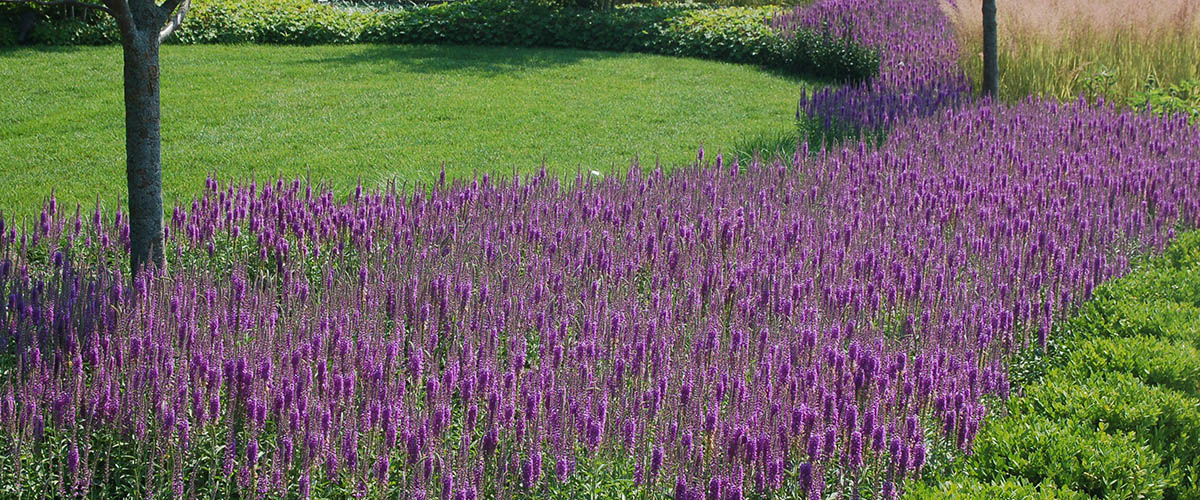
Evaluating Perennials for Chicagoland Gardens
Perennials in Focus is a plant evaluation program that examines new and underused plants for Chicagoland, the third largest metropolitan area in the country. A group of horticultural experts trials and evaluates plants at numerous locations across the region. Results help consumers, public gardens, growers, landscape designers, breeders, and other industry professionals make informed plant choices.
Designing A Low-Maintenance Perennial Lawn In Chicagoland
A lawn made entirely of turf grass can demand frequent mowing, edging, watering, and seasonal repair. Replacing some of that grass with well-chosen perennials creates a softer, more diverse landscape while reducing the amount of weekly maintenance. The most successful approach is rarely a single plant spread across the entire property. Instead, it combines durable groundcovers, compact flowering plants, ornamental grasses, and clearly defined paths.
Chicagoland gardeners must account for cold winters, humid summers, clay-heavy soils, fluctuating moisture, and periods of drought. A plant that performs beautifully in another region may struggle here, especially when planted in a large, highly visible area. Regional trial results and careful observation can help homeowners select plants that are genuinely suited to local conditions.
A perennial lawn alternative also changes how a space is used. It may serve as a low-growing visual carpet, a pollinator-friendly front yard, a casual path system, or a meadow-like planting that receives occasional foot traffic. Defining the purpose first makes it easier to choose plants, prepare the site, and establish realistic maintenance expectations.
Start With The Site
Begin by observing sunlight, drainage, soil texture, and existing turf vigor. A sunny, dry strip near a sidewalk needs different plants from a partly shaded backyard with compacted clay. Mark areas that stay wet after rain, locations where snow is piled, and routes used regularly for walking, play, or maintenance access.
Soil preparation should be practical rather than excessive. A soil test can reveal pH and nutrient issues, while a thin layer of compost may improve poor soil without creating a loose, fertile bed that encourages weeds. In compacted ground, loosen the upper soil and remove persistent perennial weeds before planting. Avoid deeply tilling established turf if it will bring dormant weed seeds to the surface.
The amount of foot traffic should guide the design. Most flowering perennials tolerate occasional walking once established, but few withstand constant use as well as turf grass. Use stepping stones, mown paths, or narrow mulch routes to protect planted areas and make the landscape easier to navigate.
Choose Plants For A Living Carpet
Low-growing perennials are the foundation of a turf replacement because they knit together and reduce exposed soil. Options may include creeping thyme for sunny, well-drained areas, sedges for adaptable textures, barren strawberry for light shade, and low-growing native plants selected for local conditions. Plant height, spread, flowering period, and winter appearance all matter when the planting will be viewed from close range.
Avoid choosing plants solely for a single week of bloom. A useful lawn alternative should offer a sequence of foliage, flowers, seedheads, or seasonal color. Compact species with dense leaves can suppress weeds, while taller plants can add habitat and visual structure along the edges. In a mixed planting, repeat several reliable species instead of filling every square foot with a different plant.
Plant spacing affects both establishment and long-term maintenance. Close spacing produces faster coverage but costs more at installation. Wider spacing lowers the initial expense but leaves open soil where weeds can take hold. A balanced design may place groundcovers more densely and use larger accent perennials at wider intervals.
Layer Texture, Color, And Seasonal Interest
A successful perennial landscape has a readable pattern from a distance. Use broad drifts of one plant or a small combination rather than scattering individual specimens throughout the yard. Repetition creates order and makes future editing easier when a plant spreads too aggressively or performs poorly.
Combine different forms to keep the planting attractive after peak bloom. Fine-textured sedges can sit beside broad-leaved perennials, while upright flower stems can rise through a low groundcover. Ornamental grasses and plants with persistent seedheads can provide winter structure, especially in areas where mowing is reduced to once or twice a year.
Color should support the architecture of the home and the surrounding landscape. Soft greens, white flowers, blues, and purples can make a small front yard feel calm, while warm yellows and pinks create a brighter, more informal effect. Repeating flower colors across separate planting areas ties the design together without requiring a uniform monoculture.
| Lawn Alternative Style | Best Conditions | Maintenance Pattern | Main Benefit |
|---|---|---|---|
| Low-growing groundcover mix | Sun to partial shade with moderate drainage | Hand weeding during establishment, occasional trimming | Dense, carpet-like appearance |
| Sedges and shade perennials | Part shade, woodland edges, or heavier soil | Seasonal cleanup and selective division | Strong foliage with reduced mowing |
| Sunny flowering matrix | Full sun with average to dry soil | Spring cleanup, occasional editing, limited watering | Pollinator value and extended bloom |
| Meadow-style perennial planting | Larger areas with room for natural spread | Annual or biennial cutting, weed control early on | Informal habitat and low long-term input |
| Path-and-patch design | Yards with regular foot traffic | Mow or maintain paths, weed planted islands | Easier access and clearer circulation |
Plan For Establishment And Care
The first year is usually the most labor-intensive period. Young plants have small root systems and may need supplemental watering during dry spells. Weed control is especially important while perennials fill the gaps between them. A two- to three-inch layer of organic mulch can conserve moisture and reduce competition, though mulch should stay away from plant crowns.
Water deeply and less frequently once plants begin to establish, adjusting for rainfall and soil type. Frequent shallow irrigation encourages weak, surface-level roots. Drip lines or soaker hoses can direct water to planted areas without wetting paths and foliage. Grouping plants with similar moisture needs prevents some species from being overwatered while others remain dry.
Maintenance becomes more selective rather than disappearing. Remove invasive spreaders before they move into paths, trim plants that flop into walkways, and divide crowded perennials when vigor declines. Some areas can be cut back in late winter to preserve habitat and winter interest, while others may receive a tidier fall cleanup near formal entrances.
Measure Performance In Your Own Yard
A trial mindset makes plant selection more reliable. Record when plants emerge, flower, reach their mature height, spread into neighboring spaces, and respond to drought or heavy rain. Notes about winter survival and weed pressure are especially useful because a plant may look excellent during its first summer but fail after a severe winter.
Photographs taken from the same position each month can reveal changes that are easy to overlook. Include a simple site description with sunlight, soil moisture, planting date, and maintenance performed. Gardeners who want a more structured process can use these performance notes to compare results across seasons and make better decisions for future plantings.
Use the information to refine the design gradually. Replace plants that need constant intervention, move vigorous species away from narrow borders, and expand those that remain attractive with little care. Local observations become more valuable when shared with growers, garden centers, landscape professionals, and other gardeners working in the same climate.
Keep The Design Practical
A low-maintenance landscape should reduce routine work without creating new problems. Consider how fallen leaves will be removed, where hoses will reach, and whether snow removal equipment may damage plants. Keep taller perennials away from doors, windows, signs, and driveway sightlines. A narrow strip of turf may still be worthwhile where it provides durable access or simplifies maintenance.
Choose plants from reputable sources and verify mature dimensions rather than relying on the size of a nursery container. Regional trial programs can help identify perennials that have been observed through multiple seasons rather than selected only for appearance in a catalog. This is particularly important for large-scale replacements, where a poor choice can require substantial removal and replanting.
A useful planting plan should also leave room for change. Perennials grow at different rates, weather varies from year to year, and personal preferences evolve. Design with a few open spaces for additions, use clear boundaries between plants and paths, and keep a record of plant names and locations.
Recommended Steps For A Successful Conversion
Begin with a manageable section rather than removing every square foot of turf at once. A front border, side yard, or sunny corner can provide a realistic test of soil preparation, plant performance, and maintenance needs.
- Map sunlight, drainage, soil conditions, foot traffic, and snow-storage areas before selecting plants.
- Build the planting around several dependable, regionally appropriate perennials with complementary heights and bloom times.
- Install paths or stepping stones wherever people regularly cross the planting.
- Control weeds and provide consistent moisture during the establishment period.
- Record seasonal performance so strong plants can be repeated and weak performers can be replaced.
Over time, a well-designed perennial lawn alternative becomes easier to manage because the plants occupy their intended spaces and the soil remains covered. The result may look less uniform than conventional turf, but it can offer flowers, texture, habitat, and seasonal change with fewer mowing demands.
Start with one clearly defined area this growing season, document how each plant performs, and use those observations to guide the next stage of the landscape. A thoughtful, regionally informed conversion can turn unused turf into a resilient planting that works with Chicagoland’s conditions rather than against them.
In the Garden
Evaluator gardens are located across the Chicagoland area, representing a range of growing conditions. Visit our retail and wholesale partners to find trialled perennials for your own garden.
Retail & Wholesale: Hinsdale Nurseries (Willowbrook, IL), Mariani Nurseries (Kenosha, WI & Garden Prairie, IL), Northwind Perennials (Burlington, WI), The Growing Place (Aurora, IL).
Wholesale Only: Hinsdale Nurseries (Plano, IL), Intrinsic Perennial Gardens (Hebron, IL).
Our Evaluation Program
The 2017–2020 evaluation cycle included Agastache 'Blue Boa', Allium senescens 'Blue Eddy', Amsonia ciliata var. filifolia 'Georgia Pancake', Astilbe 'Chocolate Shogun', Boltonia astroides 'James Crocket', Brunnera 'Alexander's Great', and Geranium cinereum 'Jolly Jewel Purple'. Completed evaluations include Amsonia 'Blue Ice' (2004–07).
On April 10, 2020, the program published snapshot profiles for Vernonia lettermanii 'Iron Butterfly', Stokesia laevis 'Elf', Stachys officinalis 'Pink Cotton Candy', Lobelia 'Monet Moment', Helleborus 'Winter Thrillers', Geum 'Mai Tai', Geranium soboliferum 'Butterfly Kisses', Gentiana x intermedia 'True Blue', Eurybia divaricata, Asparagus 'Purple Passion', and Agastache 'Bolero'.
Browse the full collection of snapshots organized alphabetically — from A–D, E–H, I–Q, and R–Z — to find detailed performance data on perennials trialled across Chicagoland.